If you've been told 'no bird feeders allowed,' the first thing to do is get the exact rule in writing today. If you're wondering whether are bird feeders allowed at apartments, the fastest path is to check your specific lease or HOA rules in writing. Whether it comes from an HOA, a landlord, a city ordinance, or a wildlife regulation, the restriction is real and usually enforceable, but the details matter enormously.
No Bird Feeders Allowed: What to Do Instead and How to Comply

Eleanor Hartwick
3 Jul 2026
Some bans are absolute; others have exceptions for specific feeder types, seasons, or placements. Until you know exactly what you're dealing with, don't put up or leave up any feeder. The good news is that you have solid, legal alternatives to keep supporting birds without breaking any rules.
What 'no bird feeders allowed' actually means and who's enforcing it
The phrase shows up in four main places: HOA governing documents (CC&Rs and rules), rental lease agreements or landlord policies, local municipal ordinances, and state or regional wildlife regulations. Each has a different enforcement mechanism and a different level of teeth.
HOA restrictions are the most common source. An HOA's CC&Rs (Covenants, Conditions, and Restrictions) legally bind every homeowner in the community. If the document says bird feeders are prohibited, that prohibition is enforceable through a formal notice-and-cure process that can escalate to fines and, in some cases, liens on your property. Typical HOA enforcement policy works like this: you receive written notice of the violation, you get a defined cure period to fix it, and if you don't, fines begin accumulating. Repeat violations usually carry higher fine tiers. The enforcement authority comes directly from the CC&Rs, so arguing 'it seems unreasonable' rarely gets you far without a formal hearing.
Landlord restrictions are simpler but just as binding. If your lease says no feeders, violating that term puts your tenancy at risk. Landlords usually aren't running formal enforcement boards, but a lease violation is still a lease violation.
Municipal ordinances are the third category. Some cities explicitly ban or restrict the feeding of wild birds, framing it as a nuisance or public health issue. California has state and local rules that can affect whether bird feeders are allowed in your area. Chandler, AZ, for example, adopted an ordinance specifically addressing non-domesticated bird feeding.
New Braunfels, TX has a wildlife-feeding prohibition with specific exceptions built in for certain setups. New Braunfels, TX includes a wildlife-feeding prohibition that has specific exceptions for certain feeder setups [New Braunfels, TX has a wildlife-feeding prohibition with specific exceptions built in for certain setups. ](https://www. newbraunfels.
gov/2303/Wildlife-Feeding-Prohibition). Strongsville, OH's nuisance code explicitly includes feeding wildlife (including birds) where it creates unsanitary conditions or health hazards. These are enforced by code enforcement officers, not your HOA board.
State or regional wildlife regulations occasionally restrict feeding specific species (migratory birds near active nesting areas, bears in certain zones), but these are less commonly the source of a 'no bird feeders' rule for typical backyard situations. If you are trying to confirm whether are bird feeders illegal in Michigan, start by checking state wildlife rules and any local or community restrictions that may apply state or regional wildlife regulations.
How to confirm the rule quickly today
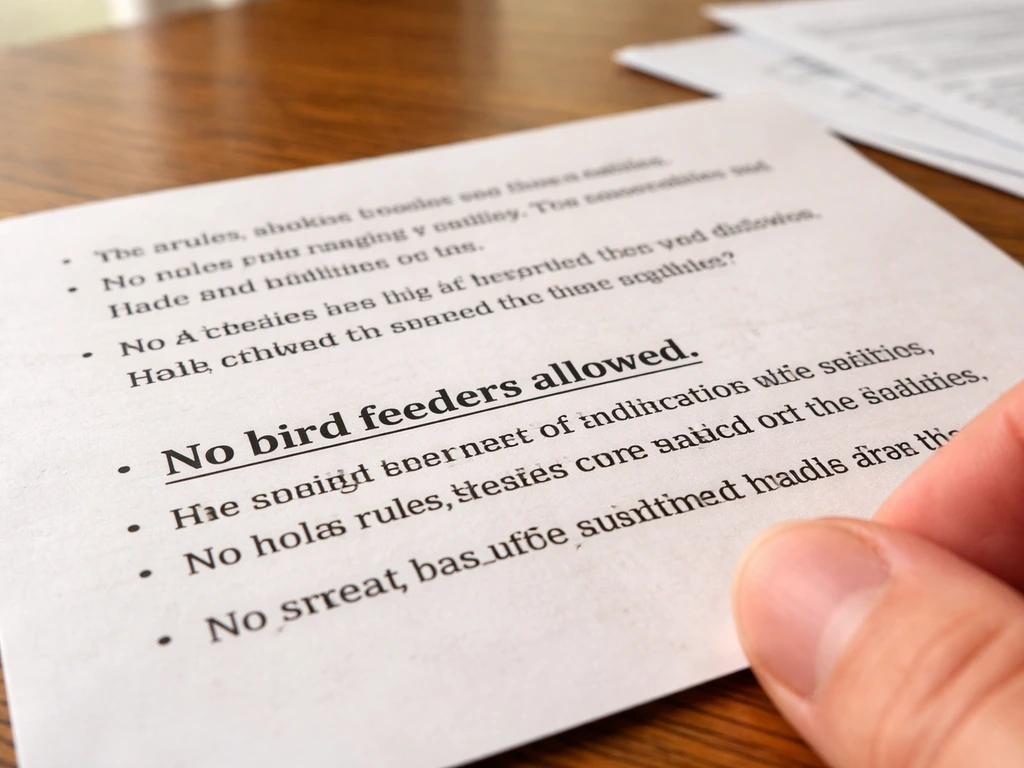
Don't assume. The exact language of the restriction determines what you can and can't do, and a vague verbal warning is worth far less than a written document. Here's how to nail it down fast:
- HOA residents: Pull your CC&Rs and current community rules. Most HOAs now post these on a resident portal. Search the documents for 'feeder,' 'bird,' 'wildlife,' and 'nuisance.' If you can't find them online, email or call the management company today and ask for the specific rule number and section that applies.
- Renters: Reread your lease top to bottom, focusing on sections about exterior modifications, pet policies, and nuisance provisions. If it's not in the lease, contact your landlord in writing and ask directly: 'Does our lease or property policy prohibit bird feeders?' Get the answer in writing (email is fine).
- City or municipality: Search '[your city name] + bird feeder ordinance' or '[your city name] + wildlife feeding ordinance.' If nothing turns up, call your city's code enforcement department and ask. You can also check your city's municipal code online at the city website or through Municode.
- Regional or state: Check your state's fish and wildlife agency website for any restrictions on feeding wild birds near your address. This matters most if you live near protected habitat or in an area with known wildlife conflict issues.
When you contact anyone about this, keep the ask factual and non-defensive: 'I want to make sure I understand the current rules about bird feeders on the property. Bird feeders are often regulated differently across HOAs, local ordinances, and state wildlife rules in Florida, so confirm the exact wording that applies to your property current rules about bird feeders. Can you point me to the specific section I should read?' That framing keeps you on solid ground and gets you documentation if you ever need it later.
Why bird feeders get restricted in the first place
Understanding the 'why' helps you work with the rule instead of around it, and it directly informs what alternatives will actually be acceptable. Restrictions almost always come down to one of these concerns:
- Rodent attraction: Spilled seed on the ground is a reliable food source for rats and mice. This is one of the most cited reasons for feeder bans in urban and suburban communities, and it's hard to argue with. Even a well-maintained feeder drops enough seed to sustain a rodent population.
- Nuisance species: Feeders attract large flocks of pigeons, starlings, and house sparrows. These species create noise, mess, and property damage. Some city ordinances, like those in Chandler and Strongsville, specifically frame this as a public health and property-maintenance concern.
- Disease transmission: Dense concentrations of birds at feeders increase the risk of spreading avian diseases like salmonellosis and, in some regions, avian influenza. HOAs and landlords are legitimately concerned about liability if a disease outbreak is traced to a feeder on their property.
- Property and common-area damage: Bird droppings corrode surfaces, stain walkways and vehicles, and damage landscaping. In a shared community, that cost isn't just yours.
- Wildlife habituation: In some areas, feeders attract raccoons, bears, or other wildlife that become problems. Even a squirrel-proof bird feeder is rarely bear-proof or raccoon-proof.
- Neighbor complaints: In many cases, the trigger for a formal ban is complaints from neighbors. One person's 'helping birds' is another person's 'pest infestation,' especially in close quarters.
What you can do instead: legal alternatives that still help birds
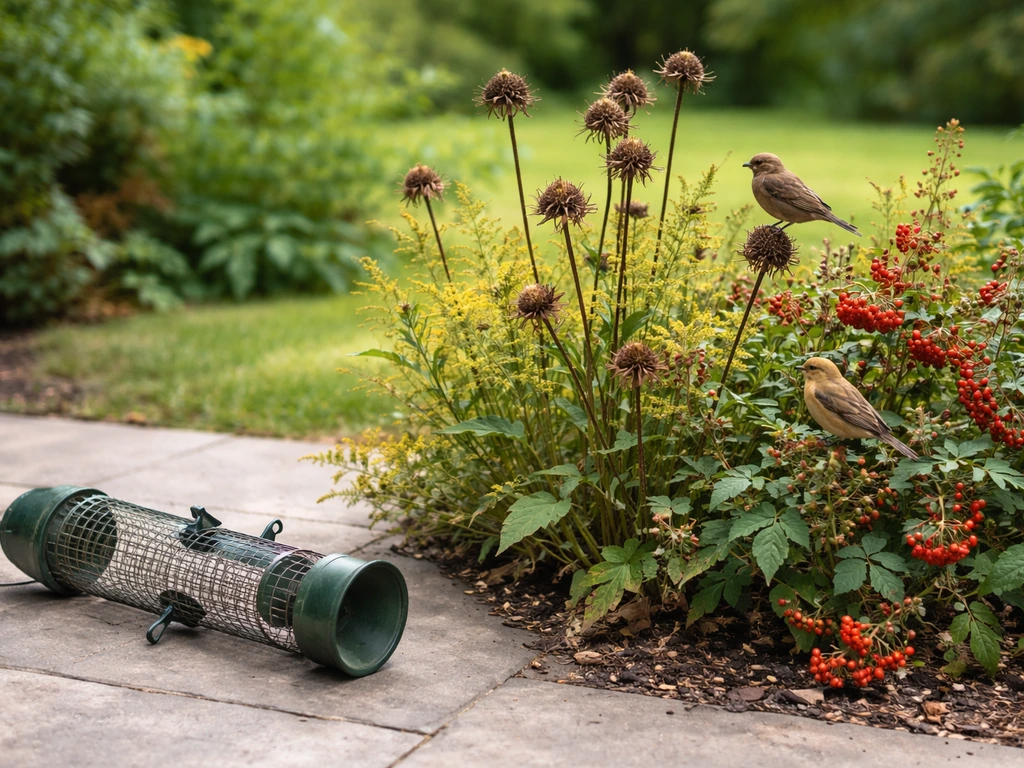
Here's what I tell people who feel like they're losing something meaningful when a feeder ban comes down: feeders are a convenience for us as much as they are for birds. Birds survived for millions of years without us filling plastic tubes with sunflower seeds. What they actually need is habitat, water, and safety. You can provide all three without a feeder, and most 'no feeder' policies don't touch any of these alternatives.
Native plants and habitat
This is the single most impactful thing you can do for local birds, and almost no policy restricts it. Native flowering plants, shrubs, and trees provide seeds, berries, nectar, and insects that birds need year-round. Coneflowers (Echinacea), black-eyed Susans, native sunflowers, and ornamental grasses all produce seed heads that birds feed on directly. Native berry-producing shrubs like serviceberry, elderberry, and native viburnums are magnets for fruit-eating species. The key difference from a feeder: the food is distributed across the whole plant, doesn't concentrate in one spot, and doesn't spill on the ground in ways that attract rodents.
Water sources
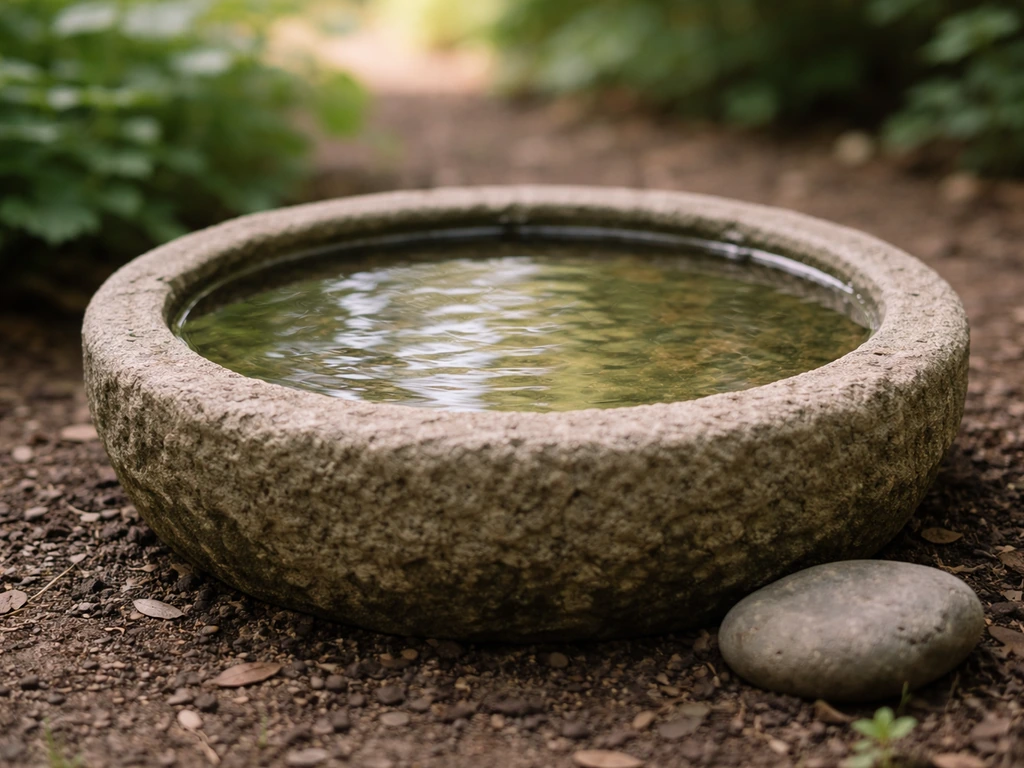
A birdbath or shallow water dish is almost always permitted under 'no feeder' rules because it isn't a food source. Clean, fresh water is genuinely scarce for urban birds, and a birdbath will attract more species than most feeders in summer. Check that any birdbath you install is permitted under your specific property rules (some HOA aesthetic rules cover outdoor decor), keep it shallow (no more than 2 inches deep), and change the water every 2 to 3 days to prevent mosquito breeding. A small solar-powered wiggler or dripper adds movement that birds find irresistible and also prevents stagnation.
Nesting and shelter
Nest boxes for cavity-nesting species (bluebirds, chickadees, wrens, tree swallows) are not feeders and aren't covered by most feeder restrictions. Installing a properly sized, clean nest box is legal in nearly every context where feeders are banned. Dense shrubs and brush piles (where allowed) also provide vital winter shelter and roost sites. If your HOA prohibits brush piles, a dense native hedge can serve the same purpose while looking intentional.
Insect-friendly gardening
Most songbirds feed their nestlings exclusively on insects, especially caterpillars. Reducing pesticide use in your yard and planting host plants for native caterpillars (native oaks support hundreds of caterpillar species alone) does more for breeding bird populations than any seed feeder. This also helps pollinators, which tends to be uncontroversial with HOAs and neighbors.
Exceptions worth asking about
Not every 'no bird feeders allowed' rule is a hard, permanent, total ban. If you're also wondering whether similar rules mean bird feeding is illegal in Singapore, check the local wildlife and municipal guidance for your situation no bird feeders allowed. Before you give up entirely on feeders, it's worth asking a few pointed questions. Some restrictions have built-in exceptions or variance processes, and some can be worked around with the right approach.
- Location and height requirements: Some ordinances (like New Braunfels, TX) prohibit feeders in certain configurations but allow them if specific conditions are met, such as minimum height off the ground, setback from property lines, or enclosed catch-tray designs that prevent seed from reaching the ground. Ask whether a different placement or feeder design would comply.
- Species-specific exceptions: A few communities allow feeders specifically designed for hummingbirds or orioles, since nectar feeders don't spill seed and don't attract rodents. If your restriction is primarily about seed feeders and pest attraction, a nectar feeder might be a gray area worth clarifying.
- Seasonal windows: Some municipalities and HOAs have 'seasonal' wildlife feeding restrictions tied to periods when wildlife conflict is highest (often tied to bear activity or migratory pest bird seasons). Ask whether winter-only or summer-only feeding is addressed differently.
- Formal variance or exception requests: HOAs typically have a process for requesting an exception or accommodation. If you have a documented reason (for example, you actively monitor and maintain the feeder and can demonstrate you're managing the associated risks), it's worth submitting a written request. Be specific about what you're proposing, how you'll manage mess and pests, and what you'll do if problems arise. Frame it as a maintenance plan, not a complaint.
- Rulemaking participation: HOA rules can be changed. If you feel the restriction is overly broad, show up to meetings, talk to neighbors, and propose evidence-based amendments. This takes longer than 24 hours but is a legitimate long-term path.
It's worth noting that rules about bird feeders vary widely by location. Whether you're in New Jersey, Michigan, California, Florida, or elsewhere, the specifics of what's permitted often depend on overlapping layers of state, municipal, and community rules. For help with the New Jersey side specifically, you will want to check the state and local rules that govern whether bird feeders are restricted. If your situation involves a specific state or city ordinance (not just an HOA or landlord), it's worth verifying the local legal layer separately.
Reducing problems even when you can't use a feeder
If you're using any of the legal alternatives above (birdbaths, nest boxes, native planting), a few sanitation and pest-management habits will keep you out of the same trouble that feeders cause and protect you from complaints:
- Keep birdbaths clean and change water every 2 to 3 days. Stagnant water breeds mosquitoes and can spread avian disease just as a dirty feeder can. A quick rinse and refill is all it takes.
- If you're in a region where bird feeding at any level is restricted due to disease concerns (like active avian influenza activity), check your state wildlife agency's current guidance. Sometimes temporary suspensions apply to all supplemental feeding, including birdbaths.
- Keep native plant areas tidy enough that they don't look neglected to neighbors or HOA boards. Intentional native plantings that are clearly maintained rarely trigger complaints; an 'overgrown mess' always does.
- Monitor your yard for rodent activity regardless. If rats or mice show up near your property, they're probably not there because of birds (absent a feeder), but you'll want to document that so you're not blamed.
- If you previously had a feeder and are removing it, clean up all spilled seed and debris from the ground thoroughly. Residual seed under a removed feeder keeps attracting rodents for days and can still generate a complaint or code violation.
Your next 24-hour checklist
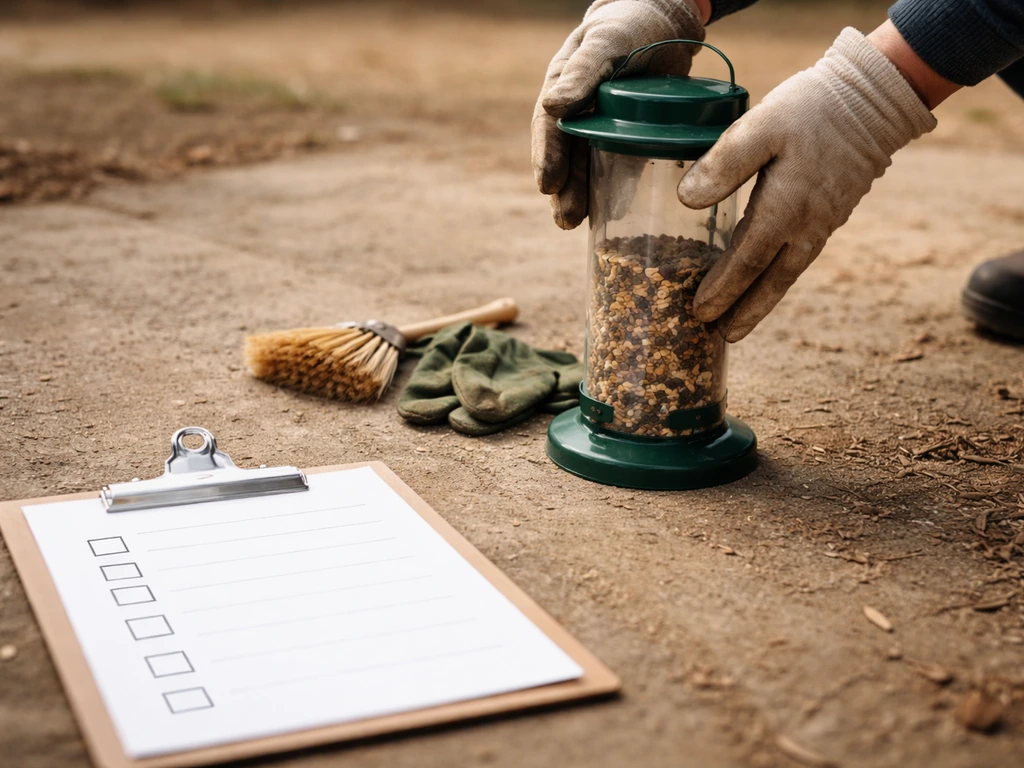
Here's what to actually do today, in order, to get yourself into a clear, compliant, and forward-moving position:
- Remove any active bird feeders immediately if you've received a verbal or written notice. Don't wait to 'confirm the rule' with a feeder still up. Taking it down stops the clock on any violation.
- Locate the governing document. Pull your CC&Rs, lease, or city ordinance and find the exact language. Screenshot or save the relevant section.
- If you can't find it in writing, contact your HOA management company, landlord, or city code enforcement today by email or phone. Ask for the specific rule citation. Keep a record of who you contacted and when.
- Read the rule carefully for exceptions. Does it cover all feeders? Only seed feeders? Is there a location or design exception? Is there a variance process?
- If there's a variance process and you want to pursue it, draft a brief written request that describes the specific feeder, its location, your maintenance plan, and how you'll manage mess and pests. Submit it through the proper channel.
- Plan your bird-friendly alternatives. Identify one or two things from the alternatives section above that fit your space: a birdbath, a nest box, or a native plant addition. These give you something positive to do and genuinely help birds.
- Clean up the feeder area. Remove spilled seed, clean the ground, and store your feeder properly. If you decide to pursue an exception, having a clean, problem-free track record helps your case.
The frustrating truth is that a feeder ban doesn't have to mean you stop supporting birds. If you want to know whether are bird feeders illegal where you live, the fastest path is to confirm the exact local and property rules in writing feeder ban. It means you shift your approach. Native plants, water, and nest boxes often do more lasting good for local bird populations than a seed feeder anyway, and none of them come with the rodent, mess, or disease risks that make feeders controversial in shared-property settings. Comply first, explore exceptions through proper channels, and invest that energy into habitat instead.
FAQ
If the rule says “no bird feeders allowed,” does that also ban suet, seed cakes, or hummingbird feeders?
Often yes, but not always. Some bans target “feeding wild birds” generally, while others define specific devices or specific food types (seed, suet, nectar). Ask for the exact definition section in your CC&Rs, lease addendum, or ordinance, and confirm whether hummingbird nectar and suet are explicitly included as “feed” or only the common hanging seed feeders are covered.
What if I already have a feeder up, and I’m waiting to get the rule in writing?
Take it down as soon as you receive the notice, even if you are still verifying details. Many enforcement systems start counting after the violation date, and leaving it up can turn a “could be clarified” situation into a documented repeat offense.
Can I put up a feeder inside my balcony or on my patio if my HOA bans feeders?
Placement usually matters, but it depends on the wording. Some rules restrict feeders anywhere on the property, others restrict feeders visible from shared areas or that create litter or rodent attraction. Check whether the rule is tied to “location” (balcony, common areas, front yards) or to “device” and “feeding.”
Are temporary feeders allowed during migration or winter, like for a few weeks?
Sometimes, but you need the exception language. Look for terms like “seasonal exceptions,” “temporary/limited feeding,” “variance,” or “special circumstances.” If the rule has none, a short duration still can count as a violation.
Does “no bird feeders” also cover putting food out on the ground (like scattered seed) or using window trays?
Not every ban is limited to hanging devices. Ground feeding, broadcast seed, and tray setups can still be treated as “feeding” or “attracting wildlife,” especially if the rule targets nuisance, sanitation, or rodent attraction. The safest approach is to assume any intentional food placement is included unless the rule explicitly excludes it.
What about bird feed intended for backyard birds, like flourworms or mealworms, not typical seed?
Many policies treat any edible offering for birds as a feeder. Mealworms and other “live” or high-protein foods can also create heavy waste and insect issues, which can trigger nuisance complaints. Confirm whether your rule defines “bird food” broadly, not just seed.
I’m worried about enforcement, do HOAs have to give me a hearing before fines start?
Usually they must follow their stated notice-and-cure and dispute process, but the timeline varies by governing documents and local law. Ask for the HOA’s written enforcement policy and whether you can request a hearing or administrative review after the notice. Also check if they require a specific cure period length before assessing late-stage fines.
If my lease says “no feeders,” can the landlord deny it even if my HOA would allow it, or vice versa?
Yes. HOAs govern homeowners, and landlords govern lease terms, so you can end up with conflicting restrictions. In practice, you must comply with both, meaning you should not rely on “the other layer” being permissive. If you want an override, request it in writing from the party that controls your status (lease for tenants, HOA for homeowners).
Are birdbaths allowed under “no bird feeders” rules, even if birds splash and drop some debris?
Most bans focus on feeding, not water, so birdbaths are often permitted. The catch is sanitation and appearance rules, especially under HOA aesthetic or nuisance standards. Keep the water shallow, refresh on a schedule, and avoid overflows that create muddy buildup, which can lead to complaints even if water is technically allowed.
If nest boxes are allowed, do they ever count as a “feeder” or get restricted for safety reasons?
They usually are not categorized as feeders, but some communities restrict “outdoor structures” or placement (height, visibility, attachment method). Confirm whether there are limits on structure size, drilling into exterior surfaces, or locations. Also note that some bird species have legal protections, so avoid “occupancy interference” during active nesting.
What alternatives are least likely to trigger complaints under a feeder ban?
Native plants that distribute food across the landscape, plus water sources and insect-focused habitat (host plants), tend to attract fewer formal objections because they do not concentrate seed in one spot and they reduce spill and rodent activity. Still, check HOA rules for plant type, height, and whether any landscaping changes need approval.
If I want to request an exception or variance, what should I ask for so it doesn’t get denied automatically?
Request the process by name (variance, exception, or modification) and ask what criteria are required (medical hardship, safety justification, documented species needs, or limited placement). Provide a compliance plan that addresses the common enforcement triggers: no mess, no spillage, frequent cleanup if any food is used, and placement away from shared walls or ground-level areas.
How can I prove compliance if neighbors keep reporting me, or if enforcement is unclear?
Keep copies of the exact written rule, your communication requests, and dates when you removed or changed anything. If you install alternatives like a birdbath or nest box, document the approval status (email approvals, submitted forms) and take before-and-after photos so you can show what was installed and where.