Whether bird feeders are allowed at your apartment depends almost entirely on your specific lease, building rules, and local ordinances, there's no universal answer. Most apartments don't explicitly ban them, but many have clauses about balcony modifications, wildlife attraction, or nuisance that can be applied to feeders. The fastest way to know where you stand is to check your lease, ask your landlord directly, and then set up your feeder in a way that makes complaints unlikely in the first place.
Are Bird Feeders Allowed at Apartments? Rules and Tips

Eleanor Hartwick
4 Jun 2026
Apartment rules on bird feeders
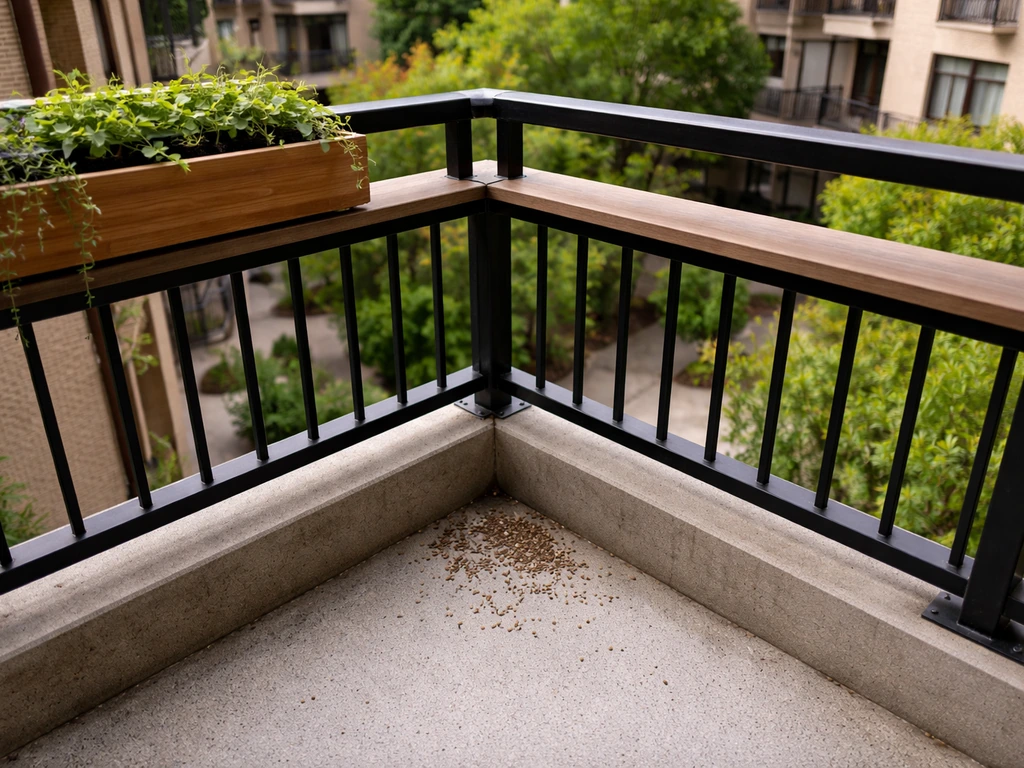
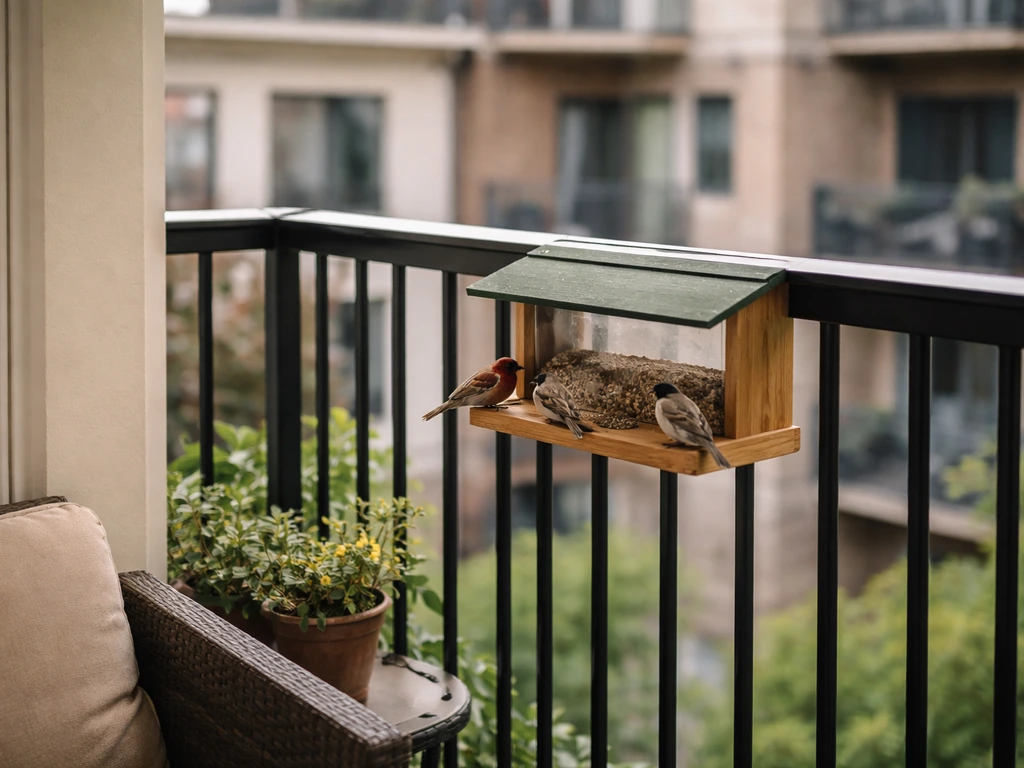
Most apartment leases don't mention bird feeders by name. What they do mention are things like balcony modifications, pest or wildlife attraction, nuisance behavior, and property damage, all of which a poorly managed feeder can trigger. That's the tension. A feeder sitting on a balcony railing with hulled sunflower seeds and a weekly cleaning routine is a very different thing from a platform feeder stuffed with cheap mixed seed that showers the parking lot with millet and draws pigeons, squirrels, and rats.
If your building has an HOA, the rules are often more explicit. HOA documents sometimes prohibit feeders outright, restrict balcony items by type or size, or require that any feeder be pre-approved. In city-managed or subsidized housing, local ordinances can also apply. For example, Detroit's city code requires that bird feeders be elevated at least 48 inches above ground and designed so only birds can access the food, a rule aimed squarely at keeping rats and other wildlife out of the feed. Alexandria, Virginia has similar language requiring feed to be placed on raised platforms inaccessible to rodents. Your city may have comparable rules worth looking up before you buy a feeder.
The other layer to watch for is state wildlife regulations. In Michigan, the DNR has a baiting and feeding framework that covers how and where wildlife feed can be dispersed, and bird feeding can sometimes fall under that umbrella depending on location and circumstances. If you need the specific answer for Michigan, check state and local rules because they can treat feeding birds as regulated wildlife baiting in some situations. Virginia's Department of Wildlife Resources goes further, noting that even unintentional wildlife feeding can violate regulations if it creates public health risks, and DWR can advise people to stop feeding birds entirely when disease is a factor. These aren't common enforcement scenarios for typical apartment balcony feeders, but they're worth knowing about, especially if neighbors escalate a complaint.
How to check your lease, HOA, and landlord requirements
Don't assume. Pull out your lease and search it for a few key terms: balcony, patio, wildlife, nuisance, modifications, and alterations. Read what you find in context. A clause that says 'tenants may not make structural modifications to balconies' doesn't necessarily prohibit a hanging feeder, but a clause about 'attracting pests or wildlife' probably does cover feeders if they're poorly maintained.
- Read your lease for balcony use, nuisance, and wildlife attraction clauses — those are the sections most likely to apply to feeders.
- If you have an HOA or condo association, request the full community rules document (CC&Rs) and check the balcony and common-area sections specifically.
- Email your landlord or property manager with a direct, low-key question: 'I'd like to hang a small bird feeder on my balcony — is that permitted?' Keep it in writing so you have a record.
- Check your city's municipal code for any bird-feeding ordinances (search '[your city] bird feeding ordinance' or check your city's online code library).
- If your state has wildlife regulations that touch on bird feeding — Michigan and New Jersey both do — check whether they apply to residential feeding in your area.
Getting explicit written permission from your landlord is the best move even if your lease seems silent on the issue. It protects you if a neighbor complains later. If your landlord says no, you have a clear answer, and some alternatives to consider, which we'll cover at the end.
Placement and neighbor-safety tips for shared buildings
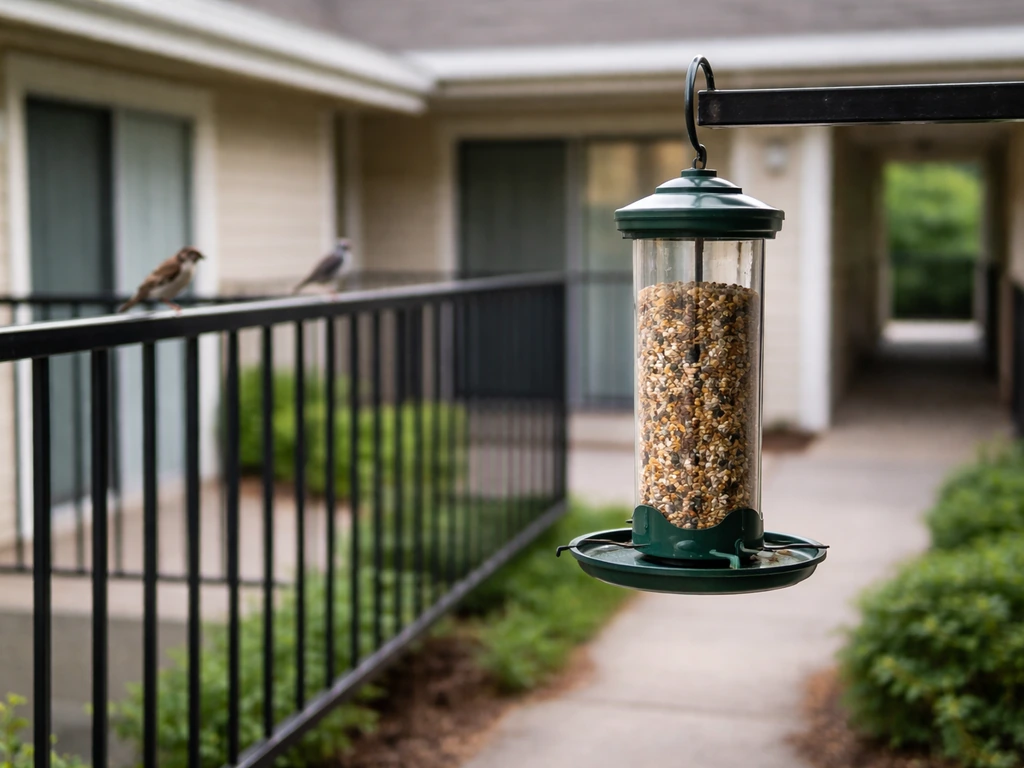
Feeder placement in an apartment setting is mostly about not creating problems for the people around you. The Cornell Lab of Ornithology recommends placing feeders either very close to windows (within about 3 feet) to reduce bird strike injuries, or further away. In an apartment, a feeder mounted close to your own window using a suction-cup mount or a window feeder is often the most practical setup, it keeps the feeder visible to you, contained to your unit, and away from shared walkways or neighboring balconies.
- Avoid hanging feeders over walkways, courtyards, or shared outdoor spaces where seed shells and droppings fall on areas other people use.
- Position feeders so that seed scatter lands on your own balcony, not onto a lower neighbor's patio or a shared lawn below.
- Use a tray or catch basin under the feeder to collect falling seed — this is one of the single most effective moves for keeping neighbors happy.
- If you're on an upper floor, check whether wind will blow seed or husks onto lower balconies before you commit to a spot.
- Avoid placement near a neighbor's window, especially if they haven't opted into having birds nearby — the noise, mess, and bird activity are not universally welcome.
Window feeders that attach via suction cups are often the most apartment-friendly option. They're self-contained, easy to remove and clean, and they don't require any permanent mounting. The tradeoff is smaller capacity, so you'll be refilling more often, but in an apartment that's usually fine since you're not trying to feed a large backyard flock.
Maintenance to avoid attracting unwanted wildlife
This is where most apartment feeder setups go wrong. A neglected feeder with wet, moldy seed and a pile of hulls underneath it is an open invitation for rats, squirrels, raccoons, and pigeons, and that's exactly the kind of problem that gets feeders banned building-wide and gets tenants in trouble. The U.S. Fish & Wildlife Service recommends cleaning feeders at least once every two weeks, and sweeping up or discarding old seed and debris from beneath the feeder regularly. In an apartment setting, I'd push that to weekly cleaning if you're using a high-traffic feeder.
- Clean the feeder every one to two weeks with a diluted bleach solution (one part bleach to nine parts water), rinse thoroughly, and let it dry completely before refilling.
- Sweep or vacuum up seed hulls and debris from your balcony floor at least weekly — this is the main thing that draws pests.
- Use no-waste or low-mess seed mixes: hulled sunflower seeds, nyjer (thistle), or shelled peanuts leave far less debris than mixed seed with millet and milo.
- Avoid suet in hot weather — it can go rancid quickly and creates a mess that's difficult to clean off surfaces.
- Don't overfill the feeder. Match the fill level to how quickly birds are emptying it so seed doesn't sit and go stale.
- If you're in bear country (as New Jersey's DEP Fish & Wildlife specifically advises), take feeders in at night or stop feeding during bear-active seasons.
Best practices for feeder types, food, and seasonality
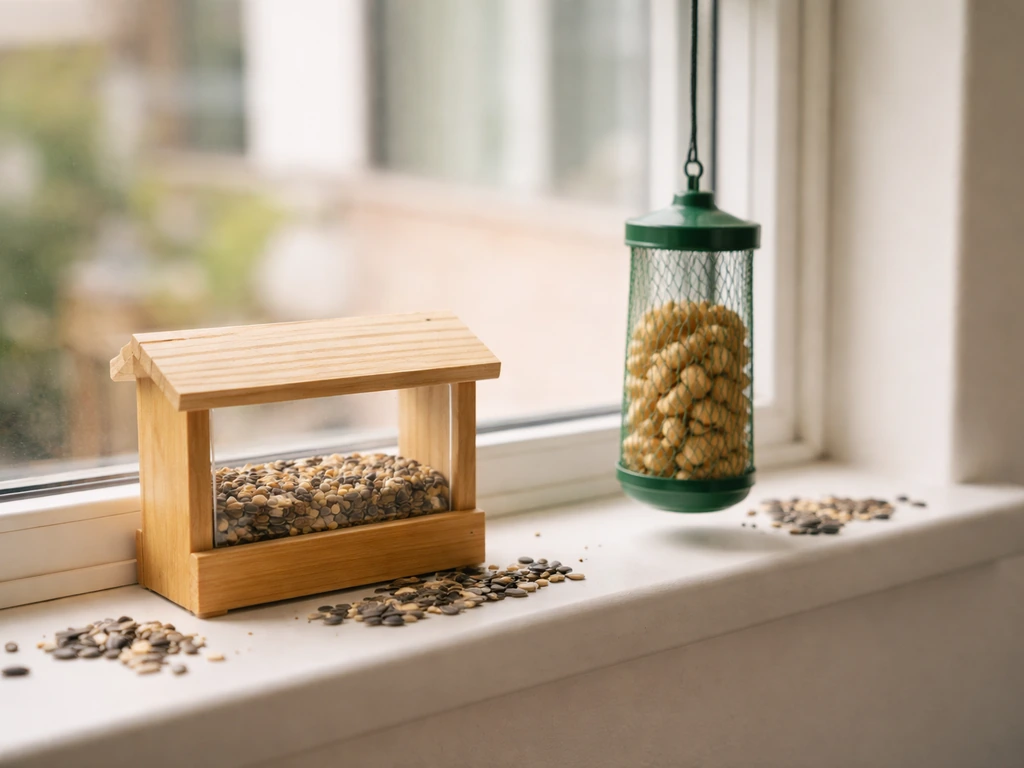
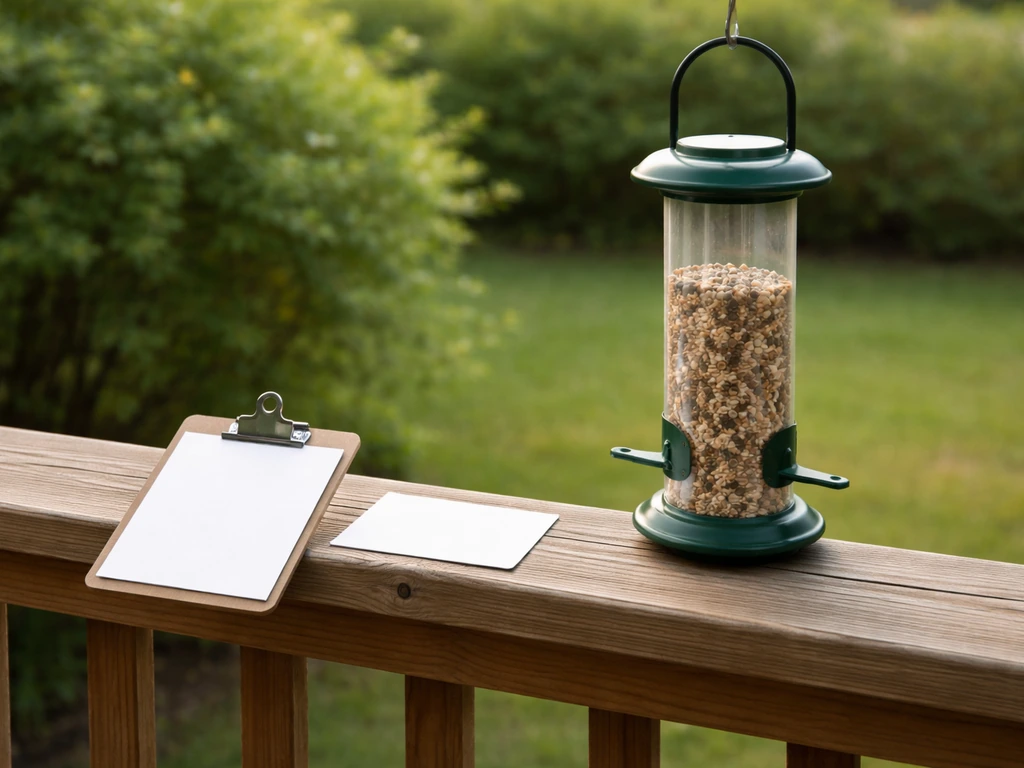
For an apartment, smaller and simpler is almost always better. You don't need a multi-port tube feeder attracting twenty birds at once, a single window feeder or a small hanging tube feeder is easier to manage, easier to clean, and far less likely to create the kind of mess that triggers complaints.
| Feeder Type | Best For Apartments? | Mess Level | Wildlife Risk |
|---|---|---|---|
| Window suction-cup feeder | Yes — ideal | Low | Low |
| Small tube feeder (hung from balcony) | Yes, with catch tray | Medium | Low to medium |
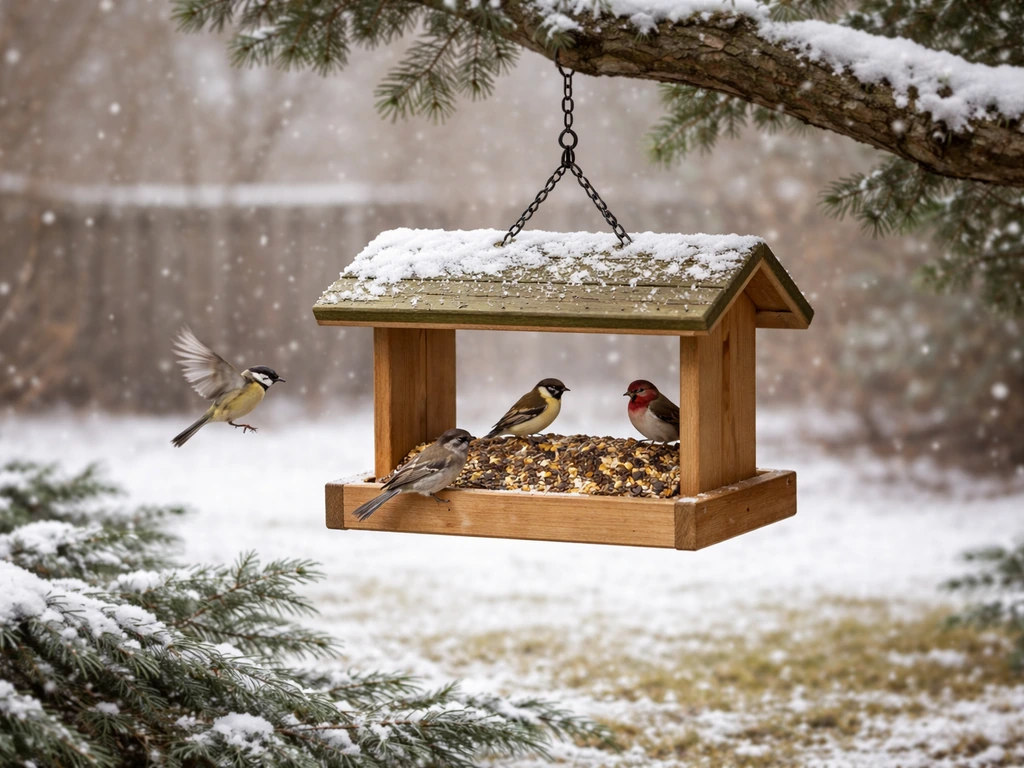
| Platform/tray feeder | Risky — open design attracts pigeons and sparrows | High | Medium to high |
| Suet cage | Seasonal use only; avoid in summer | Low | Low to medium |
| Large hopper feeder | Not ideal for balconies | High | High |
For food, hulled (shelled) sunflower seed is the single best choice for apartment feeders. It attracts a wide variety of birds, leaves almost no hull debris, and doesn't contain filler seeds that birds toss aside. Nyjer seed in a fine-mesh or tube feeder is excellent for finches and produces very little mess. Avoid cheap mixed seed bags, the millet, milo, and red wheat in those mixes are largely ignored by most songbirds and end up on the ground, where they attract the birds and mammals you don't want.
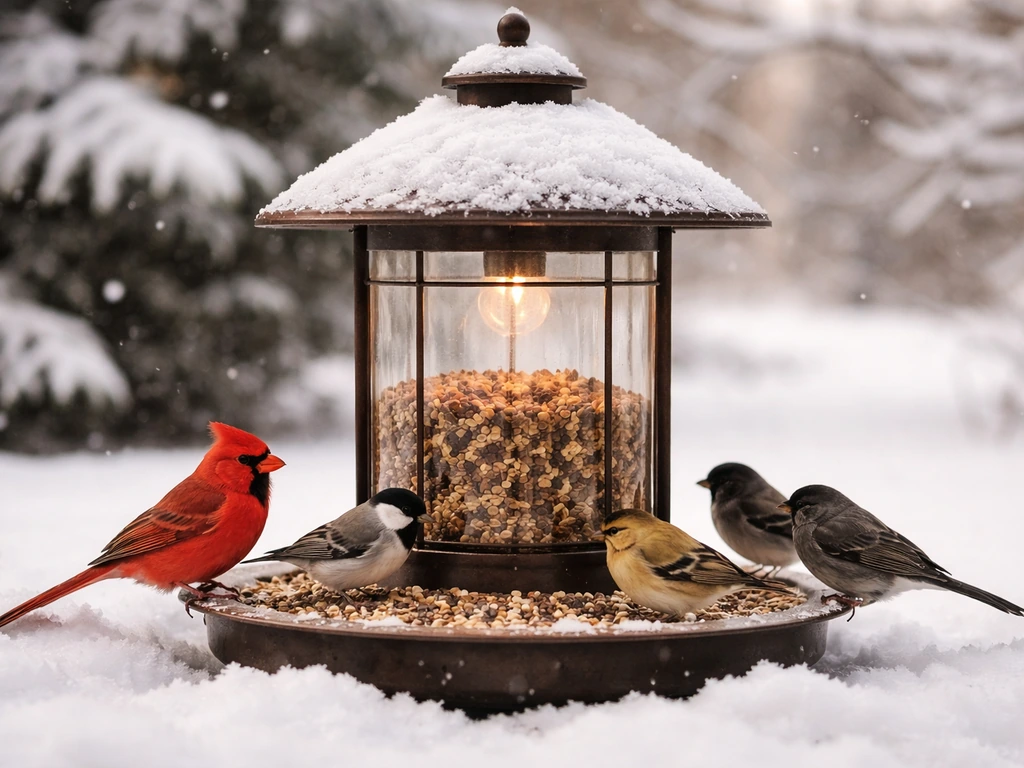
Seasonality matters more than many people realize. Spring and summer feeding in apartments is genuinely higher-risk: more insects and natural food are available, so you attract more birds with less selective feeding, and warm weather accelerates seed spoilage and mold. Fall and winter are when supplemental feeding provides the most benefit to birds and creates the least nuisance, natural food is scarce, seed dries out more slowly in cool weather, and pests like rats and raccoons are less active. If your building is on the fence about feeders, starting in fall and framing it as a seasonal activity is a reasonable middle ground.
Liability and compliance: what to do if you're denied or get complaints
If your landlord says no, respect it. If your lease or building rules say no bird feeders allowed, treat that as a clear prohibition rather than something you can negotiate. Running a feeder in defiance of a clear lease prohibition creates real risk: you can be cited for lease violations, charged for cleaning or pest remediation costs, or in rare cases face eviction action. It's not worth it for a bird feeder. That said, 'no' on one feeder type doesn't mean no on all bird-friendly options, window feeders mounted entirely inside a window, or feeders placed on indoor windowsills with the window cracked, are sometimes a workable compromise that falls outside a balcony-use restriction.
If you receive a complaint from a neighbor (rather than a formal notice from management), talk to them directly and without defensiveness. Most complaints are about mess, noise, or pest attraction, all things you can fix with better maintenance and seed choice. Offer to add a catch tray, switch to hulled seed, or clean more frequently. A neighbor who sees you take the complaint seriously is far less likely to escalate it to management.
If management issues a formal warning or notice, respond in writing promptly. Acknowledge the concern, describe the specific steps you're taking to address it (cleaning schedule, seed type, catch tray), and ask what standard you need to meet to keep the feeder. If the decision is final and feeders are prohibited, remove it immediately and document that you complied. Keeping that paper trail protects your security deposit and your tenancy.
It's also worth knowing that some restrictions on bird feeders come from broader regulatory frameworks that apply regardless of what your landlord says. If you're wondering about legality beyond your lease and HOA, it helps to look up whether bird feeding is illegal in Singapore and what local rules apply some restrictions on bird feeders. Virginia's wildlife regulations, for instance, give the state authority to require someone to stop feeding birds if it's creating a public health or safety issue, that's separate from your lease. If you're ever in a situation where feeding is tied to a disease outbreak or wildlife conflict, take any agency guidance seriously and comply promptly. The 'no bird feeders allowed' principle at a regulatory level is covered in more detail elsewhere on this site, as are state-specific rules in places like New Jersey, Michigan, California, and Florida. In California, local wildlife rules and city ordinances can determine whether bird feeders are allowed and under what conditions. If you’re specifically wondering whether bird feeders are illegal in New Jersey, you’ll want to check the relevant state and local wildlife rules in your area bird feeders allowed principle at a regulatory level.
The bottom line: bird feeders are allowed at many apartments, conditionally allowed at others, and prohibited at some. The difference between a feeder that works in your building and one that gets you in trouble is almost never the feeder itself, it's whether you got clear permission and whether you're maintaining it in a way that doesn't create problems for the people around you. Do those two things and you'll probably be fine.
FAQ
If my lease does not mention bird feeders, can I assume they’re allowed?
Not automatically. Many leases cover related issues indirectly, like balcony/patio restrictions, “nuisance” behavior, pest attraction, or limitations on tenant alterations. Even if feeders are not named, check those clauses in context, then ask for written permission to avoid a later enforcement dispute.
Are window bird feeders (suction-cup or inside-the-window) treated differently than balcony feeders?
They often are. Because they are contained within your unit, do not require balcony placement, and usually create less seed litter on common areas, they are less likely to violate balcony-use or exterior appearance rules. Still, confirm with your landlord if the building has an “any feeder on the premises” policy.
What feeder placement is most likely to trigger complaints in an apartment building?
Placement over or near shared walkways, under stairwells, or directly above doors and railings is higher risk because seed and debris fall into common areas. If birds perch heavily on a neighboring balcony or window and produce droppings, that can also be treated as a nuisance even when the feeder is “clean.”
How can I prevent rats or squirrels if I want to feed birds safely?
Use hulled sunflower seed (minimizes hull waste), use feeders with a tray or catch area, and do not let seed accumulate underneath. Keep cleaning tighter than “every two weeks,” especially in warm months, and remove uneaten seed promptly. If you’re seeing frequent visits from mammals, switch seed type and stop immediately if the building reports ongoing pest activity.
Do bird feeders count as “balcony modifications” if I mount them on a railing?
Sometimes, yes. A mount that requires hardware, drilling, or permanent attachment can be treated as a modification, even if the feeder seems small. Non-permanent suction mounts or entirely window-contained setups are usually safer, but confirm what your building considers a modification.
If an HOA bans feeders, is there any compromise like “bird-friendly plants” or selective feeding?
HOA rules vary, but some allow limited or pre-approved setups. If feeders are prohibited outright, alternatives like landscaping that provides natural food and shelter may avoid the feeder restriction. Ask the HOA or property manager whether any specific feeder type, size, or location is approved.
What should I say when a neighbor complains about my feeder?
Focus on fixable specifics, not intent. Offer a concrete plan such as switching to hulled seed, adding a catch tray, changing cleaning frequency, and moving the feeder to a more contained location if needed. Keep the tone cooperative, because neighbor complaints are often “mess and pests” driven.
If I get a formal warning, how do I respond to protect my tenancy?
Reply in writing quickly. State what you changed (seed type, cleaning schedule, catch tray, placement), and ask what requirement you must meet to continue. If management ultimately bans it, remove the feeder immediately and document the removal so you can show compliance if costs or deposit issues arise.
Can I keep feeding if the building starts asking everyone to stop due to a wildlife issue or disease concern?
Be careful. Even if feeders were allowed initially, wildlife disease scares or public health concerns can lead management or wildlife agencies to require a stop or targeted restrictions. If you receive guidance to discontinue feeding, pause promptly and follow the agency or management instructions.
Does “no bird feeders allowed” on one balcony or unit mean it’s allowed for others in the same building?
Usually no. A clear building-wide or policy-level prohibition typically applies across units. If only your unit was targeted, ask whether the rule is general or if there was a specific issue (like mess or pests), but don’t treat a single exception as permission.
How do I choose a feeder type for an apartment to minimize mess?
Smaller, contained options tend to work best, such as single-port tube or window feeders designed for minimal spillage. Avoid cheap mixed seed that creates lots of dropped filler, and prefer seed choices that birds consume with less hull debris. Also prioritize designs that collect drips and debris so you’re not sweeping shared areas.