
Peanut butter bird feeders are safe when you use plain, unsalted peanut butter, mix it with a binder like cornmeal to reduce the choking risk, and keep the feeder clean. The real dangers are not the peanut butter itself but the conditions around it: moldy or rancid fat, contaminated feeder surfaces that spread disease, and rich summer offerings that can cause digestive problems for nestlings. Get those things right and peanut butter is one of the most effective, high-energy foods you can offer backyard birds.
Are Peanut Butter Bird Feeders Safe? Evidence-Based Guide

Eleanor Hartwick
26 Jul 2026
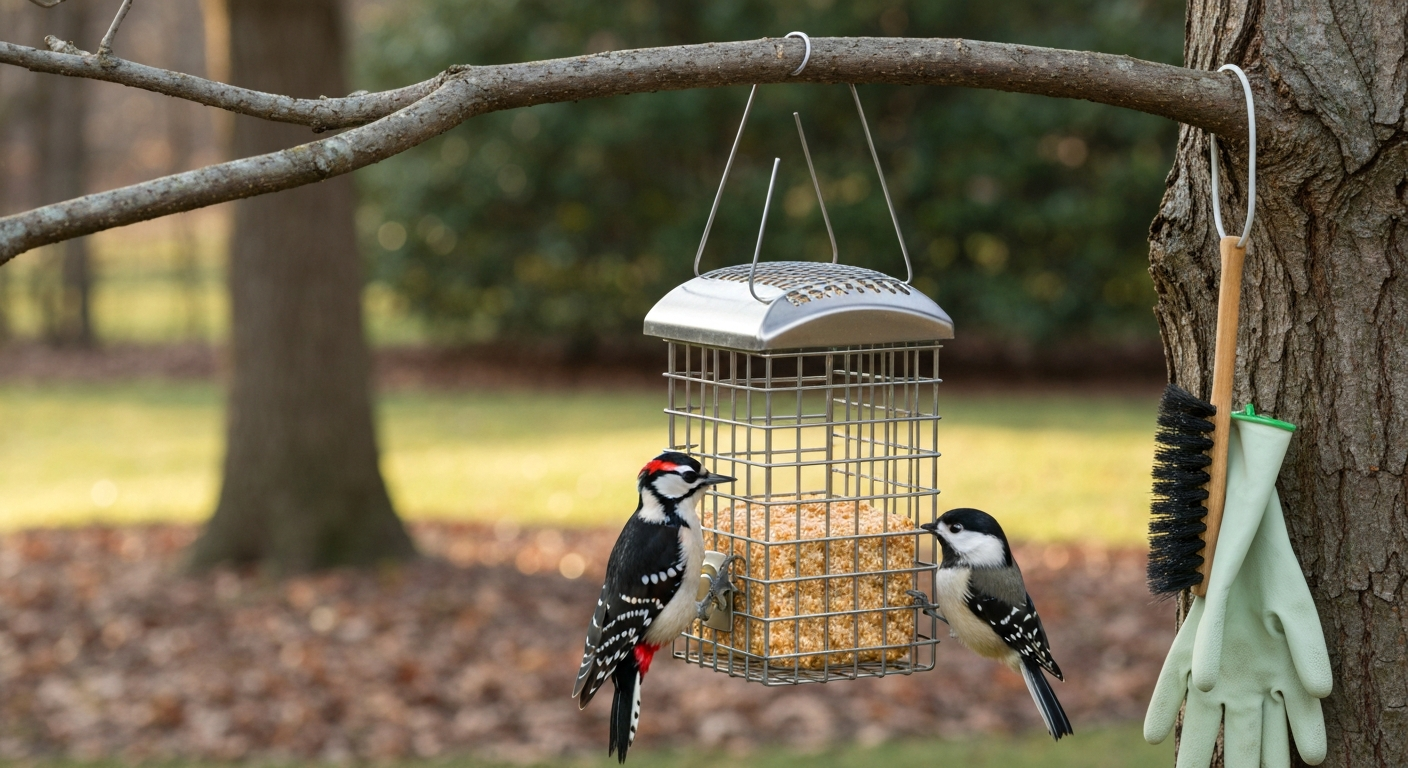
Pros and cons at a glance
| Pros | Cons |
|---|---|
| High-calorie, high-fat energy source — excellent for cold-weather feeding | Plain peanut butter can clump and theoretically stick in the throat in very hot weather when it softens |
| Attracts a wide range of species: woodpeckers, nuthatches, chickadees, titmice, wrens, jays and more | Rich fat content can cause digestive issues for young nestlings if fed directly |
| Easy and cheap — almost every kitchen has a jar already | Goes rancid quickly in warm weather, especially on exposed platform feeders |
| Can be mixed with cornmeal, seed or suet to create versatile homemade cakes | Feeder surfaces act as fomites for Salmonella, Mycoplasma gallisepticum, and Trichomonas gallinae if not cleaned regularly |
| Works in multiple feeder types: suet cages, mesh feeders, drilled logs, pinecones | Peanut products attract squirrels, rodents, raccoons, and bears more aggressively than seed alone |
| No-melt commercial peanut-butter suet cakes available for year-round use | Xylitol and added salt in some flavored peanut butters are toxic to birds — label-checking is essential |
Who should use peanut-butter feeders (and who should think twice)
Backyard birders
If you have a modest yard and a handful of feeders, peanut butter is a great addition from October through April. You'll pull in species that sunflower seeds alone won't attract, particularly woodpeckers and creepers. Keep it to a suet cage or drilled log rather than a wide open platform, and commit to cleaning that feeder every week during warm months and at least twice a month in winter. If you're already careful about hygiene with your seed feeders, extending that discipline to a peanut-butter feeder is straightforward.
Homeowners in suburban or urban settings
The main concern here is pest attraction. Peanut butter's fat and protein smell travels. Squirrels will find it within hours, and in areas with dense populations of raccoons or rats, the mess from a leaking or poorly positioned feeder can become a real problem quickly. Use a feeder with a squirrel baffle, position it at least 10 feet from any fence or structure, and take the feeder in overnight if rodents are a known issue in your neighborhood. If you live in bear country, peanut-butter feeders should only go out during the coldest months when bears are denning.
Park stewards and community garden managers
High-traffic feeding sites are where disease risk concentrates most. Research into Mycoplasma gallisepticum and Trichomonas gallinae consistently shows that time spent at shared feeders is a primary predictor of infection and transmission. If you're managing a public or communal feeding station, flat platform feeders with peanut butter are the worst option because multiple birds can access contaminated surfaces simultaneously. Stick to suet cages or mesh tube feeders that limit direct food-contact area, establish a written cleaning schedule, and follow RSPB- and BTO-style seasonal guidance: consider pausing or significantly reducing offerings between late spring and early autumn when disease risk is highest and natural food is abundant.
Who should avoid peanut-butter feeders entirely
- Anyone who cannot commit to weekly cleaning in warm weather
- Households in bear-active areas from spring through autumn
- Anyone who has recently seen birds with eye swelling, oral lesions, or lethargy at their feeders — stop all feeding, clean thoroughly, and wait until no sick birds have been observed for at least two weeks
- Apartment dwellers using window feeders in peak summer heat, where peanut butter softens and spoils within hours
Which birds eat peanut butter and how to present it
| Species | Peanut Butter Appeal | Best Presentation Method |
|---|---|---|
| Downy & Hairy Woodpecker | Very high — primary target species | Drilled log, suet cage, or smeared bark crevice |
| Black-capped & Carolina Chickadee | High | Suet cage, mesh tube feeder, or pinecone feeder |
| Tufted Titmouse | High | Suet cage or drilled log |
| White & Red-breasted Nuthatch | High — will cling and feed upside-down | Suet cage or smeared bark |
| Blue Jay | Moderate-high | Platform feeder with cornmeal mix (never plain soft peanut butter in heat) |
| Carolina Wren | Moderate | Low-hanging mesh sachet or suet cage close to cover |
| Dark-eyed Junco | Low-moderate | Crumbled peanut-butter/cornmeal cake on ground tray |
| American Robin | Low — occasional | Only encountered incidentally; not worth targeting |
| House Sparrow | Moderate | Will use any accessible feeder; consider this if disease management is a concern at busy sites |
| Starling | High — can dominate feeders | Use a caged suet feeder with smaller mesh openings to exclude larger birds |
How birds actually eat peanut butter (and why that matters)
Most birds take peanut butter by wiping their bill across the surface repeatedly, pulling off small amounts rather than swallowing a lump. Woodpeckers in particular are well adapted to this: they use their long, brush-tipped tongues to extract sticky food from crevices and do not experience the kind of blockage that early feeder guides warned about. The 'choking hazard' concern circulated for years but lacks solid documented evidence in birds. That said, it is a reasonable precaution to mix peanut butter with cornmeal or another dry binder, not because of proven choking cases but because it improves the texture for birds, reduces how quickly the mixture softens in heat, and makes it easier to pack into feeder types like pinecones and drilled logs.
The risk that is real and documented is disease transmission through shared feeder surfaces. Birds feeding at the same suet cage or platform feeder can transfer Trichomonas gallinae through infected oral secretions left on food or feeder surfaces. Trichomonosis causes lesions in the mouth and throat that prevent swallowing, and seasonal mortality events in pigeons, doves, and some passerines have been linked directly to contaminated communal feeding sites. Mycoplasma gallisepticum, the pathogen behind house finch conjunctivitis, spreads similarly: infected birds shed the bacteria onto feeder perches and food, and healthy birds pick it up during subsequent visits. Experimental and field studies show feeder use facilitated Mycoplasma gallisepticum spread via contaminated feeder surfaces (fomites) (Attenuated Phenotype of a Recent House Finch‑Associated Mycoplasma gallisepticum Isolate in Domestic Poultry (PMCID)) Attenuated Phenotype of a Recent House Finch‑Associated Mycoplasma gallisepticum Isolate in Domestic Poultry (PMCID).. This is why presentation matters: feeders that concentrate multiple birds onto a single sticky surface are a higher-risk design than feeders that give each bird a limited, separated contact point.
Safe recipes: peanut butter mixes you can make at home
Before anything else, check your peanut butter label. Avoid any product containing xylitol (an artificial sweetener toxic to wildlife), added salt, honey, or flavoring. Plain, natural, unsalted peanut butter is the only version worth using. Once you have that, here are three proven mixes.
Recipe 1: Basic peanut butter and cornmeal mix (pinecones, logs, bark)
- Combine 1 part plain unsalted peanut butter with 5 parts plain yellow cornmeal (the Audubon-referenced ratio). Some sources use a 1:1 ratio for a stiffer, drier cake — the higher-cornmeal version stays firmer in warm weather and is better for summer use.
- Mix thoroughly until the cornmeal is evenly distributed and the mixture holds its shape when pressed.
- Pack into pinecone scales, drilled log holes, or suet cage molds. The mixture should not be runny or excessively sticky.
- Refrigerate unused mixture and discard after 5 days, or freeze in portions for up to 6 weeks.
Recipe 2: Peanut butter and seed mix (platform or tray serving)
- Combine 1 cup plain unsalted peanut butter with 2 cups mixed bird seed (sunflower chips, millet, safflower).
- Add 1 cup plain cornmeal and stir until the mixture is crumbly but cohesive.
- Press into a shallow tray or mold and chill before serving.
- Only offer in small amounts on platform feeders, remove any uneaten portion after 24 hours in warm weather, and after 48 hours in cold weather.
Recipe 3: Peanut butter suet blend (suet cage or mold)
- Melt 1 cup plain rendered suet or lard (not drippings or fat from seasoned cooking) in a saucepan over low heat.
- Remove from heat and stir in 1/2 cup plain unsalted peanut butter until fully combined.
- Mix in 1 cup each of: plain cornmeal, plain oats, and sunflower chips.
- Pour into a suet mold or loaf pan and refrigerate until solid.
- Store unused cakes in the freezer and offer only one cake at a time, replacing when it shows any sign of discoloration, off-smell, or mold.
A note on commercial no-melt peanut butter suet cakes: these are a legitimate shortcut and some are genuinely formulated to hold their shape in warmer temperatures. They remove the preparation step and typically use rendered fat processed to reduce rancidity. If you go that route, still change the cake on the manufacturer's recommended schedule and inspect it regularly.
How to build and offer peanut-butter feeders: five methods
Method 1: Pinecone feeder
- Collect a large, open pinecone (at least 4 inches long) and tie a loop of natural twine around the top scales.
- Using a butter knife or gloved fingers, press the peanut butter and cornmeal mix into the spaces between the scales.
- Roll the coated pinecone in bird seed or plain oats to add variety and reduce stickiness.
- Hang from a branch at least 5 feet off the ground and away from surfaces a cat could jump from.
- Replace every 3 to 5 days, or sooner if the mixture looks wet, discolored, or smells off.
Method 2: Mesh or sachet feeder
- Pack a commercial mesh peanut feeder (the type sold for whole peanuts) with a firm peanut butter and cornmeal cake cut to size.
- Alternatively, wrap a small portion of suet-peanut mix in a mesh onion bag and hang with natural twine.
- Hang vertically so birds must cling and pick rather than perch and linger — this reduces feeder-surface contact time.
- Inspect daily in warm weather; the mix can go soft and drop through the mesh if temperatures are above 75°F.
Method 3: Suet cage feeder
- Press the peanut butter suet blend (Recipe 3) into a standard suet cage mold or use a commercial peanut-butter suet cake.
- Lock the cage closed and hang it from a dedicated suet feeder hanger or tree branch with a gap-free squirrel baffle above it.
- Face the cage opening downward or to the side rather than upward to discourage starlings, which prefer flat upward-facing feeding surfaces.
- Check every two days and remove the cake if it develops a white film (mold), unusual smell, or discoloration.
Method 4: Platform or tray feeder
- Use only a crumbled or firm peanut-seed cake on a platform, never soft plain peanut butter — it smears surfaces, softens quickly, and is harder to clean thoroughly.
- Keep the portion small: offer only what birds will consume within a few hours.
- Place the platform under a roof or baffle to keep rain off, since moisture speeds mold growth dramatically.
- Clean the platform surface with a stiff brush and diluted bleach solution after every refill, not just weekly.
Method 5: Jar or window-mount feeder
- Some commercial window feeders include a small jar or cup designed to hold peanut butter. Fill with a firm cornmeal-based mix, not raw peanut butter.
- Window feeders positioned close to glass (within 3 feet) or at very large distances (over 30 feet) carry lower window-strike risk; the dangerous zone is the mid-range where birds build up speed.
- In summer heat, check the jar daily — thin mixes can liquefy against a sun-facing window within hours.
- Clean the jar insert with hot soapy water and a bottle brush every 2 to 3 days at minimum.
Feeder types compared for peanut-butter use
| Feeder Type | Peanut Butter Suitability | Disease Risk | Pest Risk | How to Make It Safer |
|---|---|---|---|---|
| Suet cage | Excellent — holds firm cakes well | Low-moderate — limited contact area | Moderate — squirrels will attempt it | Add a squirrel baffle; orient cage downward to deter starlings; clean weekly |
| Mesh tube / peanut feeder | Good — works with firm mixes | Low — birds contact limited surface area | Moderate | Use stainless steel or powder-coated metal mesh; clean and dry thoroughly between refills |
| Platform / tray | Poor for raw peanut butter; acceptable for crumbled cake | High — multiple birds share same surface simultaneously | High — open surface attracts rodents, raccoons, squirrels | Roof the tray; offer small portions; clean after every use; avoid entirely in warm months |
| Drilled log / bark smear | Excellent — natural presentation, easy to inspect | Low — each crevice is a discrete feeding spot | Moderate | Replace log insert monthly; clean bark surface with brush and diluted bleach solution |
| Window-mount jar | Acceptable with firm cornmeal mix only | Low if cleaned frequently | Low | Use a firm mix not raw PB; clean insert every 2–3 days; check for window-strike risk and position accordingly |
| Pinecone hanger | Good for short-term offerings | Low | Low — limited amount available | Replace every 3–5 days; use twine not metal wire; hang away from fences and rooflines |
Feeder materials and finish safety
Peanut butter's fat content interacts with feeder materials in ways that plain seed does not. Fat residue soaks into unsealed wood and porous surfaces and becomes a persistent substrate for bacterial growth. Metal feeders, both steel and aluminum, are easier to disinfect thoroughly, which is why many experienced birders prefer them for fat-based offerings. For a deeper look at whether metal bird feeders are safe for birds, see our article “are metal bird feeders safe for birds.”. Powder-coated metal is particularly practical: it resists corrosion, tolerates repeated bleach-solution cleaning, and does not absorb grease the way untreated wood does. Whether metal feeders pose a burn risk to birds' feet is worth considering in very hot climates: dark metal surfaces in direct sun can reach temperatures that are uncomfortable or harmful for small birds to stand on for extended periods, so lighter colors and shaded positioning help. For more detail on whether metal feeders can heat enough to burn birds' feet, see do metal bird feeders burn birds feet.
Plastic feeders present a different trade-off. If you're wondering whether plastic bird feeders are safe, see our guide on are plastic bird feeders safe. They're lightweight and inexpensive, but older or UV-degraded plastic can develop microscopic surface cracks that harbor bacteria and are impossible to clean adequately. If you're using a plastic feeder for peanut-butter mixes, inspect it at the start of every season and replace it if you see crazing, deep scratches, or permanent discoloration. BPA-free, food-grade polycarbonate holds up better than cheaper plastics. Painted feeders are safe if the paint is fully cured and non-toxic (latex or water-based paints, no lead), but paint on the interior food-contact surfaces is never a good idea regardless of formulation, leave those surfaces bare, untreated, or use a food-safe sealant only. If you're unsure whether feeders should be painted, see should bird feeders be painted for guidance on safe paint types, proper curing, and which surfaces (if any) to finish. For detailed guidance on choosing non-toxic paints and proper curing, see is it safe to paint a bird feeder.
Cleaning, disinfecting, and disease prevention
How often to clean
| Conditions | Recommended Cleaning Frequency |
|---|---|
| Cold, dry weather, low bird traffic | At minimum, once a month |
| Moderate traffic, spring or autumn temperatures | Every 2 weeks |
| Warm or wet weather (above 60°F), heavy traffic | Weekly |
| Very hot weather (above 75°F), summer months | Every 2–3 days for fat-based feeders |
| Any sick birds observed at the feeder | Immediately: stop feeding, remove feeder, clean and disinfect, wait at least 2 weeks before restarting |
Step-by-step disinfection procedure
- Put on rubber or nitrile gloves before handling a feeder that has been in active use — direct contact with contaminated surfaces is a real transmission route for pathogens like Salmonella.
- Remove all remaining food and dispose of it in a sealed bag in the trash, not compost. Contaminated seed or fat spread on the ground can infect birds foraging below the feeder.
- Scrub the feeder with hot soapy water and a dedicated stiff brush (not one you use in the kitchen) to remove all fat residue, seed hulls, and droppings.
- Prepare a fresh 10% bleach solution: 1 part household bleach to 9 parts water. Mix fresh solution each time — bleach degrades quickly once diluted.
- Submerge or thoroughly wet all feeder surfaces with the bleach solution and allow at least 10 minutes of contact time before rinsing.
- Rinse thoroughly with clean water — at least two full rinses — until no bleach smell remains.
- Dry the feeder completely before refilling. Residual moisture combined with peanut butter or fat accelerates mold growth within hours. Air-dry in a shaded outdoor spot or use a clean cloth, then leave in open air for at least 30 minutes.
- Clean the area around and beneath the feeder at the same time: rake up dropped food and droppings, and periodically treat the ground below with the diluted bleach solution if birds congregate there heavily.
Spotting contaminated food and signs of sick birds
Rancid or contaminated peanut-butter mix shows specific warning signs before visible mold appears: a sharp, soapy, or ammonia-like smell (indicating fat oxidation), a grayish or darkened color, an oily slick on the surface, or a wet, greasy texture when it should be firm. Discard it immediately and clean the feeder. Project FeederWatch, Sick Birds and Bird Diseases recommends cleaning feeders at least monthly and increasing to weekly or more during warm/wet weather, heavy bird traffic, or when sick birds are present Project FeederWatch — Sick Birds and Bird Diseases (cleaning frequency and practices).. Visible mold, white, black, or green fuzzy growth, is an absolute discard trigger; do not attempt to scrape off the moldy parts and continue using the rest.
Watch the birds visiting your feeder as closely as you watch the food itself. Trichomonosis presents as repeated head-shaking, open-bill breathing, and an inability to swallow, birds will often sit hunched at or near the feeder looking distressed. Mycoplasmosis (house finch eye disease) is visible as swollen, weeping, or crusty eyes; affected birds often sit still at the feeder longer than healthy birds because their vision is impaired. Salmonellosis can look like general lethargy, puffed feathers, and sudden die-offs at the feeding site. If you see any of these signs in more than one bird, stop feeding immediately: take the feeder in, clean and disinfect it fully, safely dispose of all remaining food, and contact your local wildlife health authority or a wildlife rehabilitator if multiple birds are affected.
Placement, seasonal timing, and pest management
Where to hang a peanut-butter feeder
Height and clearance matter: hang the feeder at least 5 feet from the ground and at least 10 feet from any fence, roof edge, or tree branch that a squirrel or raccoon could use as a launch point. For window-mount versions, the same collision-risk logic applies as with any window feeder: very close (under 3 feet) or very far (over 30 feet) reduces fatal window strikes. For more on collision risks and how to reduce them, see are window bird feeders safe. The dangerous mid-range is where birds have enough distance to accelerate. If your feeder placement is somewhere between those extremes, apply frosted window film or a pattern of vertical tape strips on the glass to break up the reflection. Keep peanut-butter feeders in shade as much as possible, direct sun melts the mix faster and accelerates rancidity.
When to use peanut-butter feeders seasonally
Winter is the prime time for fat-based feeders. Birds burn through calories fast in cold weather and natural food sources are scarce. October through March is the window where peanut butter provides the greatest benefit and carries the lowest disease and spoilage risk. Spring and autumn are medium-risk transition periods: natural food is available but migration adds density of birds at feeders. Summer is when I'd recommend pausing or significantly reducing peanut-butter offerings in most climates. The RSPB's recent guidance (recommending a pause from May 1 through October 31) reflects this concern: warm, wet conditions spike disease transmission risk, and birds in breeding season have access to the protein-rich insects their nestlings actually need. Peanut butter fed to nestlings directly is a real risk: the fat-heavy mix is not appropriate nutrition for young chicks, and adult birds that find easy peanut butter at feeders may substitute it for the insects they should be feeding their young.
Managing squirrels, rodents, ants, and bears
- Squirrels: use a pole-mounted feeder with a smooth pole baffle (dome style, positioned about 4 feet off the ground) and hang the feeder at least 10 feet away from any jumping-off point. Avoid shepherd-hook hangers without baffles — squirrels climb them easily.
- Rodents: bring feeders in overnight if rat or mouse activity has been seen. Fallen fat-based food beneath feeders is the main attractor — clean it up daily.
- Ants: hang feeders on a line or pole and use a water moat (a cup or ring filled with water positioned above the feeder) to interrupt the ant trail. Petroleum jelly on the pole also works but needs refreshing regularly.
- Bees and wasps: peanut butter itself is less attractive to bees than sweet foods, but the seed and cornmeal mix can draw attention. If wasps become a problem, temporarily relocate the feeder rather than using pesticides anywhere near the feeding area.
- Bears: if you are in an area with black bear activity, take all feeders in from April through November. Bear attractants at feeders are a welfare risk for the bear, not just an inconvenience — habituated bears are frequently euthanized. No bird-feeding practice is worth that outcome.
Troubleshooting common peanut-butter feeder problems
| Problem | Likely Cause | Fix |
|---|---|---|
| Mix softens and drips in warm weather | Too much peanut butter, too little binder, direct sun exposure | Increase cornmeal ratio; use a suet cage in shade; switch to commercial no-melt suet cake |
| Feeder clogged or sticky after refill | Fat residue from previous fill not fully cleaned before reloading | Soak feeder in hot water before scrubbing; dry completely before refilling; do not layer new mix over old residue |
| Mold appears within a day or two | Moisture getting into the mix, feeder not dried after cleaning, or high humidity | Roof the feeder; dry completely after cleaning; offer smaller portions so food is consumed quickly |
| Birds visit briefly but don't feed | Mix is too hard (too much cornmeal) or feeder position is wrong | Adjust ratio; reposition to a quieter, sheltered spot closer to shrub cover |
| Starlings taking everything | Open-access suet cage facing upward | Switch to a cage with a tail-prop perch that only allows upside-down feeders (woodpecker-style); starlings struggle to feed in that orientation |
| Squirrels emptying feeder daily | Feeder within jumping distance of structure; no baffle | Reposition feeder; add a dome baffle; consider switching to a caged suet feeder with narrow mesh starlings and squirrels cannot access |
The bigger picture: is it safe to have any bird feeder?
Peanut butter feeders don't exist in isolation from the broader question of whether supplementary feeding is a net benefit to birds. For a quick overview of the core safety considerations, see our guide on whether it is safe to have a bird feeder is it safe to have a bird feeder. The honest answer is that it depends heavily on how you do it. Poorly managed feeders, any kind, can spread disease, create dependency in local populations, attract predators, and contribute to window strikes. The research on Mycoplasma gallisepticum, Trichomonas gallinae, and Salmonella in wild birds is real and should be taken seriously. But well-managed feeding, done seasonally and maintained hygienically, provides genuine welfare benefits especially during winter cold snaps, migration, and drought conditions when natural food is limited.
Peanut butter, used correctly, is one of the better options in that system: it's dense in energy, works in feeder designs that reduce shared-surface disease transmission, and attracts species that genuinely benefit from supplemental fat in cold weather. The key word is correctly. Check your product labels, commit to your cleaning schedule, watch your birds, and adjust what you're doing based on what you actually see happening. That active, observant approach is what separates feeder use that helps birds from feeder use that harms them.
FAQ
Are peanut butter bird feeders safe?
Short answer: Yes, when used and maintained properly peanut butter feeders can be safe and beneficial for many backyard birds; but they can increase disease transmission risk if feeders or food become contaminated or if hygiene and placement practices are poor (evidence: feeder‑associated disease literature and wildlife health guidance).
What are the main risks of offering peanut butter to birds?
Main risks: (1) Disease transmission (Mycoplasma, Trichomonas, Salmonella) via contaminated food or feeders; (2) mold or rancidity in wet/warm conditions causing illness; (3) increased predator or pest attraction (squirrels, rodents, bears, ants); (4) window‑strike and collision risk if feeders are poorly placed. These risks are highlighted in multiple wildlife health sources and feeder‑disease reviews (USGS NWHC; PubMed studies on Mycoplasma and Trichomonas).
Which bird species eat peanut butter and how should it be presented for each?
Common visitors: chickadees, titmice, nuthatches, woodpeckers, house finches, sparrows, mourning doves (occasionally), jays and starlings. Presentation guidance: (a) Small perching insectivores (chickadees, titmice, nuthatches) — smear on bark, pinecones, mesh feeders or suet cages; (b) Woodpeckers — suet cages or drilled‑log suet; (c) Finches/sparrows — small pinches in mesh or mixed with seed/grain in appropriate feeders (but note higher finch disease risk and practice caution); (d) Doves/pigeons — avoid placing large globs on flat trays (higher contamination risk). Species disease vulnerabilities (e.g., house finch Mycoplasma) mean observe species‑specific local guidance (research on Mycoplasma and finches).
What are safe ways to make and offer peanut‑butter feeders? (step‑by‑step)
Stepwise safe method: (1) Choose a feeder type (suet cage, mesh peanut feeder, drilled log, pinecone method) rather than an open flat tray; (2) Use fresh, plain peanut butter (no xylitol or added salts/sugars/unknown oils); (3) Mix if desired: common recipes include 1 part peanut butter to 5 parts cornmeal or 1:1 peanut butter:cornmeal depending on desired firmness (Audubon/extension sources cite similar ratios); or mix peanut butter with rendered suet for year‑round cakes; (4) Pack into suet cages, stuff drilled log holes or smear into pinecones/bark crevices; (5) Replace every 2–5 days in warm weather or when visibly dirty; (6) Discard any moldy, greasy, or rancid material and wash feeders (see hygiene).
What feeder types are recommended and which should be avoided?
Recommended: suet cages, mesh peanut feeders, drilled/log feeders, pinecone stuffing, enclosed suet cakes in cages. Avoid: flat open trays and shallow platform feeders for peanut butter (they hold moisture and are easy to contaminate). Recommendation based on disease transmission guidance that discourages flat surface feeding (BTO/RSPB reviews).
How should I clean and disinfect peanut butter feeders?
Follow these steps: (1) Remove all old food and debris; (2) Soak/brush with hot soapy water; (3) Disinfect with a fresh 10% household bleach solution (1:9 bleach:water) with ~10 minutes contact time (per wildlife health and biosafety guidance); (4) Rinse thoroughly and allow to dry completely before refilling; (5) Wear gloves when handling heavily soiled feeders and prepare fresh bleach daily. Cleaning frequency: baseline monthly, increase to weekly or more during warm/wet weather, heavy use, or if sick birds are observed (Project FeederWatch/Ornithological Council guidance).