
Yes, metal bird feeders can burn birds' feet, but it takes the right combination of conditions to happen: direct summer sun, dark or bare metal surfaces, small feeder contact areas, and a bird that lingers long enough. Under those conditions, a metal perch or tray can reach surface temperatures above 60°C (140°F), well past the threshold where tissue damage starts. That said, this is not an everyday hazard for most backyard setups. With a few targeted changes to placement, perch material, or surface color, you can reduce the risk to near zero.
Do Metal Bird Feeders Burn Birds' Feet? Risks and Fixes

Eleanor Hartwick
15 Jul 2026
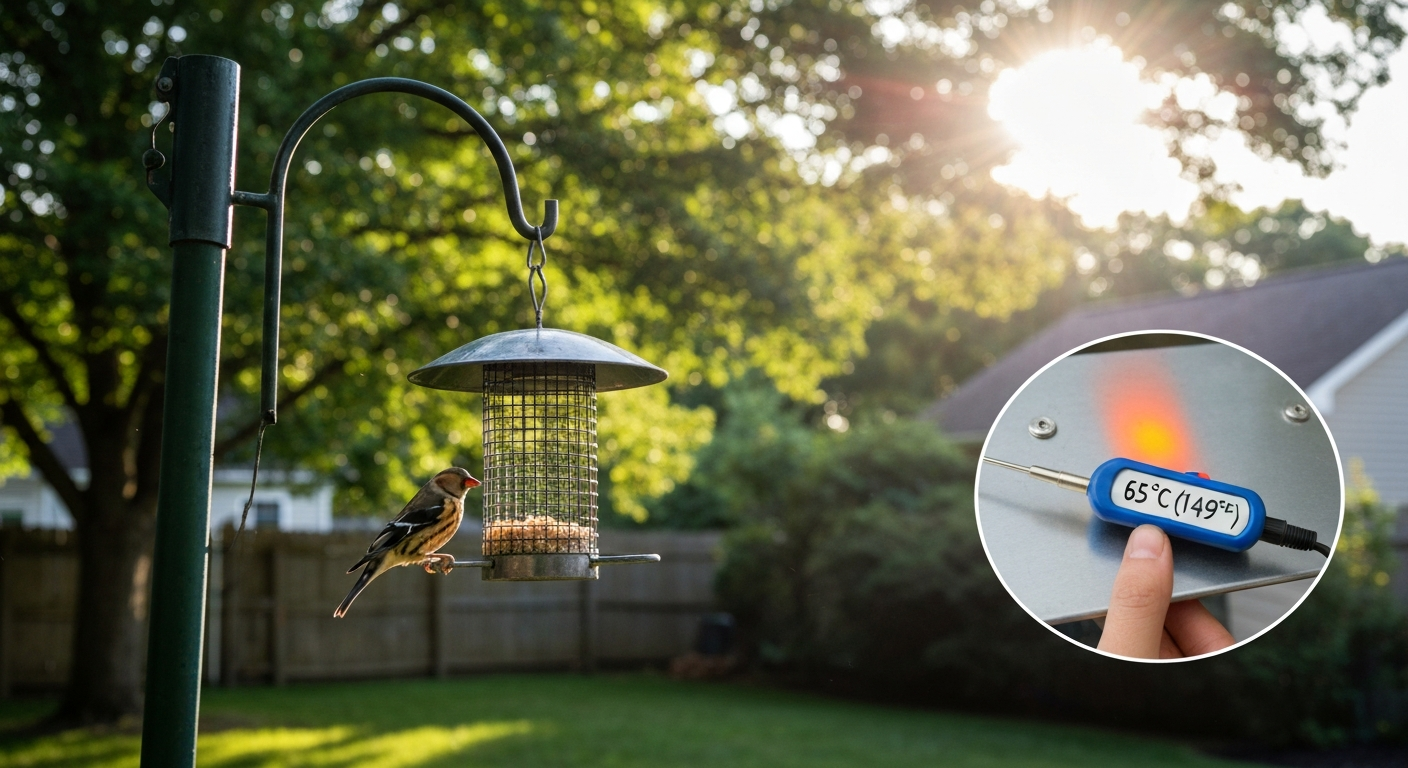
How metal feeders heat up (and why it matters for birds)
Metal heats faster and transfers that heat to whatever touches it far more efficiently than wood or plastic. Aluminum, one of the most common feeder materials, has a thermal conductivity around 200–230 W/m·K. Stainless steel runs much lower, roughly 15–20 W/m·K, but still conducts heat orders of magnitude faster than wood or most plastics. What that means practically: when a metal perch is hot, it dumps that heat into a bird's foot almost instantly on contact.
How hot can a feeder actually get? A 1939 National Bureau of Standards study found that some sun-exposed metal surfaces can run more than 22°C (40°F) above ambient air temperature. More recent field measurements of dark roofing materials, which behave similarly to dark metal feeders in direct sun, have recorded surface temperatures of 60–65°C on hot afternoons. On a 35°C (95°F) summer day with full sun on a dark metal feeder, you are almost certainly looking at surface temperatures above the burn threshold. Shiny or polished metal surfaces look like they would stay cooler, but low infrared emissivity actually limits their ability to radiate heat away, so they can surprise you.
The cool-down side matters too, especially in winter. Metal loses heat rapidly when temperatures drop, and a metal perch in freezing conditions can wick heat out of a bird's foot fast enough to cause frostbite. The same conductivity that makes metal dangerous in summer makes it a problem in winter, just in the opposite direction.
Who is actually at risk: birds, feeder designs, and conditions
Not every bird at every feeder is equally exposed. The risk profile depends on three overlapping factors: which bird is visiting, what the feeder looks like, and what the environment is doing.
Species most at risk
Hummingbirds are probably the species I worry about most. They feed at exposed metal ports and perch rods repeatedly throughout the day, and their tiny contact area means concentrated heat transfer to very small feet. Research using thermal imaging has shown that hummingbirds actively seek cooler microsites during heat stress, which suggests they do notice and respond to thermal discomfort. Small passerines such as finches, sparrows, and chickadees also spend extended time on feeders and have relatively small, featherless feet. Larger birds with more body mass and greater foot surface area are less vulnerable to brief contacts, but even they can sustain injury on very hot surfaces if they stay put for long.
Feeder designs that increase exposure
- Solid metal trays and platforms: large, unshaded surface area that absorbs sun across the whole feeding zone
- Ring-style and single-rod perches: small contact area concentrates heat transfer into a narrow band of the foot
- Exposed metal feeding ports on hummingbird feeders: birds rest their feet directly on bare metal while feeding
- Dark or matte black powder-coated finishes: absorb the most solar radiation and reach the highest surface temperatures
- Bare galvanized or polished aluminum finishes: low emissivity limits radiative cooling even when they look 'bright'
- Feeders on south- or west-facing mounts with no overhead shade: maximum afternoon sun exposure
Environmental conditions that push temperatures over the edge
- Air temperatures above 30°C (86°F) combined with direct, unobstructed sunlight
- Low wind: wind carries heat away from surfaces; still air allows temperatures to climb
- High solar angles in midsummer, especially between 10 a.m. and 3 p.m.
- Hard frost or temperatures below -10°C (14°F) for the cold-injury equivalent
- Wet feet followed by freezing contact: moisture accelerates both heat transfer and cold injury
Temperature thresholds: when does contact become harmful?
The clearest reference point we have comes from classic burn research by Moritz and Henriques (1947), whose time-temperature data for tissue injury is still used as a benchmark in burn-prevention literature. Bird foot tissue is not identical to human skin, but the cellular injury thresholds are broadly comparable, and if anything, small birds with less thermal mass are likely more vulnerable, not less.
| Surface temperature | Approximate contact time to cause injury | Practical implication for feeders |
|---|---|---|
| 44°C (111°F) | ~6 hours | Unlikely unless a bird is trapped or injured |
| 50°C (122°F) | ~15 minutes | Possible for a bird that perches repeatedly on a warm tray |
| 60°C (140°F) | ~5 seconds | Realistic on a dark metal feeder in direct summer sun |
| 65°C (149°F) | ~2 seconds | Documented surface temperature for dark materials in full sun |
| Below -10°C (14°F) | Minutes to hours depending on wetness and wind | Frostbite risk on uninsulated metal in winter |
The numbers at the lower end of that table might seem reassuring, birds do not typically sit on one perch for 15 minutes without moving. But repeated short contacts add up, and a bird that is focused on feeding, or one that is sick or injured and not moving normally, is at genuinely elevated risk. The 60°C and 65°C rows are where I pay real attention, because those temperatures are achievable on a dark metal feeder on a hot July afternoon, and five seconds is well within normal perching time.
What thermal injury actually looks like in birds
Most of the time, a bird that touches a hot perch will simply fly off before serious injury occurs. But watch for behavioral and physical signs that suggest something has gone wrong, because the early signs are subtle and easy to miss.
Acute signs to watch for
- Reluctance to land or perch, approaching the feeder but pulling back repeatedly
- Hopping or weight-shifting between feet more than usual
- Holding one foot up while perching on the other
- Favoring one foot while feeding, or tucking a foot against the body
- Visible swelling, redness, or discoloration on the lower leg or toes
- Blistering or peeling of the foot pad skin
Chronic or late-stage signs
- Darkened, blackened, or shriveled toes — a sign of necrosis following either heat or cold injury
- Missing toes or partial digit loss (a common outcome of severe frostbite in birds)
- Scarring or thickened tissue around the foot pad
- Unsteady perching, falling, or inability to grip
- Increased vulnerability to re-injury due to compromised circulation in previously affected tissue
If you see a bird at your feeder showing these signs, contact a licensed wildlife rehabilitator rather than attempting treatment yourself. For heat burns, the immediate veterinary approach is prompt cooling of the affected area; for frostbite, gradual rewarming is indicated. Neither should be rushed or improvised.
Placement and design choices that cut the risk
This is where most of the practical work happens. You do not necessarily need to replace your feeder, placement and orientation changes alone can bring surface temperatures down significantly.
Shade and orientation
Moving a feeder out of direct afternoon sun is the single highest-impact change you can make. In the northern hemisphere, south- and west-facing positions receive the most intense and longest afternoon sun during summer. Positioning feeders on the east side of a structure, under a tree canopy, or beneath a porch overhang keeps surface temperatures dramatically lower. You do not need full shade all day, just covering the peak exposure window between roughly 10 a.m. and 3 p.m. makes a meaningful difference. A surface that stays under 40°C rather than climbing to 65°C is the goal.
Mounting height and airflow
Feeders mounted where there is natural airflow, such as on a pole in an open yard rather than tucked against a heat-radiating wall, benefit from convective cooling. A few degrees of air movement makes a measurable difference in surface temperature. Avoid mounting feeders against brick or masonry walls that absorb and re-radiate heat, this can elevate the ambient temperature around the feeder beyond what you see on a standard thermometer.
Seasonal adjustments
A placement that works perfectly in spring can become a hazard by July. I move several of my feeders in late May or early June every year specifically to account for the higher sun angle and longer exposure windows. In winter, the concern flips: bare metal perches in freezing conditions can cause frostbite, particularly when a bird's feet are wet from snow or ice. Adding insulating perch covers or moving feeders to a less exposed location in extreme cold addresses both ends of the seasonal risk spectrum.
Step-by-step retrofit options for your existing feeder
If your feeder is already in place and you want to reduce thermal risk without replacing it, these retrofits are practical, low-cost, and do not require special tools.
- Replace metal perches with wooden or plastic dowels: Most tube feeders and platform feeders allow you to swap out or add perch rods. Wooden dowels (birch or untreated hardwood, around 8–10mm diameter) conduct heat roughly 100 times less efficiently than aluminum and are a straightforward upgrade. Plastic perch inserts from feeder manufacturers work the same way.
- Wrap existing metal perches with insulating sleeves: Self-adhesive cork tape, natural fiber rope (untreated sisal or jute), or heat-resistant rubber tubing slipped over metal rods creates an insulating barrier. Avoid synthetic materials that may off-gas when heated. Check and replace wrap seasonally as it degrades.
- Add a shade roof or baffle above the feeder: A simple wooden or opaque plastic roof panel mounted a few inches above the feeder body blocks direct solar radiation from hitting perches and trays. Even a cheap plastic dome squirrel baffle repurposed as a shade canopy reduces surface temperature considerably.
- Apply a light-colored, bird-safe paint or powder coating to metal surfaces: Switching from dark to white or light-colored surfaces measurably lowers peak temperature — research on comparable materials shows differences of up to 15°C between dark and light-coated surfaces. Use only paints confirmed non-toxic when dry (no lead, no zinc, no VOCs that linger).
- Install rubber or cork foot pads on platform trays: Adhesive cork sheet cut to fit a metal tray platform creates an insulating contact surface. Replace annually as cork absorbs moisture and can harbor mold.
- Use clip-on shade fabric: UV-resistant shade cloth clipped or tied above an exposed feeder provides a quick, adjustable solution without permanent modification. Garden centers sell small cut sections that work well for this.
Feeder materials compared: metal, plastic, wood, and window styles
If you are choosing a new feeder, or weighing whether to replace an existing one, the material makes a real difference to thermal risk. If you use peanut butter in feeders, see whether peanut butter bird feeders are safe for birds are peanut butter bird feeders safe. If you use window-mounted feeders, see the section on are window bird feeders safe for collision and thermal risks. This is where it is worth thinking holistically about trade-offs, because no single material is perfect across all criteria. If you want details about plastic feeders specifically, see are plastic bird feeders safe for safety and thermal considerations.
| Material | Thermal risk (heat) | Thermal risk (cold) | Durability | Maintenance | Notes |
|---|---|---|---|---|---|
| Bare aluminum | High: heats fast, slow to radiate | High: cools fast, wicks heat from feet | Excellent | Low | Thermal conductivity ~210 W/m·K; low emissivity limits cooling |
| Stainless steel | Moderate-high: slower than Al but still conductive | Moderate-high | Excellent | Low | Thermal conductivity ~15–20 W/m·K; more durable long-term than coated options |
| Powder-coated metal (dark) | High: dark coating absorbs maximum solar radiation | High | Good | Low | Dark coatings can reach 60–65°C in summer sun |
| Powder-coated metal (light/white) | Moderate: lighter coatings reduce solar absorption significantly | High | Good | Low | Best metal option for heat; still conducts cold |
| Hard plastic | Low-moderate: poor conductor, slower heat uptake | Low-moderate | Moderate | Moderate | Degrades with UV over time; cracks in cold |
| Untreated wood | Low: poor conductor, stays near ambient | Low | Lower | Higher | Best thermal profile; requires regular cleaning and replacement |
| Window/suction-cup style | Varies by construction | Varies | Moderate | Moderate | Glass backing; perch material determines foot contact risk |
My practical recommendation for most backyard setups: a powder-coated metal feeder in a light color (white, light gray, or pale green), placed in dappled or afternoon shade, with wooden or plastic perch rods. For a concise overview on whether metal bird feeders are safe for birds, see whether metal bird feeders are safe for birds. That combination keeps the durability and squirrel resistance of metal while meaningfully reducing the peak surface temperature and conductive heat transfer to feet. If you are feeding hummingbirds specifically, look for feeders with recessed ports and minimal exposed metal, or wrap any exposed metal rods with cork tape.
Paints, coatings, and surface finishes: what to know
Surface finish affects both the temperature a feeder reaches and whether the coating itself poses a chemical risk to birds. These are two separate concerns, and it helps to think about them separately.
Temperature effects of different finishes
Color and surface texture drive solar absorption. Dark matte finishes absorb the most radiation and produce the highest surface temperatures. Light or white finishes reflect more sunlight and stay substantially cooler, the Lawrence Berkeley National Laboratory's cool-roof research and the 1939 NBS panel studies both confirm that switching from dark to high solar-reflectance coatings can drop peak temperatures by up to 15°C. Rough or textured finishes also tend to have higher infrared emissivity than polished bare metal, which means they radiate heat away more effectively. A white, slightly textured powder coat is better on both counts than polished bare aluminum.
Toxicity and what to avoid
This connects directly to the broader question of whether metal feeders are safe overall, which is worth reading about carefully if you are selecting a new feeder. For paints and coatings specifically, the main hazards are lead-based paints (now rare but still found in older or imported feeders), zinc-rich primers (toxic to birds if ingested via chipping paint), and coatings that have not fully cured and continue to off-gas VOCs. If you ask “is it safe to paint a bird feeder”, the short answer is yes, but only with non-toxic paints applied in thin coats, fully cured before use, and avoiding surfaces birds peck at. Powder coatings, once fully cured, are generally considered safe and do not chip the way liquid paints do. If you are repainting a feeder yourself, use paints explicitly labeled non-toxic when dry, apply thin coats, allow full curing time before putting the feeder out, and avoid painting surfaces birds directly contact with their bills. For more on choosing and applying safe coatings, see the guide on whether you should paint bird feeders, which covers recommended paint types, curing times, and which surfaces to avoid should bird feeders be painted.
What shiny bare metal actually does
There is a common assumption that a shiny, bright metal feeder must run cooler because it looks reflective. This is not reliably true. Polished aluminum and galvanized metal have low infrared emissivity, which limits their ability to shed heat through radiation. They also tend to produce inaccurate readings on standard infrared thermometers unless emissivity correction is applied. If you are trying to assess how hot your feeder gets, use a contact thermometer (a cooking thermometer pressed to the surface works fine) rather than an IR gun, which will likely underread on bare metal. The open-access paper 'Measuring two-dimensional heat flux using a plate sensor and infrared thermography' documents that polished metals give falsely low apparent temperatures to IR cameras unless emissivity is corrected and therefore recommends contact thermometry or emissivity‑corrected IR methods for accurate surface readings Measuring two-dimensional heat flux using a plate sensor and infrared thermography (open-access article describing emissivity/IR issues and recommended painted sensor surfaces).
Monitoring your feeders through the season
The best habit I have developed is a brief touch test during peak heat hours in early summer. Before birds have arrived for the morning rush, go out and press your hand or fingertip to every metal contact surface on your feeders. If it is uncomfortable to hold for more than a second or two, it is too hot for a small bird. This is not a precise measurement, but skin perception of discomfort begins around 43–44°C, which is almost exactly the threshold where bird tissue starts to sustain injury. Your hand is a reasonably calibrated instrument here.
Track where your feeders sit relative to the sun at different times of day, and note when they get direct exposure. In midsummer, many setups that were fine in April are getting full afternoon sun by July. A feeder journal, even just notes in a phone app, helps you spot these seasonal shifts before birds bear the consequences. Watch for any of the behavioral signs described earlier, particularly birds hovering near the feeder but not landing, which can be an early indicator that the perches are uncomfortably hot.
FAQ
Short answer: can metal bird feeders burn birds' feet?
Yes — metal feeders can reach surface temperatures that cause thermal injury to birds' feet under the right conditions. Tissue damage begins near about 44°C and the speed of injury increases rapidly with higher temperatures, so hot metal perches or trays in strong sun can cause burns if contact is long enough or repeated.
How and when do metal feeders heat or cool to harmful temperatures?
Metal surfaces heat by absorbing solar radiation and equilibrating with ambient conditions. Factors controlling peak surface temperature are sunlight intensity, color/finish (dark absorbs more), surface reflectance/emissivity, wind, and whether the metal is a good conductor (aluminum heats and equilibrates faster than stainless). In strong sun on hot afternoons, dark metal can reach temperatures capable of causing rapid injury (examples show dark surfaces up to ~60–65°C). Night cooling or shaded conditions reduce the risk; polished or reflective finishes don’t guarantee safety because emissivity and radiative cooling also matter.
Which species are most at risk?
Small passerines and hummingbirds are relatively vulnerable because they land briefly on small perches and have concentrated contact areas; hummingbirds may repeatedly touch exposed metal ports. Species with exposed, featherless feet (many songbirds, doves, finches, sparrows) are susceptible. Very large birds may spread weight and contact area, reducing local heat flux, but can still be injured by very hot surfaces. Cold-related injuries are also possible in winter when metal can cause frostbite.
Which feeder designs and parts are highest risk?
Designs with long, exposed metal perches, solid metal trays that require prolonged standing, continuous metal rings, and uninsulated feeding ports are highest risk. Smooth polished metal can be deceptively hot and contact-area geometry matters: small-diameter rods concentrate contact and can transfer heat quickly. Recessed ports, short perches, or feeders with insulating perch sleeves lower risk.
What environmental factors increase risk?
Direct mid‑day sun on hot days, low wind (reducing convective cooling), dark coatings, low thermal emittance, and surfaces that heat quickly (thin metal sheets or dark-painted metal) all raise surface temperature. Repeated visits or long perch durations, and lack of shade or vegetation cover, increase cumulative exposure. Conversely, shade, ventilation, light-colored coatings, and wind reduce risk.
What observable signs suggest a bird has suffered a thermal injury?
Acute signs include hesitation or refusal to perch on the feeder, hopping or shifting weight off a perch, visible swelling, redness or discoloration of feet or toes, drooping toes, bleeding, open sores, or obvious lameness. Chronically, scarring, toe loss, persistent limping, and feeding avoidance may appear. Sudden changes in feeder use patterns (birds avoiding a particular perch) can be an early indicator.