Yes, bird feeders do attract chipmunks, and it happens reliably. Spilled seed on the ground is the main draw, but chipmunks will also climb poles and access feeders directly if nothing stops them. Eastern chipmunks are granivorous by nature, meaning seeds and nuts are their preferred food, so a bird feeder is essentially a free, reliable pantry sitting in your yard. If you have feeders and chipmunks in your area, expect visits. The real question is whether those visits bother you, and what you can do about it if they do.
Do Bird Feeders Attract Chipmunks? How to Prevent Visits

Eleanor Hartwick
18 Jul 2026
Why chipmunks visit feeders in the first place
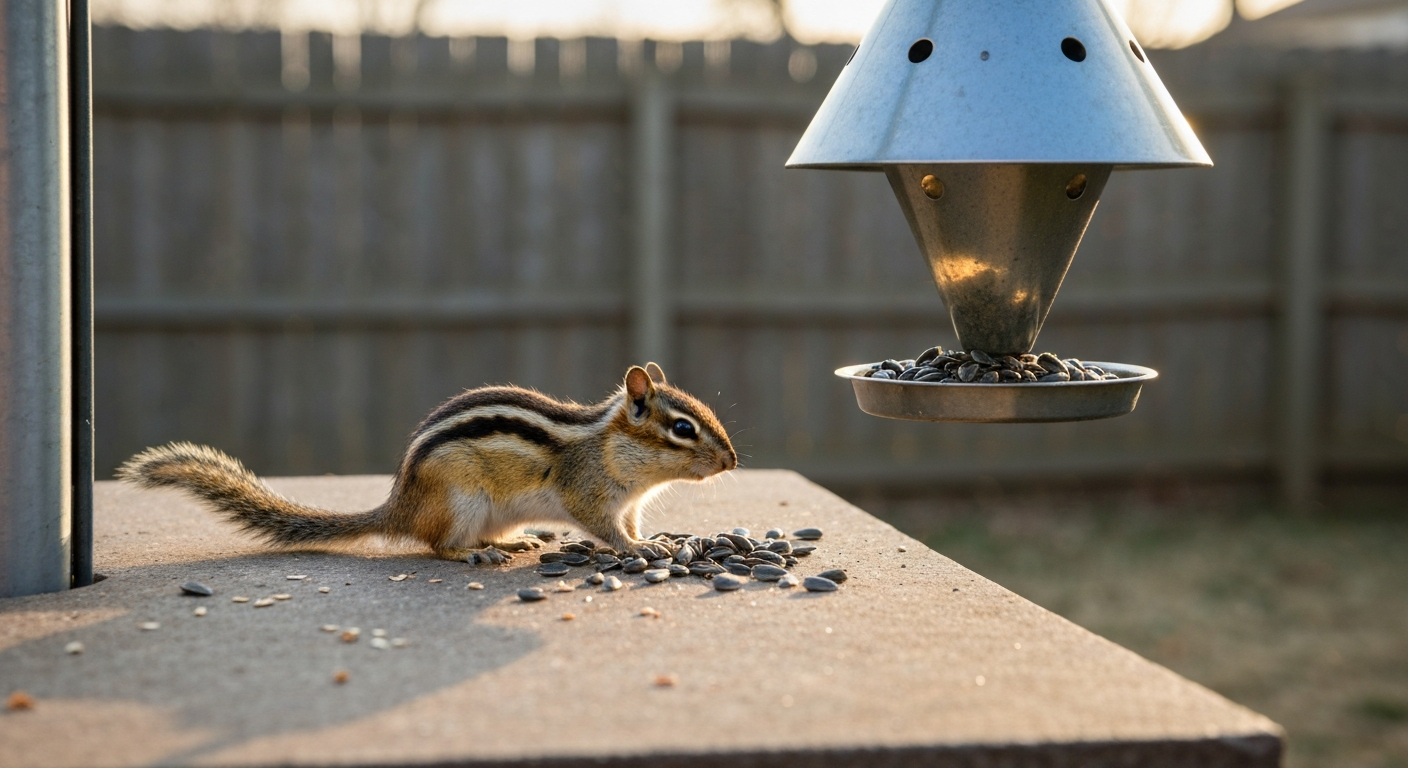
Chipmunks (primarily the Eastern chipmunk, Tamias striatus, in North America) are primarily seed eaters. Their natural diet includes tree seeds, nuts, fruits, fungi, and insects, but seeds are the core of it. See Natural history / Mammalogy references summarizing Tamias diet and caching behavior for detailed accounts of Eastern chipmunks' seed-heavy diet and scatter-hoarding (caching) behavior. Birdseed, particularly black-oil sunflower, is energetically rich and easy to handle, which makes a feeder an extremely attractive target. What's more, chipmunks are scatter-hoarders: they don't just eat on the spot, they cache food for later. Research into chipmunk caching behavior shows they'll even hull seeds before storing them to reduce the chance another animal will steal the cache. That means every trip to your feeder can be a foraging-and-stocking run, not just a quick snack.
The spillage dynamic is just as important as the feeder itself. Birds are messy eaters. They toss hulls and uneaten seeds to the ground constantly, and that debris accumulates fast under any active feeder. For related details on why birds visit feeders, see what attracts birds to bird feeders. Camera-trap studies in residential yards have documented chipmunks, mice, and squirrels all converging on ground spillage beneath feeders, sometimes pulling in larger predators like coyotes that hunt the rodents gathering there. So even a well-placed tube feeder with no direct chipmunk access still creates a ground-level food source that acts like a magnet. Spillage is often harder to manage than the feeder itself.
Which foods attract chipmunks most
Not all birdseed is equally appealing to chipmunks, but the gap is smaller than most people hope. Black-oil sunflower seed is the top attractor: it's the most popular birdseed overall, it's easy for chipmunks to hull and cache, and it's calorie-dense. Peanuts (in the shell or shelled) are highly attractive. Striped sunflower and safflower are also accepted, even though safflower is often marketed as a squirrel-deterrent seed. Chipmunks will take safflower and cache it without much hesitation. Mixed seeds containing white millet, cracked corn, or milo will draw them too, particularly when that mix ends up on the ground.
Suet is less of a primary draw for chipmunks compared to seeds and nuts, but peanut-based or nut-flavored suet will get their attention. Nyjer (thistle) seed is the one common feeder food that chipmunks tend to ignore, largely because the tiny seeds aren't worth the handling effort for them. If reducing chipmunk attraction through seed choice is part of your plan, nyjer-only feeders are your best bet, though the trade-off is that you'll primarily be feeding finches rather than a broad range of species.
Feeder designs: which ones chipmunks love (and which give them trouble)
Feeder design makes a real difference, though no feeder is completely chipmunk-proof without also addressing placement and spillage. Here's how the common types stack up.
| Feeder Type | Chipmunk Access Level | Notes |
|---|---|---|
| Platform / tray (ground or low-hung) | Very high | Designed for ground feeders; chipmunks use these freely and constantly |
| Hopper feeder | High (pole-mounted) to very high (hung from structure) | Accessible from poles; spillage tray adds ground attraction |
| Tube feeder | Moderate | Perch size limits direct access; spillage beneath is still a draw |
| Caged feeder (large cage openings) | Moderate to high | Small chipmunks can fit through cages designed for large squirrels |
| Caged feeder (small-mesh cage, <1.5 in openings) | Low | Physically excludes chipmunks when cage mesh is fine enough |
| Weight-activated feeder | Variable | Chipmunks are light; many do not trigger the closing mechanism reliably |
| Nyjer/sock feeder | Very low | Seed type is unappealing; small ports limit access anyway |
The key takeaway from that table is that caged feeders only work if the cage openings are small enough. Many 'squirrel-proof' caged feeders are sized for grey squirrels (which are much larger) and a chipmunk slips right through. Similarly, weight-activated feeders that close perches under heavier animals often don't register a chipmunk's weight, so the doors stay open. If you're shopping specifically for chipmunk exclusion, look at the cage mesh measurement before you buy, not just the product name.
Placement and maintenance: the details that change everything
Where you put your feeder and how you maintain it probably matters more than which feeder you buy. Multiple university extension programs (Penn State, Michigan State, and others) recommend placing feeders at least 15 feet from dense ground cover, shrub borders, rock piles, wood piles, and buildings. Chipmunks use cover heavily for safety: they sprint from cover to food source and back. A feeder positioned in the open, on a smooth metal pole, well away from launch points forces them to travel across exposed ground, which they're reluctant to do.
Height alone isn't enough. The standard guidance from wildlife agencies is that a pole-mounted feeder should have the baffle top at least 4 to 5 feet above the ground, and the feeder should be at least 8 to 11 feet horizontally from any fence, wall, tree branch, or structure a chipmunk could jump from. That 8-to-11-foot clearance is the part most people miss. They install a baffle and then position the feeder 3 feet from a fence rail, and the chipmunk simply leaps over the baffle entirely.
Cleaning is non-negotiable regardless of pest concerns. Cornell Lab's Project FeederWatch recommends cleaning seed feeders at least every two weeks with hot soapy water or a dilute bleach solution (1 part bleach to 9 parts water), rinsing thoroughly, and letting the feeder dry completely before refilling. In warm, wet weather, do it more often. Ground spillage under the feeder should be raked up or removed regularly, both to reduce mammal attraction and to prevent mold and disease that can harm birds.
Humane deterrents that actually work
There's no silver bullet, but layering several of these methods together produces genuinely good results. Here's what I'd recommend working through in order.
- Install a pole baffle: Use a smooth metal pole (not wood, not textured) and attach a conical or cylindrical baffle with the top at 4 to 5 feet above ground. Commercial baffles with diameters of 16 to 18 inches or more are most effective. Wrap the pole with a smooth metal sleeve if it has ridges or hardware a chipmunk could grip.
- Check horizontal clearance: Measure 8 to 11 feet from every potential launch point (fences, garden walls, tree trunks, patio furniture, building edges) and reposition if needed. This step alone stops most failed baffle installs.
- Add a seed-catching tray or seed hoop: These attach below the feeder and catch seed before it falls to the ground. They don't eliminate spillage entirely, but they reduce the ground food source significantly. Clean the tray regularly so it doesn't just become a ground-level feeder.
- Switch to a tight-mesh caged feeder: If your current feeder is accessible, replace it with a caged model where the wire spacing is 1.5 inches or less. This physically blocks chipmunks while still allowing most songbirds to feed.
- Rake and remove ground spillage daily during peak activity: Morning and late afternoon are when chipmunks are most active. Removing fallen seed before they can exploit it reduces the reward of visiting.
- Store seed in rodent-proof containers: Metal bins with tight lids prevent chipmunks from accessing your seed supply and reduce the attractant near the feeder area overall.
- Trim nearby vegetation and clear cover: Reduce rock piles, brush heaps, and low-growing dense shrubs within 10 to 15 feet of the feeder. Less cover means more exposure, and chipmunks avoid exposed routes.
Specific feeder features and what to look for when buying
When shopping to reduce chipmunk access, focus on three things: cage mesh diameter, pole compatibility, and tray design. For cage mesh, look for openings no larger than 1.5 inches on any side (some retailers list this as the 'wire spacing'). This blocks chipmunks but still allows chickadees, titmice, nuthatches, and finches. For tube feeders, models with a cage surrounding the feeder body (not just a cage dome on top) are more effective. Avoid feeders with wide flat trays built in at the base because those function as a landing platform for chipmunks.
For DIY options, a smooth metal conduit pipe from a hardware store (1-inch EMT conduit works well) combined with a 16-inch diameter metal squirrel baffle and a no-spill seed catcher hoop is a low-cost, effective setup. The total cost is typically under $40 in materials. Weight-activated feeders are worth considering for squirrels but are generally unreliable for chipmunks because of the weight issue noted earlier. If you go that route, look for models with an adjustable tension setting so you can lower the trigger threshold.
Seed and feed choices to discourage chipmunks
Changing what you offer is one of the easiest modifications, though it comes with real trade-offs in which bird species you'll attract. Here's the practical breakdown.
| Seed / Feed Type | Chipmunk Appeal | Bird Appeal | Recommendation |
|---|---|---|---|
| Black-oil sunflower | Very high | Very high (broad species) | Use only in caged or baffled feeders |
| Striped sunflower | High | Moderate (larger birds) | Same restrictions as black-oil |
| Safflower | Moderate (widely accepted) | Moderate (cardinals, doves) | Not a reliable chipmunk deterrent |
| White millet | High (especially ground spillage) | High (sparrows, juncos) | Avoid in areas with chipmunk pressure |
| Peanuts (shelled or in shell) | Very high | High (jays, woodpeckers) | Remove or use in caged feeders only |
| Nyjer (thistle) | Very low | High (finches, siskins) | Best option for reducing chipmunk attraction |
| Cracked corn | High | Moderate | Avoid; strong mammal attractant |
| Hot pepper / capsaicin-treated seed | Variable (reduced but not eliminated) | Unaffected | Helpful for squirrels; less reliable for chipmunks |
| Peanut-based suet | Moderate to high | High (woodpeckers, nuthatches) | Use in caged suet feeders only |
The capsaicin note deserves a bit more explanation. Hot-pepper coated seeds are a genuinely useful tool against grey squirrels, and many birders swear by them. The effect on chipmunks is less consistent, likely because chipmunks' fur-lined cheek pouches reduce contact with the capsaicin as they carry seeds. You may see a reduction in chipmunk visits, but don't count on it as your only strategy. Think of it as one layer in a multi-layer approach, not a standalone fix.
Landscape and habitat changes that make a real difference
What's happening around the feeder matters as much as the feeder itself. Chipmunks need cover to feel safe: they don't forage in wide-open spaces if they can avoid it. Rock walls, mulch beds with deep loose mulch, brush piles, and dense ground-level plantings all make excellent chipmunk habitat right next to your feeder. If you want to reduce visits, pull those features back. Clear a 10 to 15-foot radius around the feeder of low cover, fill chipmunk burrow entrances near foundations (using hardware cloth or gravel), and consider pulling back heavy mulch from beds immediately adjacent to the feeder area.
If you're going the other direction and want to make your yard more welcoming for chipmunks alongside your birds, the habitat approach is exactly reversed: add rock piles, low dense shrubs, leaf litter areas, and native plantings with berries and seeds. A small shallow dish of water on or near the ground provides drinking water for both birds and chipmunks. Just be thoughtful: dense chipmunk habitat right next to an active feeder also concentrates other small mammals and the predators that follow them.
If you actually want chipmunks around: feeding tips and honest risks
Some people enjoy watching chipmunks and are happy to share the feeder space. That's a completely reasonable position, but go in with eyes open. The Humane Society and wildlife rehabilitators caution that intentionally provisioning wild mammals (including chipmunks) can cause habituation, alter their natural foraging patterns, and increase disease transmission risk both between animals and, rarely, to humans. HSUS – Humane Wildlife Conflict Guide / rehabilitation and humane-deterrence recommendations advises against intentionally feeding wild mammals and recommends contacting licensed wildlife rehabilitators rather than attempting ad-hoc feeding. Chipmunks can carry fleas that transmit plague in some regions of the western U.S., and they can carry ticks, so handling them or allowing very close contact is not advisable.
If you want to welcome chipmunks passively, the safest approach is simply to maintain your feeder normally and let spillage happen within reason, while managing it enough to avoid attracting mice or larger wildlife. You don't need to put out a dedicated chipmunk feeder: spilled seed beneath a standard bird feeder is more than enough. Avoid hand-feeding entirely: chipmunks that associate humans with food become bold, and bold chipmunks can cause more garden damage and become nuisances.
Troubleshooting persistent chipmunk problems
If you've made several changes and chipmunks are still a constant presence, work through this escalation sequence before giving up or going to a pest control option.
- Audit your setup: Walk the yard and measure actual horizontal clearance from the feeder to every potential launch point. Most persistent problems trace back to a fence, planter, or patio chair within jumping distance that was overlooked.
- Check the baffle: Is it actually smooth? Is it secured so it can't be bypassed? Try applying a thin coat of petroleum jelly to the upper surface of a conical baffle to make it even more slippery (reapply monthly).
- Eliminate all ground spillage for 2 to 3 weeks: This is an aggressive step but gives you a clean baseline. Remove the catch tray, rake under the feeder daily, and watch whether visit frequency drops.
- Switch seed mix: If you're using a mixed seed containing millet or corn, switch to straight nyjer or straight safflower for a few weeks and observe the change in activity.
- Address burrows near the foundation: Chipmunks living under your deck or in garden walls have a shorter commute to the feeder. Fill entrance holes with hardware cloth and gravel (not poison or trapping unless you've exhausted other options and consulted local wildlife guidance).
- Contact your local cooperative extension office: State extension programs (Penn State Extension, Michigan State Extension, and others) offer free site-specific advice and can tell you if there's an unusual population pressure in your area.
- Consider a temporary feeder break: Taking feeders down for 2 to 4 weeks during peak late-summer foraging (when chipmunks are aggressively caching) can reset the learned behavior of local chipmunks. Birds will return quickly when you resume.
How chipmunk problems compare to other feeder pests
Chipmunks are one of several animals that feeders can draw in, and the management strategies overlap but aren't identical. Mice are a closely related concern: like chipmunks, they're drawn to ground spillage and will exploit gaps in seed storage. If you're concerned about mice, see our guide on whether bird feeders attract mice for practical steps to minimize rodent visits. The key difference is that mice are nocturnal and harder to monitor visually, and they pose greater disease risk through droppings. Pigeons present a completely different challenge because they're large, arrive in flocks, and can take over platform feeders, though they have no interest in burrowing or caching. For more on pigeons at feeders, see do bird feeders attract pigeons. Raccoons target feeders mostly at night and are strong enough to damage feeders directly; standard chipmunk baffles won't stop a raccoon. Do bird feeders attract raccoons? This short guide explains how and when raccoons are drawn to feeders and what deterrents actually work. Bears are in a different category entirely: in bear country, feeders may need to come down seasonally, no deterrent short of removal is reliable, and the legal and safety stakes are much higher. For guidance specific to bears, see Do bird feeders attract bears? for advice on seasonal removal, legal considerations, and safety measures.
For chipmunks specifically, the good news is that the solutions are manageable and don't require the same level of intervention as bear or raccoon problems. A well-baffled pole, regular cleaning, and some seed discipline handles the majority of cases. The strategies for reducing chipmunk attraction, particularly spillage management and seed choice, also reduce mouse attraction, so these two problems are often solved together.
Safety, property damage, and wildlife welfare
Chipmunks are mostly harmless in a backyard context, but there are legitimate concerns worth knowing. In gardens, they dig and can disturb bulbs, seedlings, and shallow plantings. Near foundations and retaining walls, their burrow networks can undermine structures over time, particularly in sandy or loose soil. These aren't hypothetical risks, especially if you're actively concentrating food sources and increasing the local chipmunk population around your home.
On the wildlife welfare side, a 2017 study published in The Condor found that bird feeders can change local predator communities in ways that increase nest predation risk for some songbirds. Chipmunks are documented nest predators: they will take bird eggs and nestlings when the opportunity arises. Feeders that concentrate chipmunks near active bird nests (especially within 50 meters) can increase that risk. This isn't a reason to stop feeding birds, but it's worth being thoughtful about feeder placement in relation to nesting habitat, particularly during spring and early summer.
Seasonal and legal considerations
Chipmunk activity follows a predictable seasonal arc. They're most active in spring and fall, when they're either emerging from torpor or frantically caching food for winter. Late summer through October is peak caching season, and feeder visits will be most frequent and persistent during this window. During true winter, Eastern chipmunks enter a light torpor (not as deep as groundhogs) and largely disappear from feeders until temperatures rise in late winter or early spring. If chipmunk pressure is driving you crazy, a 4 to 6 week feeder break in late September and October can meaningfully reduce the reward-based learning that keeps bringing them back.
On the legal side, regulations around feeding wildlife vary significantly by location. Most bird-feeding ordinances in the U.S. are focused on bears, not chipmunks specifically, but some municipalities prohibit attracting any wildlife to feeders or require feeders to be inaccessible to mammals. If you're in bear country, the same baffling and placement practices that reduce chipmunk access are consistent with most bear-safety guidance, though in high-bear-activity seasons many agencies recommend bringing feeders inside at night or removing them entirely. Check your local wildlife agency's current advisories before setting up feeders in these areas.
Should you keep feeding, modify your setup, or stop? A decision checklist
There's no universal right answer here. The decision depends on what you want from feeding birds, how much the chipmunks actually bother you, and what your yard situation looks like. Run through these questions honestly.
- Are chipmunks causing real damage (burrowing near foundations, eating garden plantings, getting inside structures)? If yes, active exclusion and habitat modification are justified and should come before any other step.
- Are you in bear country or an area with current bear advisories? If yes, review local agency guidance first because feeder management overlaps directly with bear safety.
- Do you have active bird nests within 50 meters of the feeder in spring or summer? If yes, consider repositioning the feeder farther from nesting areas to reduce nest predation risk.
- Are you seeing mice or rat activity in addition to chipmunks? If yes, ground spillage is likely the core issue and needs to be addressed aggressively regardless of feeder type.
- Do you enjoy watching chipmunks and don't mind sharing? If yes, modest spillage management and proper seed storage are probably sufficient without major changes.
- Have you tried baffles, seed changes, and spillage management without success? If yes, work through the troubleshooting escalation above before considering live trapping or more invasive options.
Quick action plan based on your goal
If you want to keep feeding birds but exclude chipmunks: mount feeders on smooth metal poles with 16-inch or larger baffles at 4 to 5 feet height, verify at least 8 to 11 feet of horizontal clearance from any launch point, add a seed-catching hoop, switch to nyjer or tight-mesh caged feeders for sunflower, and clean up ground spillage daily. Start with the clearance audit because that one step fixes more failed baffle installs than anything else.
If you want to reduce chipmunks without overhauling your setup: switch the seed mix toward nyjer and safflower, add a catch tray to reduce ground spillage, store seed in a metal bin, and rake under the feeder every morning. You won't eliminate visits, but you'll reduce them meaningfully and make the area less attractive to mice at the same time.
If you want to welcome chipmunks alongside your birds: maintain your feeders normally, manage spillage enough that you're not creating a large ground accumulation that attracts mice or larger animals, avoid hand-feeding, and enjoy the activity without deliberately expanding the food supply. Keep your seed stored securely, clean feeders on schedule, and watch for any signs of burrow activity near your foundation that would warrant a change in approach.
FAQ
Do bird feeders attract chipmunks?
Yes. Bird feeders — especially those that spill seed onto the ground or are placed near cover — attract chipmunks because seed and nuts are a high-energy food that matches their diet and caching behavior. Camera-trap and field studies show small mammal visitation increases around concentrated food sources, and feeders can draw chipmunks into yards.
Why do chipmunks visit feeders (what exactly attracts them)?
Chipmunks are attracted by: 1) accessible seeds and nuts (sunflower, safflower, millet, mixed seed), 2) spilled seed beneath feeders, 3) ground-level or platform feeders they can reach easily, and 4) nearby cover (brush, rock walls, foundation plantings) that provides quick escape routes. They also cache seeds, so feeders provide both immediate food and cacheable items.
Which feeder designs are most and least attractive to chipmunks?
Most attractive: tray/platform and ground feeders, and any feeder that creates spillage on the ground. Less attractive: tube and hopper feeders mounted on smooth, pole-mounted hardware with proper baffles and distance from launch points. Note: small chipmunks can still exploit spillage and some caged/weight-activated designs may not reliably exclude them.
Do some seeds or foods attract chipmunks more than others?
Yes. Small seeds and nuts (black-oil sunflower, striped sunflower, safflower, mixed seed, peanuts) are attractive because chipmunks handle and cache them easily. Safflower and nyjer deter some pests and birds but do not reliably exclude chipmunks. Seed swaps can reduce some unwanted species but will not guarantee chipmunk avoidance.
How much does spilled seed matter?
Spilled seed is a primary attractant. Studies and backyard camera work show that seed on the ground draws chipmunks, mice and other predators. Catching spillage (seed trays/hoops), sweeping under feeders, or using feeders that minimize drop-through will substantially reduce visits.
How effective are weight-activated or caged 'squirrel-proof' feeders for chipmunks?
Variable. Many weight-activated feeders are designed for heavier tree squirrels and may not trigger with lightweight chipmunks. Caged feeders with small-bar spacing can work if the cage hole is small enough to exclude chipmunks, but clever individuals may still access spilled seed or fit through larger gaps. Combine with other measures for best results.