
Hang your oriole feeder 5 to 6 feet off the ground, at least 10 to 15 feet from trees or dense shrubs, and either within 3 feet of a window or more than 30 feet away from one. That single combination of height, setback, and window distance handles the three biggest placement problems at once: predator access, squirrel launches, and window collisions. Everything else, shade, wind, visibility, ant control, is refinement on top of that foundation.
Where to Put Oriole Bird Feeder: Best Heights, Spots & Tips

Eleanor Hartwick
20 Jul 2026
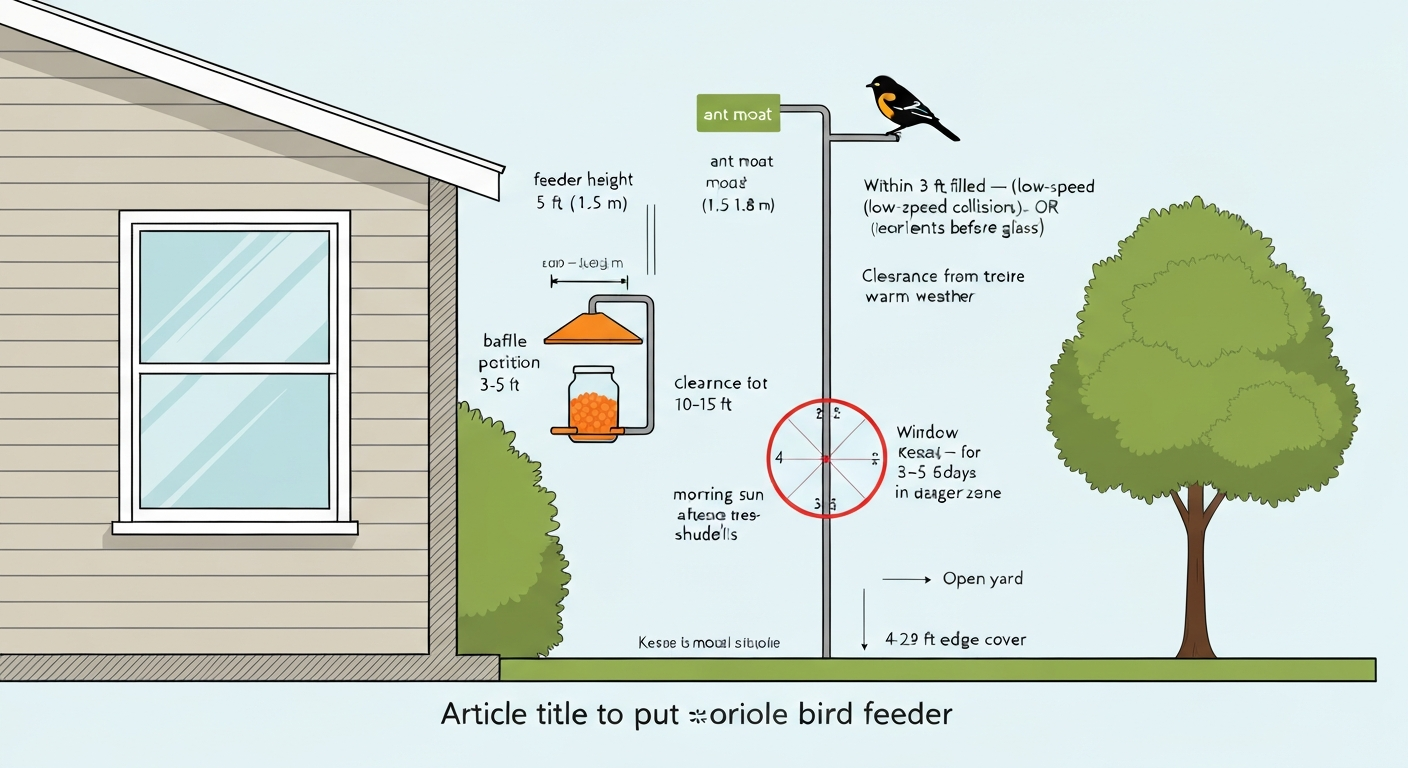
Quick placement checklist
Before getting into the why behind each measurement, here is a fast reference you can act on immediately. Tick these off when you set up your feeder and you will have covered the essentials. For broader bird feeder placement tips covering pole setup, baffles, and spacing, see the site's feeder placement guide.
- Hang at 5–6 ft (1.5–1.8 m) above the ground
- Keep 10–15 ft (3–4.5 m) of open space between the feeder and any tree trunk, fence, or dense shrub
- Place either within 3 ft (1 m) of a window OR more than 30 ft (9 m) away from glass
- Install an ant moat above the feeder and keep it filled with water
- Add a pole baffle if pole-mounting (baffle positioned 3–5 ft above ground on a smooth metal pole)
- Put it up 1–2 weeks before your local oriole arrival date (check Audubon's Migration Explorer for your region)
- Face it so you have a clear sightline from indoors — you want to see them visit
- Choose a spot you can reach comfortably for weekly or twice-weekly cleaning
Why location matters more for orioles than most feeder birds
Orioles are edge-habitat birds. In the wild they forage along the borders of woodlands, orchards, and open canopy, spots where trees meet open space. They are not dense-thicket birds the way sparrows or wrens tend to be, and they are not open-field birds like finches. That middle zone is what you are trying to recreate in your yard. A feeder tucked deep inside a shrub mass will rarely get used. A feeder hanging in the middle of a wide open lawn with no trees within sight is a harder sell too, because orioles like a quick escape route nearby.
Placement also determines whether your feeder becomes a health risk or a safe resource. Nectar and jelly, the two foods orioles visit feeders for most reliably, spoil fast. Sun and warm temperatures accelerate fermentation and mold, which is why where you hang the feeder relative to sun exposure directly affects how often you need to clean it. A poorly placed feeder that you cannot reach easily ends up going uncleaned, which is a real hazard for birds. Placement and maintenance are genuinely connected.
Window collisions are the safety concern I see underestimated most often. Orioles are fast, directional fliers. If a feeder sits in the 4–29 foot danger zone from a reflective window, a bird flushing from a feeder in a hurry can hit the glass at speed. The 3-foot or 30-foot rule from Cornell Lab exists because both extremes work for different reasons: very close feeders mean any collision is at low speed because the bird has no room to accelerate, and feeders beyond 30 feet are far enough that the bird has reoriented before reaching glass.
Exact siting measurements to use
Specific numbers are more useful than vague advice like 'near trees but not too close,' so here is what the evidence and practical experience actually point to.
| Placement factor | Recommended measurement | Reason |
|---|---|---|
| Hanging height | 5–6 ft (1.5–1.8 m) above ground | Reduces cat and raccoon access; comfortable for refilling; birds are relaxed at this height |
| Distance from tree trunks / fences / shrubs | 10–15 ft (3–4.5 m) minimum | Removes squirrel and raccoon launch points while keeping escape cover nearby |
| Distance from windows (option A) | Within 3 ft / 1 m | Collision speed is too low to cause serious injury |
| Distance from windows (option B) | More than 30 ft / 9 m | Bird reorients before reaching glass |
| Distance from other feeders (multiple feeder setups) | At least 10–15 ft apart | Reduces territorial competition; mimics natural spacing |
| Distance from buildings / walls | 3+ ft from walls without glass; treat glass walls like windows | Allows birds to approach from multiple angles; reduces reflection confusion |
The window distance is the one most people miss. I hear from readers regularly who cannot figure out why an oriole keeps hitting their sliding glass door, and when I ask where the feeder is, it is almost always in that 5–20 foot danger zone. Moving the feeder to within arm's reach of the window, or pulling it well back past the 30-foot mark, typically solves the problem. If you cannot do either, window decals or Acopian BirdSavers cords on the glass are the recommended treatment.
Running multiple oriole feeders: spacing and layout
Baltimore Orioles can be territorial around food sources, especially when numbers are lower in early season. If you want to run two or more feeders, spread them out enough that a dominant bird cannot guard all of them from a single perch. Ten to fifteen feet between feeders is a reasonable minimum; if your yard allows 20–25 feet between stations, even better. Placing feeders on opposite sides of the yard, or around a corner, is more effective than lining them up in a row.
If you are also running other feeder types, the same spacing logic applies. Oriole feeders placed too close to heavily trafficked seed feeders can be intimidating for a species that tends to avoid crowded, chaotic feeding stations. Keeping oriole feeders somewhat separated from your main seed setup gives them a quieter feeding zone, which I have found makes a real difference in whether birds linger or just pass through.
Hanging from a branch vs. using a pole or shepherd's hook
Both methods work, but they come with very different trade-offs. Here is how they compare honestly.
| Method | Pros | Cons |
|---|---|---|
| Tree branch | No hardware needed; natural look; easy to reposition; birds may feel more secure near cover | Squirrels have direct access; hard to maintain the 10–15 ft clearance rule; feeder may swing excessively in wind; branch height is fixed |
| Shepherd's hook | Inexpensive; portable; easy to install; height-adjustable on most designs | Many are too lightweight and tip in wind or when squirrels grab them; harder to add a quality baffle; limited height |
| Dedicated pole mount | Most secure; baffle-compatible; height and setback fully controllable; best long-term solution for pest control | Requires installation; higher upfront cost; less flexible if you want to move it seasonally |
My honest recommendation: if squirrels and raccoons are active in your yard, a smooth metal pole with a quality cone or cylindrical baffle is worth the effort. Hanging from a tree branch looks natural and is genuinely convenient, but maintaining that 10 to 15 foot setback from the trunk is nearly impossible because the branch you are hanging from is part of the tree. That means squirrels have a direct highway to your feeder. The pole option lets you place the feeder exactly where the siting measurements call for it.
How to install a pole or hook for oriole feeders
Height and position
Drive or anchor your pole so the feeder hangs at 5 to 6 feet above ground. Most shepherd's hooks and dedicated feeder poles are designed with this range in mind. Position the pole at least 10 feet from any tree, fence, roofline overhang, or structure a squirrel or raccoon could use as a jump-off point. For more on exactly where to put bird feeder poles, consult our guide on where to put bird feeder pole. This is not a suggestion you can fudge by a few feet, squirrels can cover surprising horizontal distances, so erring toward 12 to 15 feet of clearance is smarter if you have the space.
Baffles: what to get and where to put them
A baffle mounted on the pole below the feeder is the single most effective anti-mammal measure for pole-mounted setups. Mount a cone or cylindrical baffle 3 to 5 feet above the ground on a smooth metal pole. The pole itself should be metal and relatively smooth, wooden posts give climbing animals too much grip. The baffle works by making it physically impossible for a raccoon or squirrel to get past it. The key word is 'properly placed': a baffle mounted too high (above 5 feet) gives a squirrel room to jump past it from below. Keep the baffle in that 3 to 5 foot window and the feeder above it at 5 to 6 feet.
Ant moats: position and maintenance
An ant moat is a small water-filled cup that sits between the hanging hook and the feeder. Ants crawling down the line hit the water barrier and cannot cross. Many commercial oriole feeders include a built-in moat; if yours does not, an aftermarket moat hangs above it on the hook. Retailer product pages such as Perky-Pet Hummingbird Oasis Feeder, product listing (example showing built-in ant moat) illustrate built-in ant-moat designs and show how the moat sits between the hook and feeder Perky-Pet Hummingbird Oasis Feeder — product listing (example showing built-in ant moat). Keep the moat topped with water, an empty moat does nothing. In hot weather the water evaporates faster than you expect, so check it every time you are refilling the feeder. One practical note from product care guides: before winter, empty the moat completely so freezing water does not crack the plastic or metal housing.
Raccoon and cat mitigation beyond baffles
Raccoons are nocturnal, so bringing your feeder in at night is a simple and effective deterrent, one that wildlife extension programs actually recommend. If that is impractical, a properly installed pole baffle is your main defense. For cats, the combination of a pole height above 5 feet and at least 10 feet of open ground around the pole removes the ambush geometry cats rely on. Research published in Nature Communications estimated free-ranging domestic cats kill between 1.3 and 4 billion birds annually in the U.S., so this is not a trivial concern. Open sightlines around the feeder give birds time to spot a cat and react.
Sun, shade, wind, and visibility: finding the right balance
There is a genuine tension here that I want to be upfront about. Full sun makes a feeder highly visible to orioles, which helps with attraction. But oriole nectar ferments significantly faster in heat, and jelly can develop mold quickly in direct afternoon sun. My practical compromise: place the feeder where it gets morning sun and afternoon shade, especially in summer. This keeps the feeder visible and appealing without turning it into a fermentation experiment by 2 p.m.
Wind is a secondary concern but worth thinking about. A feeder that swings violently every time a breeze picks up is harder for birds to feed from and spills nectar, which attracts ants and wasps. If your preferred spot is in a wind corridor, a heavier feeder or one with a lower center of gravity will swing less. Positioning the feeder on the leeward side of a shrub or fence, with the required clearance maintained, can reduce swing without putting the feeder in deep shade.
Visibility from indoors is something I feel strongly about including in placement decisions. You put the feeder up to enjoy watching orioles. A feeder you can see from your kitchen window or back porch gets monitored more often, which means you catch spoiled nectar sooner, notice when the moat is dry, and refill before the feeder empties completely. Practical placement and enjoyable placement usually point in the same direction.
Making cleaning and refilling genuinely easy
Nectar-style feeders, and oriole feeders are essentially nectar and jelly feeders, need to be emptied and cleaned every 3 to 5 days in warm weather, more often when temperatures are consistently above 85 degrees Fahrenheit. Cornell Lab/All About Birds recommends changing nectar every few days in warm weather and deep-cleaning feeders weekly or when mold appears. In cooler conditions, a weekly cleaning minimum is the standard recommendation. A 10 percent bleach solution (roughly one part bleach to nine parts water) is the commonly cited disinfection method: soak, scrub, rinse thoroughly, and let the feeder dry completely before refilling. Mold in a nectar feeder is not just unappetizing for birds, it is a genuine health hazard.
What this means for placement: choose a spot you can actually reach without a ladder, without awkward angles, and without navigating thorny shrubs. A feeder that is technically well-placed by every other measure but that you dread cleaning every few days will eventually go uncleaned. I would rather see someone hang a feeder at a slightly less optimal height but in a spot they will actually service than watch a feeder go moldy because it was too inconvenient to maintain.
Think about what you will do with the feeder during cleaning. You need to carry it inside, take it apart, soak it, dry it, and rehang it. If your pole or hook requires tools to remove the feeder, that friction adds up over a season. Simple S-hooks or quick-release shepherd's hook configurations make the process much faster.
When to put out your oriole feeder, and when to take it down
Timing your feeder with migration is as important as where you put it. Baltimore Orioles are migratory, and the arrival window varies significantly by region, what works for a birder in Georgia differs from one in Minnesota or Ontario. The most accurate way to time your setup is to check the Audubon Bird Migration Explorer, which draws on eBird data to show weekly abundance maps for your specific area. As a general rule, put the feeder up 1 to 2 weeks before your local first-arrival date to have it ready when scouts come through. Take it down once fall migration has clearly wrapped up for your region, and winterize the moat before hard freezes arrive.
Troubleshooting when orioles are not visiting
If your feeder is up, correctly placed, and orioles are documented in your area but nothing is visiting, work through this list before assuming the feeder is the problem.
- Verify timing: check eBird or the Audubon Migration Explorer to confirm orioles have actually arrived in your area this week, not just 'this season'
- Check the nectar or jelly: if it has been in the feeder more than 3–5 days in warm weather, replace it — fermented or discolored nectar repels birds
- Reassess visibility: is the feeder visible from the air and from nearby perch trees? Move it to a more open position if it is tucked behind foliage
- Look at the surroundings: excessive foot traffic, a dog that runs through the area, or a cat that camps nearby will keep orioles away regardless of feeder placement
- Try adding an orange half nearby: mount a cut orange on a nail or spike near the feeder — the color and scent can draw in first-time visitors who have not learned to use the feeder yet
- Reduce competition from other feeders: if a very busy seed feeder is within 10 feet, orioles may avoid the chaos; move the oriole feeder farther away
- Be patient early in the season: it sometimes takes a few seasons for orioles to establish a feeder location in their territory memory
Oriole feeder placement vs. other feeder types
The core rules, height, setback from launch points, window distance, apply across feeder types, but the specifics shift by species and feeder design. Finch feeders are often hung slightly higher or in more open spots because goldfinches are comfortable in exposed locations; oriole feeders benefit from slightly more tree proximity for the edge-habitat effect. Suet feeders are typically mounted on or near tree trunks, which is almost the opposite of what you want for an oriole feeder from a pest-control standpoint. For detailed guidance on suet-specific siting, why suet is often mounted on trunks and safer alternatives, see where to place a suet bird feeder. Pole-mounted setups, covered in depth on this site's feeder pole placement guide, follow similar baffle and setback rules regardless of what you are feeding. For step-by-step guidance on where to put a bird feeder, see the site's detailed placement guide. The general feeder placement principles covered elsewhere on this site translate well to oriole feeders, but the nectar and jelly foods mean cleaning frequency and sun exposure matter more here than they do for seed feeders.
Dos and don'ts at a glance
| Do | Don't |
|---|---|
| Hang at 5–6 ft above ground | Hang below 4 ft where cats can reach or above 7 ft where refilling becomes awkward |
| Keep 10–15 ft clearance from trees and fences | Hang directly from a branch overhanging the trunk — squirrels will find it immediately |
| Place within 3 ft OR beyond 30 ft from windows | Leave a feeder in the 4–29 ft danger zone from glass |
| Install and maintain a filled ant moat | Rely on petroleum jelly or sticky substances on poles — these can trap and harm birds |
| Use a smooth metal pole with a proper baffle | Use a wooden post, which gives squirrels and raccoons grip to climb |
| Bring the feeder in at night if raccoons are a problem | Leave nectar or jelly out overnight in raccoon-heavy areas |
| Change nectar every 3–5 days in warm weather | Let nectar sit until it looks cloudy or smells off — that is already too late |
| Put the feeder up 1–2 weeks before local first-arrival date | Put it out mid-summer and wonder why no orioles came — peak migration may have already passed |
FAQ
Quick actionable summary: Where should I put an oriole feeder to attract orioles while keeping them safe and minimizing pests?
Hang oriole feeders at about 5–6 ft (1.5–1.8 m) high on a pole or hook placed 10–15 ft (3–4.5 m) from trees or dense shrubs (close enough that birds can use cover and escape, but far enough to reduce squirrel/raccoon launch points). Keep feeders either very close to windows (<3 ft / <1 m) or well away (>30 ft / >9 m) to reduce window-collision risk. Use a smooth metal pole with a predator baffle 3–5 ft (0.9–1.5 m) above the ground (baffle below the feeder) or hang from a branch with an ant moat and predator deterrents. Site feeders where you can easily reach them for refilling and cleaning, with some afternoon shade to slow nectar/jelly spoilage and shelter from prevailing winds.
Exact siting measurements (height, distance from trees, distance from windows and other feeders)?
Height: 5–6 ft (1.5–1.8 m) above ground is a good default. Distance from trees/launch points: 10–15 ft (3–4.5 m) to reduce squirrel/raccoon access but leave nearby cover. Distance from windows: either <3 ft (<1 m) or >30 ft (>9 m) to lower collision severity and frequency. Spacing between multiple feeders: 6–10 ft (1.8–3 m) apart horizontally so orioles can feed without crowding and to limit dominance interactions; place different food types (nectar, oranges, jelly) a few feet apart so birds can easily sample multiple offerings.
Hanging from branches vs mounting on poles/hooks — pros and cons?
Hanging from branches — Pros: natural look, easy to move, close to canopy cover that orioles like. Cons: easier for squirrels to reach, less stable in wind, harder to mount effective baffles, potential branch droop/leaf obstruction. Pole- or hook-mounted — Pros: easier to add predator baffles, place at optimal distance from trees, more stable for feeding and refilling, easier accessibility. Cons: more visible to predators if poorly sited, requires installation and ground anchoring, may need aesthetic blending. For best balance, use a pole with a smooth finish plus a properly placed baffle and site it 10+ ft from climbable launch points.
What hardware reduces pests and predators (squirrels, cats, raccoons, ants) and what are recommended specs?
Ants: use an ant moat (water-filled cup or built-in reservoir) placed between hook and feeder; keep it filled and clean. Squirrels/raccoons: use a smooth metal pole and a large cone or cylindrical baffle installed 3–5 ft (0.9–1.5 m) below the feeder (baffle should be wider than the animal’s body). Place poles ≥10 ft (3 m) from trees/structures to reduce launch pathways. Cats: site feeders ≥5 ft high and >10 ft from low cover where cats can hide; encourage cat owners to keep cats indoors. Raccoons (nocturnal): remove or bring feeders in at night or use heavy-duty baffles. Hardware specs: smooth metal pole (not wood), commercial cone baffle ~18–24 in diameter or cylindrical baffle sized to block climbing, durable ant moat compatible with winter draining.
How should I protect feeders from ants and what maintenance do ant-moats need?
Place a water-filled ant moat between the hanging point and the feeder so ants must cross water. Built-in moats work similarly. Maintenance: top up water regularly (daily in hot/dry spells), clean moat when refilling feeder, and empty/drain/moisture-proof before hard freezes per manufacturer instructions to avoid cracking. If a moat is impractical, hang feeder from a slick metal hook with a short smooth sleeve and use sticky barriers carefully (they can catch debris and harm birds if misused).
Cleaning and seasonal timing: when to put feeders up and take them down, and cleaning frequency/procedures?
Timing: put feeders out close to local orioles’ arrival dates indicated by regional migration maps (Audubon/eBird weekly maps). Take feeders down after local migration/breeding period or when birds are no longer present. Nectar stability: change nectar every 3–5 days (more often in hot weather). Cleaning: deep-clean feeders at least weekly; in hot/wet conditions clean more often. Disinfect: soak in 10% bleach solution (1 part bleach to 9 parts water) for 10–15 minutes when needed, rinse thoroughly and air-dry. During disease outbreaks follow local authority guidance; consider temporary removal if advised.
Next Articles
Bird Feeder Placement Tips: Where to Put Feeders for More Birds
Practical bird feeder placement tips for more birds and fewer problems, including window safety, predator cover, spacing
Where to Put a Bird Feeder: Best Locations and Tips
Best spots to hang a bird feeder in your yard or garden, plus what to avoid and how to place for safe, wanted birds.
Where to Hang Finch Bird Feeders: Best Placement Tips
Step-by-step tips for hanging finch feeders: ideal height, window distance, visibility, shelter, and safety adjustments.