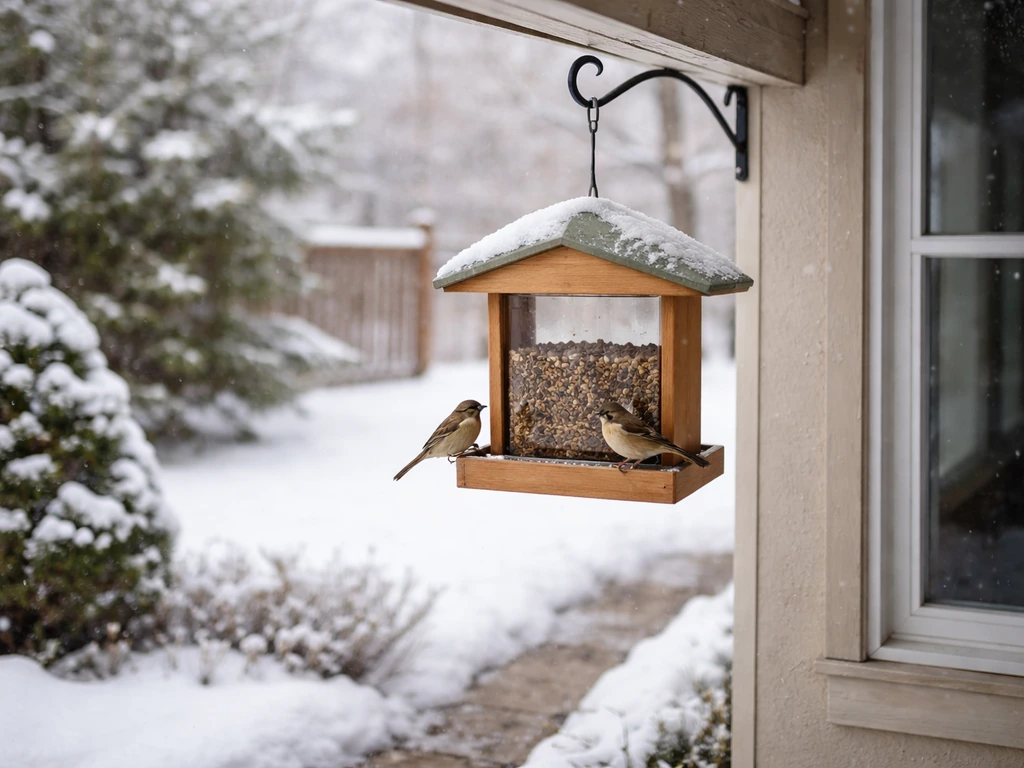
Place your suet feeder within 3 feet of a window or at least 30 feet away from one, hang it 6 feet off the ground, position it 8 to 10 feet from nearby shrubs or trees, and make sure it's shielded from prevailing wind. That's the short answer. Everything below explains why those numbers matter and how to make smart trade-offs when your yard doesn't give you perfect conditions.
Where to Place a Suet Bird Feeder: Best Locations

Eleanor Hartwick
23 Mar 2026
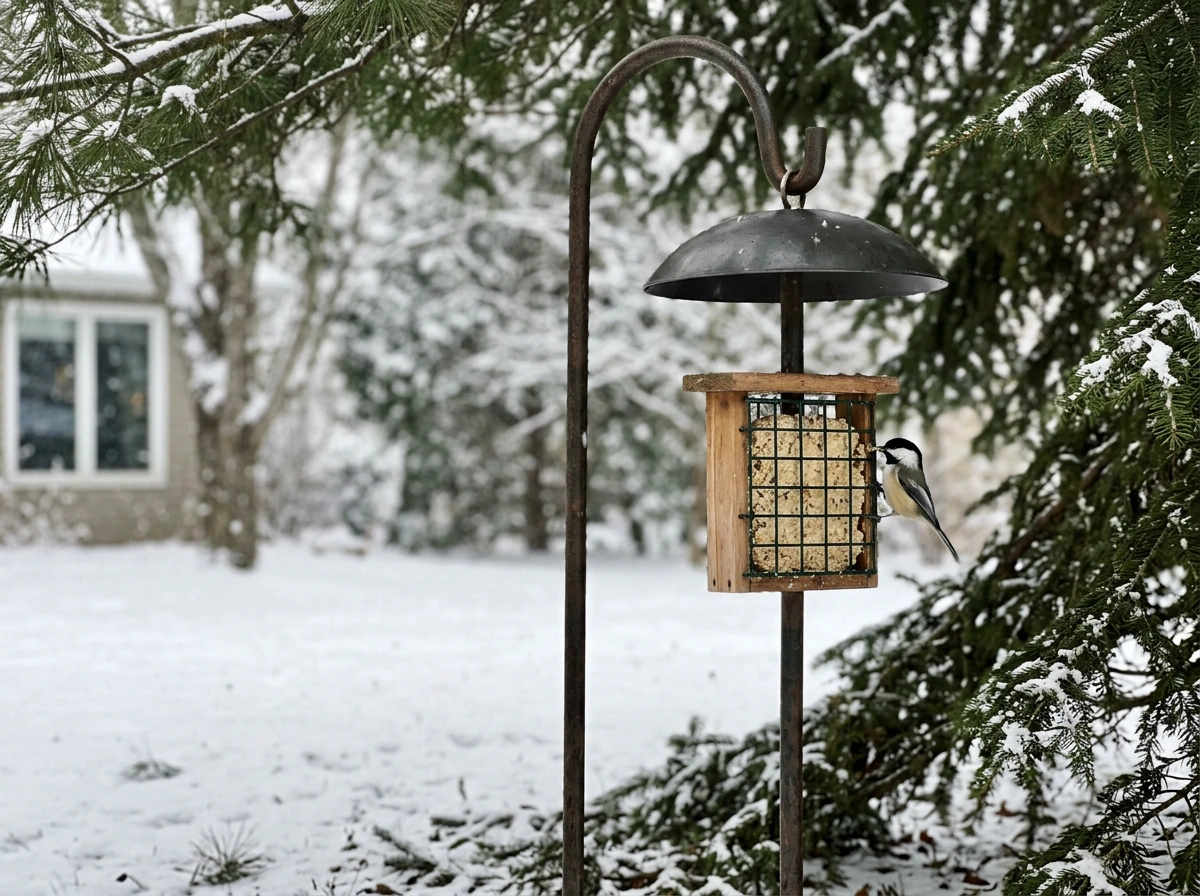
Best spots for hanging suet feeders
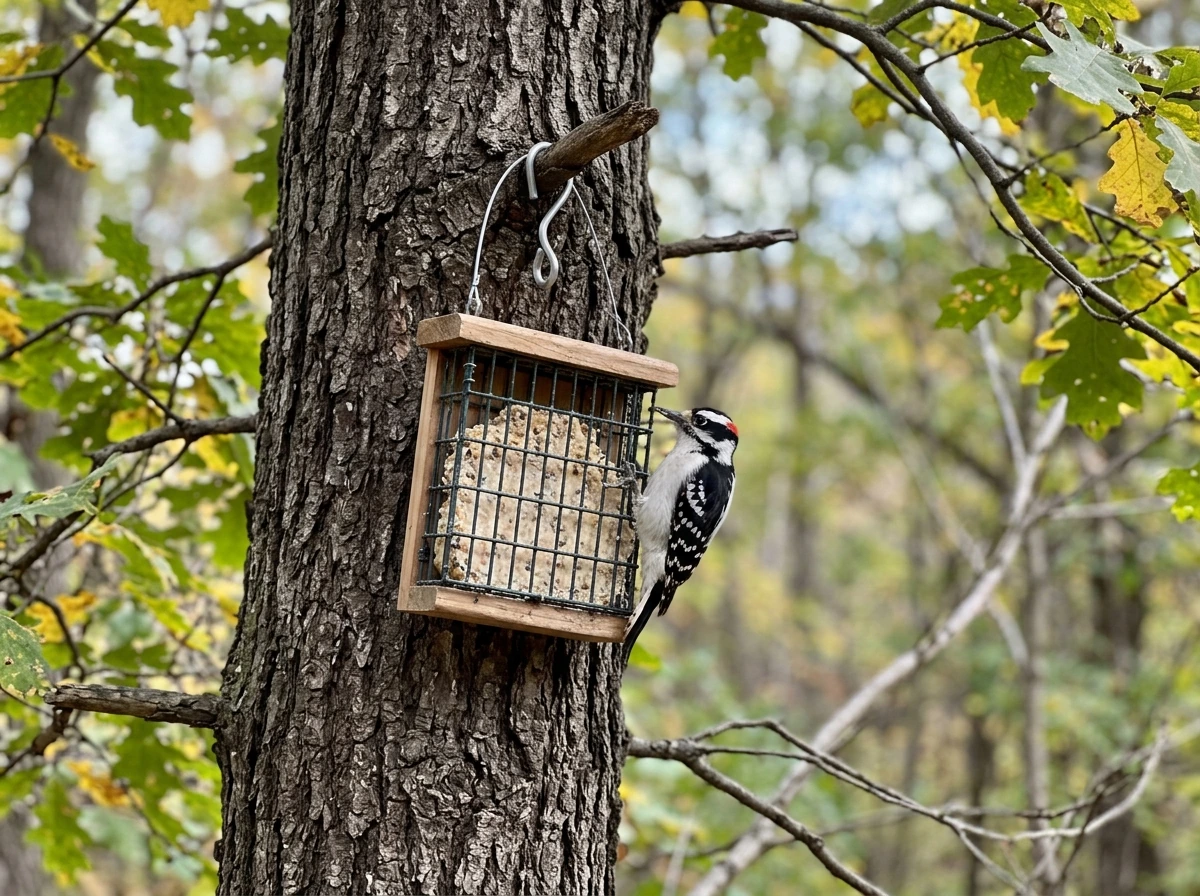
Suet feeders attract a specific crowd: woodpeckers (Downy Woodpeckers are among the most frequent visitors), White-breasted Nuthatches, Carolina Wrens, chickadees, and a handful of other insect-eating birds. These species tend to approach feeders cautiously, working their way from nearby cover rather than diving straight in from open sky. That behavioral pattern tells you a lot about ideal placement.
The general rule is to place the feeder where birds have a clear flight path in and a quick escape route out. That means near trees or shrubs, but not so close that a squirrel or hawk has a direct launch point. Connecticut Audubon recommends about 8 to 10 feet from shrubs or evergreens as a useful middle-ground: close enough that birds feel covered and can spot predators, far enough that the cover doesn't become a squirrel runway or a hawk ambush perch.
Beyond that, look for spots that are visible from inside your house. You want to actually see the feeder. If you hang it somewhere inconvenient to check on, you'll end up with an old, rancid suet cake sitting out for weeks, which is both a waste and a health risk for birds. Visibility encourages regular monitoring, which is one of the most underrated parts of good feeder placement.
Avoid placing suet feeders directly over garden beds, patios, or seating areas. Suet is messy. Dripping fat and dropped bits attract insects in warm weather and leave stains. Pick a spot where a little mess doesn't create a problem for you or your guests.
Height and distance from windows, doors, and walkways
Height first: aim to hang suet feeders at least 6 feet off the ground. This keeps them out of easy reach for cats and most raccoons, and it's a comfortable viewing height for both you and the birds. Lower than that and you're inviting problems. Much higher and maintenance becomes a hassle, which means it gets neglected.
Window distance is the placement decision that has the biggest safety impact, and it's one most people get wrong. Audubon's recommendation is clear: put feeders either within 3 feet of a window or more than 30 feet away. The logic is straightforward. If a bird flushes from a feeder that's very close to glass, it doesn't have enough speed built up to cause a fatal collision.
If it's more than 30 feet away, it's less likely to fly directly toward your windows in the first place. The dangerous zone is everything in between, roughly 3 to 30 feet, where birds launch at full speed and head straight for reflected trees or sky in your glass. Many Reddit users discuss [the “3-or-30” window rule](https://www. reddit.
com/r/birding/comments/1p388g2/shouldigetawindowbirdfeederorwillbirds_are/), advising that if you place a feeder closer than about 3 feet from a window or farther than about 30 feet away, it can reduce bird strike risk.
One honest caveat: some ornithologists point out that the 30-foot rule isn't a perfect guarantee. Daniel Klem's research (frequently cited in ornithology discussions) suggests birds can still enter that collision zone from distances beyond 33 feet. So treat the 30-foot guideline as a strong risk-reduction strategy, not a complete solution. If you can pair your placement with window treatments like exterior decals, screens, or angled glass, do it. The U.S. Fish and Wildlife Service has a practical toolkit of bird-friendly window options worth looking at.
For doors and walkways, think about disturbance. A feeder hung 4 feet from a frequently used back door is going to get flushed every time someone goes outside. That constant disruption discourages birds from returning. Give feeders at least 10 to 15 feet of buffer from high-traffic entry points if you can manage it.
Placing feeders for the birds most likely to show up
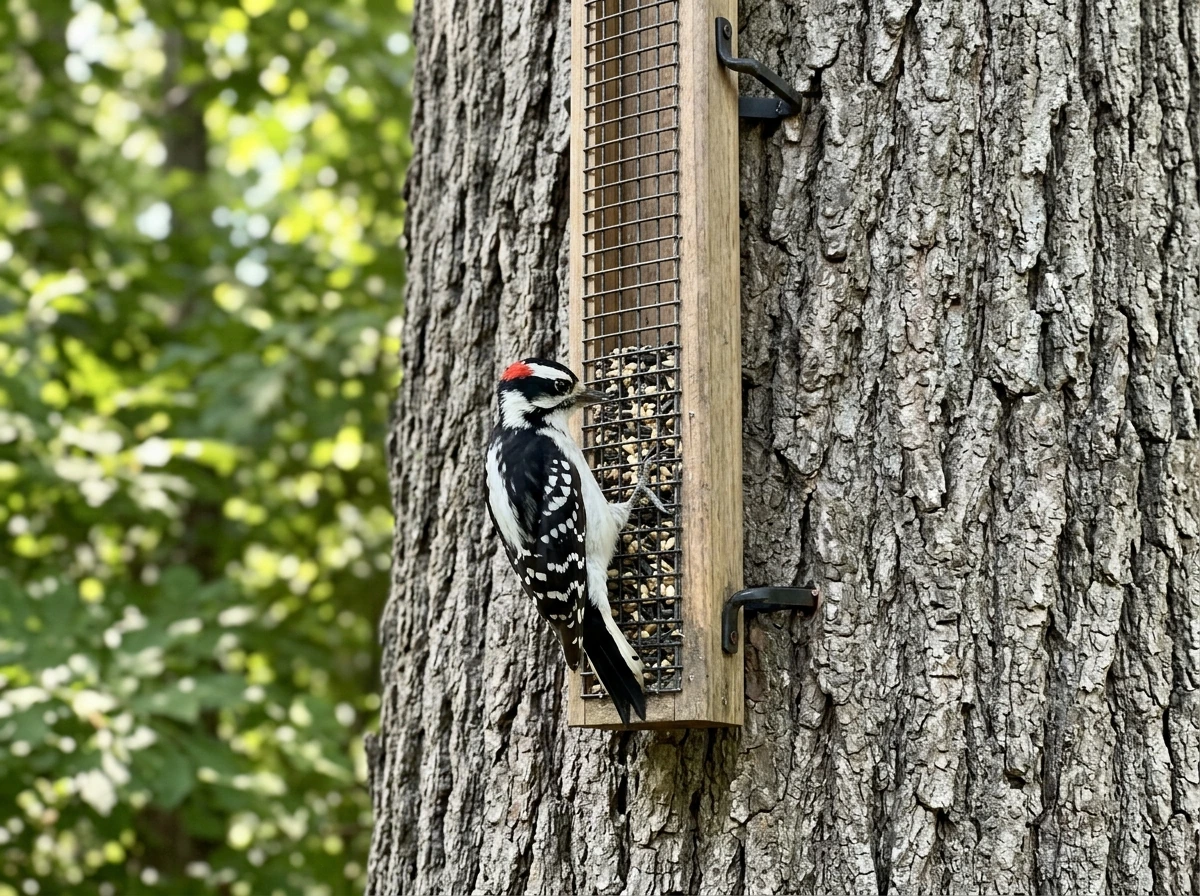
Woodpeckers are your primary suet audience, and they like vertical space. A feeder hung on a tree trunk or a free-standing pole with a cage design suits them well. They land low on a cage, work their way up, and cling while feeding. A feeder hung on a tree trunk or a free-standing pole with a cage design suits them well. If you're hanging from a tree branch, choose one that's sturdy but not so thick and bushy that the feeder is hidden from view or heavily shaded.
Nuthatches and Carolina Wrens are smaller and more skittish. They'll appreciate a feeder that's closer to shrubby cover, which gives them somewhere to retreat quickly. These birds work the edges of habitat, so a spot at the tree line or near a hedge is often more productive than hanging the feeder out in open lawn.
One placement trick that helps with European Starlings: use a cage feeder that's only accessible from the bottom. Project FeederWatch notes that upside-down or bottom-access cage designs tend to be starling-resistant while still working perfectly for woodpeckers, nuthatches, and chickadees. Starlings can't cling upside-down comfortably, so they move on. If starlings are a problem in your area, feeder design and orientation matter as much as where you hang it.
If you're also running finch or oriole feeders nearby, keep your suet setup at least a few feet separate so feeding traffic doesn't create competition and crowding. You can read more about species-specific placement strategies in our guides on where to hang finch feeders and where to put oriole bird feeder. where to put oriole bird feeder
Wind, weather, and finding sheltered spots
Suet holds up reasonably well in cold weather, which is exactly when birds need it most. But it melts, goes rancid, and gets soft in warm temperatures. Weather exposure directly affects how long each cake stays usable and safe. Placement choices that ignore weather are placement choices you'll regret in summer.
For winter feeding, the Minnesota DNR recommends placing feeders on the downwind side of shelter: a stand of conifers, a building wall, a dense switchgrass planting, or a cattail border. Birds burn more energy fighting wind than they burn in still air, so a feeder tucked out of the prevailing wind is genuinely more valuable to them than one in an exposed spot. Watch which direction the cold wind hits your yard and work with that geography.
Connecticut Audubon adds a useful detail: a sunny placement (not just sheltered) in winter helps. Birds warming up in sunlight before feeding, or eating in a patch of direct light, can regulate body temperature more efficiently. A south-facing exposure, sheltered on the north and west, tends to be ideal in most parts of North America.
In warmer months, shade becomes more important. Suet cakes left in direct afternoon sun in spring or summer turn greasy and rancid fast. Many suet feeders are designed for cool-weather use only. If you run one year-round, look for no-melt formulations and hang the feeder somewhere that gets morning light but afternoon shade. Check it frequently during warm stretches.
Rain and snow affect suet differently than seed. Cage-style suet feeders naturally shed a lot of precipitation, which is one reason they work better than open trays in wet climates. But check after heavy rain or snow to make sure the suet hasn't become waterlogged or moldy underneath where you can't easily see it.
Keeping squirrels, raccoons, and other wildlife out
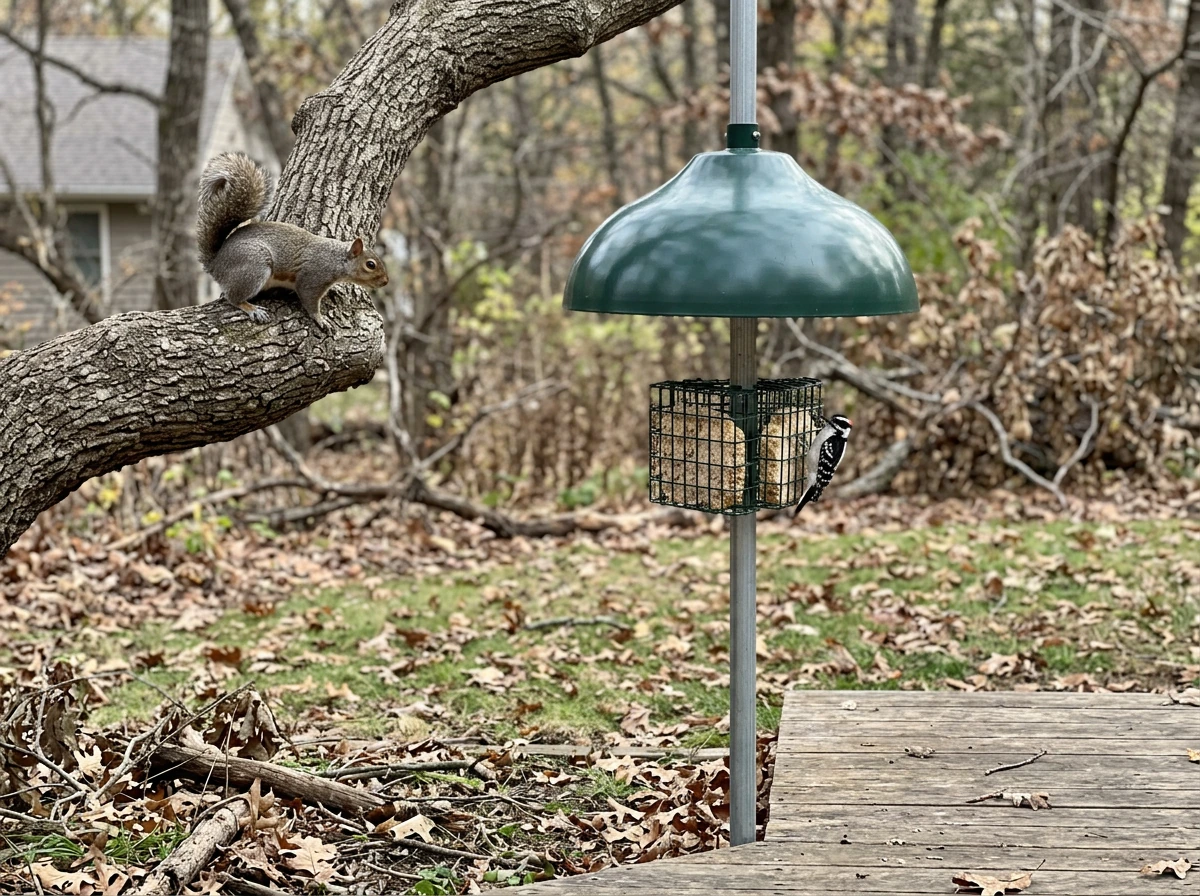
Suet attracts mammals. More specifically, it attracts squirrels and raccoons who can smell fat from a distance and are persistent enough to eventually defeat most deterrents. Your placement choices are your first and most effective line of defense.
The NWF reports that squirrels can long jump about 8 feet. That means any feeder within 8 feet of a tree trunk, branch, fence, deck railing, or roof edge is reachable by a motivated squirrel. The ICWDM recommends mounting feeders on a smooth pole so the feeder sits at least 6 feet off the ground and at least 10 feet horizontally from any structure a squirrel could launch from. That combination of height and horizontal clearance is what actually works, not just one or the other.
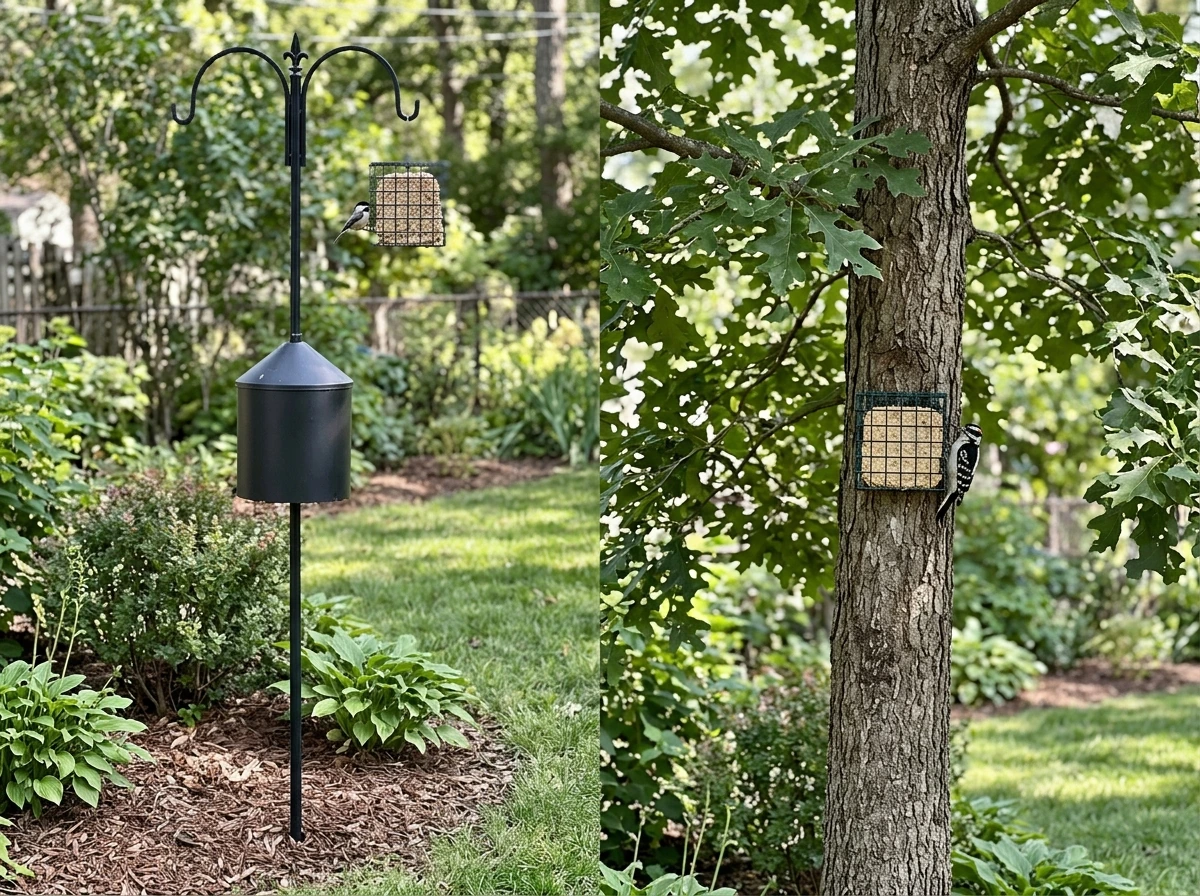
A baffle on the pole below the feeder adds another layer of protection. Audubon says a properly positioned baffle can get you pretty close to a squirrel-proof setup. The baffle needs to be large enough that a squirrel can't reach around it, and the pole needs to be far enough from any launch point that a squirrel can't bypass the baffle with a running jump from the side. The same baffle setup also discourages raccoons, which are more methodical climbers than squirrels but equally motivated by suet.
If you're hanging a suet feeder from a tree branch rather than a pole (which is common and perfectly fine for birds), squirrel management gets harder. The best option in that case is a hanging baffle above the feeder and enough drop from the branch that the feeder hangs in open space with no nearby foliage a squirrel can grab. Honestly, pole placement with a baffle is a more reliable setup if squirrels are a significant problem in your yard.
Bears are a real consideration in some regions. If you're in bear country, the simplest rule is to bring suet feeders in at night from spring through fall when bears are active. No placement trick fully compensates for a hungry bear. Vermont Fish and Wildlife and similar state wildlife agencies often have region-specific guidance on seasonal feeder management around bears.
Cats, both feral and free-roaming pets, are another issue. The 6-foot minimum height helps, but it's not a full solution. If cats are a persistent problem, a smooth pole with a baffle low on the post (not just near the feeder) makes it much harder for a cat to climb and wait below the feeder where birds land.
Seasonal adjustments and maintenance checks
Suet feeders need regular cleaning, probably more than most people expect. Audubon suggests cleaning suet feeders every other week as a baseline, and more often in humid or warm weather. Michigan Audubon recommends that if you see sick birds at your feeder, take it down immediately, discard the old suet, and do a thorough cleaning before putting it back out. Don't wait to see if more sick birds show up.
A basic cleaning routine involves scrubbing with a dilute bleach solution or another bird-safe disinfectant, then rinsing thoroughly. South Carolina DNR's guidance includes rinsing for at least 10 seconds after using any cleaning product to make sure chemical residue doesn't remain. Let the feeder dry completely before refilling it.
Beyond cleaning, tie your seasonal inspections to placement checks. Every time you change the suet cake, take 30 seconds to look at the whole setup. Here's what to check for:
- Is the hanger or hook still secure, or has it worked loose from wind or wildlife activity?
- Has nearby vegetation grown enough that a squirrel now has a new launch point you didn't have before?
- Is the feeder still in the right shade/sun balance for the current season?
- Are there droppings, old suet residue, or mold building up on or under the feeder?
- Has the pole shifted or leaned, reducing baffle effectiveness?
- Are birds still using it regularly, or has something changed (new cat in the area, new disturbance nearby)?
- Is the feeder still within the safe window-distance zone you originally chose?
In late winter and early spring, reassess your placement entirely. What worked in January (sunny exposure, near the windbreak) may be too exposed or too warm by April. Moving a suet feeder a few feet to a shadier spot in March can extend how long you can run it before summer heat makes suet impractical. Most birds that rely heavily on suet, like woodpeckers and nuthatches, will follow a relocated feeder without much difficulty, especially if you move it gradually over a few days rather than all at once.
How the main placement options compare
| Placement type | Pros | Cons | Best for |
|---|---|---|---|
| Free-standing pole with baffle | Best squirrel and raccoon deterrence; adjustable height; works anywhere in yard | Requires installation; feeder is more exposed to wind without added shelter | Yards with heavy squirrel pressure; open lawn areas |
| Hanging from a tree branch | Natural setting; birds approach comfortably; easy to set up | Squirrel access is much harder to control; branch may add wind sway | Areas with low squirrel pressure; woodland-edge yards |
| Mounted on a window (suction cup style) | Eliminates window-collision risk; close-up bird viewing | Limited weight capacity; not all suet feeders fit this style | Small spaces; apartment balconies; anyone wanting window viewing |
| Hung from a deck or porch overhang | Sheltered from rain and snow; convenient to monitor and refill | Usually within squirrel jumping range; may be too close to human activity | Low-traffic decks; winter shelter situations |
| Near a shrub or evergreen border (8-10 ft away) | Birds feel secure with nearby cover; good year-round habitat | Requires careful measurement to stay outside squirrel jump range | Yards designed for wildlife habitat; most suburban setups |
If I had to recommend one default setup: a smooth metal pole in open lawn, at least 10 feet from any tree or structure, with a baffle mounted below, feeder hanging at 6 feet, and a shrub or evergreen border 8 to 10 feet away for bird cover. Position it more than 30 feet from your nearest window or within 3 feet if you want a window-mounted view. That combination handles the collision risk, the squirrel problem, and the bird-comfort question all at once.
General bird feeder placement principles apply here too, and our broader guide on bird feeder placement tips goes deeper on some of these trade-offs if you want more context for the overall setup of your yard.
FAQ
How close can I place a suet feeder to a window if I use a bird-friendly window film or decal?
Those tools can reduce collisions, but they do not eliminate the physics risk. Keep aiming for the safe window rule (within 3 feet or beyond 30 feet). If you cannot, prioritize behavior management by also adding a clear horizontal break (such as an exterior screen or mesh) and avoid placing the feeder so birds have a direct line at the glass.
What should I do if my yard only has a spot between 3 and 30 feet from a window?
Use the window-adjacent option first (mounting at or under 3 feet) if it is feasible. If not, improve the approach path by shifting the feeder so birds approach from cover angles rather than launching straight toward the window, and add a physical window treatment on the exterior side.
Is 6 feet high always the right height for suet feeders?
6 feet is a good baseline, especially if cats or raccoons are present. If squirrels are the main issue, height alone is not enough, add a properly positioned baffle and keep horizontal clearance from launch points. If you are mostly trying to deter cats, a smooth pole with a baffle lower on the pole usually works better than only raising the feeder.
Should I choose a cage-style suet feeder or a tray-style feeder?
For your listed target birds (woodpeckers, nuthatches, wrens, chickadees), cage-style often performs better because it supports different landing positions and sheds precipitation more effectively. Tray-style can be easier for some birds to access but tends to get messier and more exposed to rain, which can shorten suet life.
Can I place a suet feeder over mulch, gravel, or a patio that I do not mind cleaning?
Better not. Even with a cleanable surface, suet dripping and dropped bits attract insects in warm weather and can create an ongoing sanitation issue. If you must, choose an area with a removable tray or place it so runoff and drips fall onto a surface you can reliably hose and disinfect without reaching garden plants.
What if I can’t keep 8 to 10 feet from shrubs or trees?
If the feeder is too close, squirrels can treat it like a launch point. If it is too far, cautious species may avoid it because they lack nearby cover for quick retreats. Adjust using a predator buffer: keep squirrels from getting a direct launch path, and choose a design with a cage and baffle so birds still feel protected.
How do I place a suet feeder on a tree trunk or branch if squirrels are frequent?
Use a hanging baffle above the feeder and avoid nearby branches or foliage that a squirrel can grab. Ensure the feeder has open drop space below and around it, and be ready to switch to a smooth pole setup if squirrels persist, because pole plus baffle is more controllable.
Will bottom-access cage suet feeders really reduce European starlings?
They often help because starlings struggle to feed comfortably from an inverted or bottom-only access setup. Still, placement matters. If starlings dominate in your area, keep the feeder near cover but limit access for other aggressive competitors by using the feeder design correctly and maintaining regular cleaning so the habitat does not become attractive for other species.
How often should I clean suet when temperatures are mild instead of very cold?
Increase cleaning frequency in humid or warm stretches, not just during summer. If you notice odor, grease buildup, or any signs of sick birds, remove the feeder immediately, discard the remaining suet, and disinfect thoroughly before refilling. A good practical approach is to inspect at every refill and clean more often than your baseline when conditions stay damp.
What does “check after heavy rain or snow” mean in practice?
Remove the feeder and inspect the suet and the underside of the feeder. Look for waterlogging, softened edges that can trap moisture, or signs of mold you cannot easily see from the top. If anything seems damp for more than a short time, replace it rather than “letting it dry” in place.
Should I bring a suet feeder in for bears even if it is on a baffle-equipped pole?
If you are in bear country, bringing it in at night during active seasons is the most reliable strategy. A baffle can deter smaller climbers, but it does not stop a bear from locating and accessing the food. Follow local state or regional guidance for exact dates and practices.
My feeder is near other feeder types (finch, oriole). How far should the suet setup be from them?
Keep the suet feeder separated enough that dominant species and different feeding behaviors do not crowd it. A few feet is often a practical start, but the better rule is to observe traffic patterns, if birds repeatedly cluster around the suet because another feeder is drawing them, increase spacing or adjust angles so the approach routes do not overlap.
Is it better to move a suet feeder gradually or all at once when placement changes?
Gradual moves tend to work best. Move it a few feet every few days so woodpeckers and nuthatches can learn the new location. Avoid big jumps that remove the feeder from familiar cover, especially when birds are actively feeding daily.
Next Article
Where to Hang Bird Feeders in Winter: Exact Placement Tips
Exact winter feeder placement tips for birds and safety: height, window distance, shelter, and troubleshooting.