
Keep your bird feeders either within 3 feet of your house windows or at least 30 feet away. That's the core rule, and it comes from U.S. Fish & Wildlife, Cornell Lab, Audubon, and basically every major wildlife organization that has looked at this seriously. The reason is window collisions: birds that launch from a feeder close to glass don't build up enough speed to hurt themselves if they do hit it, while birds feeding 30 or more feet away have enough space and visual context to avoid striking in the first place. The messy middle ground, say, 5 to 25 feet away, is genuinely the worst place to put a feeder.
How Far Should Bird Feeders Be From the House?

Eleanor Hartwick
14 Jun 2026
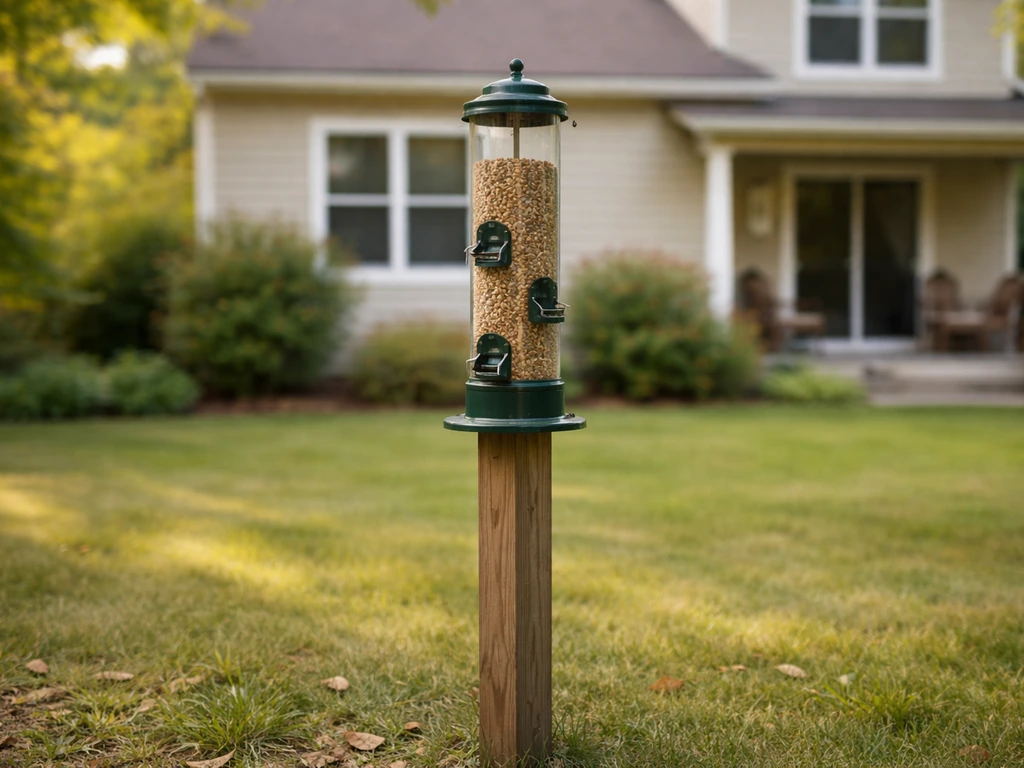
The 3-foot and 30-foot rules explained
The "3 or 30" rule is one of the most well-tested pieces of feeder placement advice out there. Within 3 feet, a bird flushing from the feeder in a panic (triggered by a hawk, a cat, or even just your movement inside) simply can't accelerate to a speed that causes fatal or serious injury before reaching the glass. At 30 feet or more, the bird has enough open space that it can detect the window as an obstacle, or fly a trajectory that keeps it well clear of the house. The Alaska Department of Fish & Game goes slightly further and recommends more than 40 feet for the "far" option, which isn't a bad idea if your yard allows it.
What about when neither option fits your yard? Cornell Lab suggests experimenting around the 10-foot mark as a real-world compromise, and some sources mention that anything beyond about 10 feet starts to reduce risk meaningfully, even if it doesn't eliminate it. In general, a good starting point for height and distance is to place the feeder around the 10-foot mark off the ground while still following the window distance rule. If you're in that awkward middle zone, adding bird-safe window treatments, external markers spaced no more than 2 inches apart vertically and horizontally, becomes essential, not optional.
Why distance actually matters: collisions, cats, mess, and disease
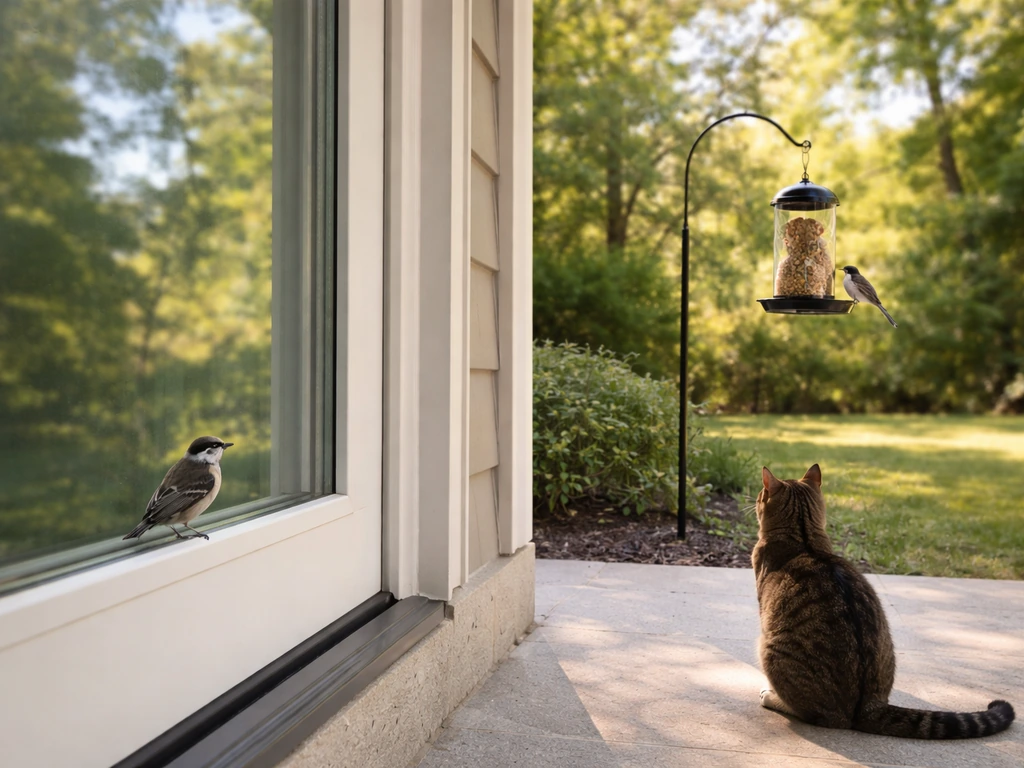
Window strikes are the biggest reason distance rules exist. Birds don't perceive glass the way we do, they fly toward reflections of sky or vegetation in the glass and have no idea there's a solid surface in the way. Putting a feeder at the wrong distance creates a flight path that ends at your window. Across the U.S., this kills hundreds of millions of birds annually, and backyard feeders are a significant contributor.
Cats are the other major hazard, and distance from the house plays into this more than people expect. Outdoor cats, and even indoor-outdoor cats that slip out, tend to use structures like decks, steps, shrub borders, and fence lines as ambush cover. A feeder placed right against the house, tucked into a corner of a deck or porch railing, is basically a gift to a hunting cat. Audubon is direct about this: keeping cats indoors is the most effective protection. Distance from cover matters too, but distance alone doesn't fix a cat problem.
Mess and seed waste are a practical concern, not just an annoyance. Hulls, uneaten seed, and bird droppings accumulate under feeders fast. If your feeder is close to a door, deck, or seating area, that waste ends up exactly where you don't want it. Mold in wet seed attracts rodents and creates real disease risk for birds. And if you have multiple feeders clustered together in one spot, you're concentrating both waste and bird activity in a way that accelerates pathogen buildup. If you have several feeders, keep them from being too close together so birds do not crowd around one spot. Spreading feeders across a few locations, rather than one big station, reduces crowding and helps manage that risk. If you're also dealing with clustering, use this guidance on how far apart should bird feeders be as a practical adjacent check.
Disease transmission between birds increases sharply when large numbers of individuals are feeding shoulder-to-shoulder at a single point. UK best-practice guidance specifically recommends using multiple smaller feeding sites to reduce close contact between species and slow pathogen accumulation. That's worth keeping in mind when you're deciding whether to cluster all your feeders together near the house.
Placement by feeder type and bird species
Not all feeders work the same way, and the birds you're trying to attract often have preferences that should influence where you hang things. Here's how to think about it by feeder type:
| Feeder Type | Target Birds | Best Placement | Distance Note |
|---|---|---|---|
| Tube or hopper feeder | Finches, sparrows, chickadees, nuthatches | Pole-mounted in open yard or on a branch away from dense shrubs | Apply the 3 or 30 rule from nearest window; ideally 10+ feet from fence lines or shrub borders that cats use |
| Platform or tray feeder | Juncos, doves, towhees, jays (ground feeders) | Low, open area; near but not directly under dense vegetation | Cats are a higher risk — keep at least 10–12 feet from shrub borders and fence lines; use baffles |
| Suet feeder | Woodpeckers, nuthatches, chickadees, creepers | Attached to tree trunk or pole, well off the ground (5–6 feet minimum) | Can go closer to the house if the 3-foot window rule is met; less ground-predator exposure |
| Hummingbird feeder | Hummingbirds | Sheltered from wind (swaying spills sugar water); visible from a distance for approach | Must still follow the 3 or 30 window rule; avoid direct deck placement near traffic areas |
Hummingbird feeders deserve a specific note. Because they're filled with sugar solution that spoils quickly, especially in summer heat, placement near the house feels convenient for refilling and cleaning. That's fine, as long as you're following the window distance rule and protecting the feeder from wind. A swaying feeder spills constantly and needs to be replaced much more often. In hot weather, hummingbird feeders need cleaning every 3 to 5 days; a sheltered but accessible spot near the house can actually work well here if the 3-foot rule is met.
Hazards to watch for: windows, decks, shrubs, and fences
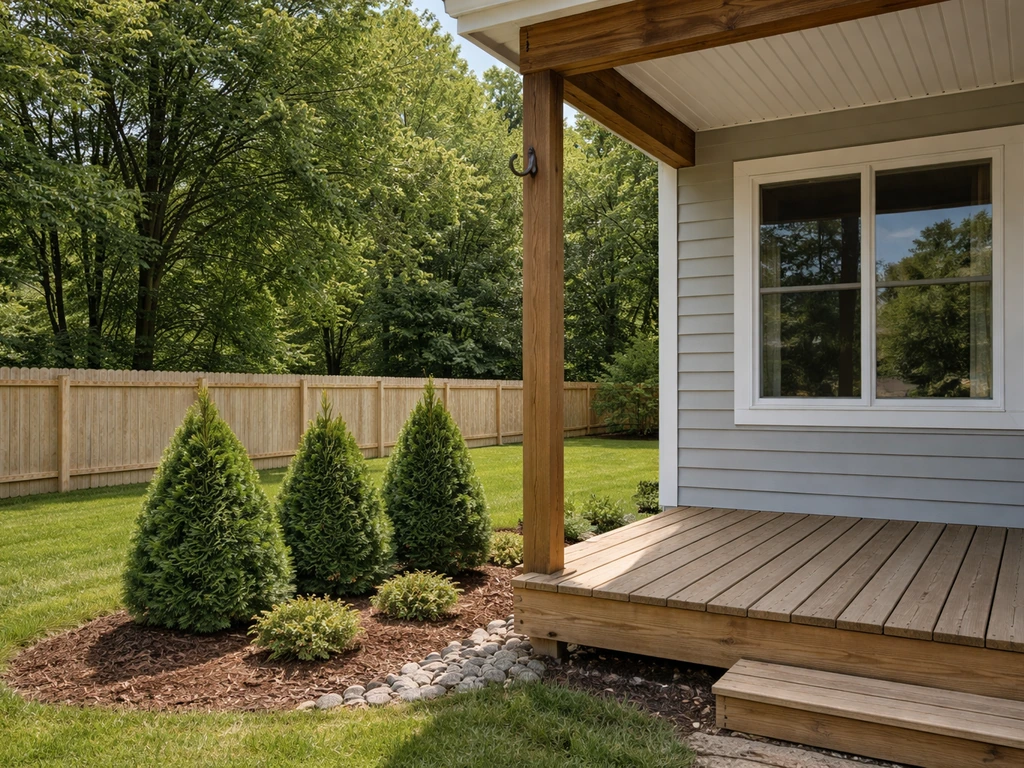
The most common placement mistakes I see involve putting feeders in spots that feel natural to humans but create problems for birds. Here's what to check before you commit to a location:
- Windows: Any window within 4 to 25 feet of a feeder is in the danger zone. Either bring the feeder within 3 feet of that window (window-mount feeders are great for this) or move it to a spot where it's more than 30 feet from any large pane of glass, including sliding doors and picture windows.
- Decks and porches: Feeders directly on deck railings deposit seed hulls and droppings on your deck surface, attract rodents, and put birds in a tight space with little escape room. If you want a deck feeder, a pole-mounted option that keeps the feeder 3 feet or less from your sliding door glass — with the window treated with bird-safe markers — is workable.
- Dense shrubs and hedgerows: Birds need nearby cover to feel safe enough to feed, but dense shrubs within 5 to 6 feet of a feeder are a hiding spot for cats. Aim for light, open cover within 10 to 15 feet — a shrub that birds can perch in but that a cat can't disappear into.
- Fences: Fence lines are natural cat highways. A feeder mounted directly on or immediately adjacent to a fence is asking for trouble. Keep feeders at least 8 to 10 feet from fence lines, or use a squirrel-proof pole with a baffle that also prevents cat climbing.
- Neighboring windows: Don't forget about angled windows on your own house or a neighbor's. A feeder placed in a spot that seems window-free from your vantage point may still line up with a reflective surface from a bird's flight path.
How to actually set it up: height, spacing, and weather
Once you've picked a spot that satisfies the distance rules, the physical setup details matter a lot. For most common setups, the feeder height should be chosen so the birds can feed comfortably while you keep it in a safe location from windows and predators how tall should a bird feeder be. Height, spacing between feeders, and weather exposure all affect how well the location works in practice. If you are wondering whether your feeder is set too high, focus on overall safety and accessibility, not just distance from windows Height, spacing between feeders.
- Height: Most tube and hopper feeders work well at 5 to 6 feet off the ground — high enough to deter cats and squirrels (especially with a baffle), low enough for you to refill without a ladder. Suet feeders can go higher, attached to a tree trunk at 6 to 8 feet. Platform feeders can sit lower, around 3 to 4 feet, but lower = higher cat risk, so use a baffled pole. Height placement is its own topic worth thinking through separately from distance.
- Spacing between feeders: If you're running multiple feeders, give each one at least 10 to 15 feet of separation. This reduces crowding, slows disease spread, and keeps dominant species from monopolizing all your feeders at once. Spreading feeders around different parts of the yard also creates a more varied habitat.
- Aiming away from problem zones: Orient your feeder so that the primary bird approach path doesn't line up with a window or reflective surface. Think about where birds are coming from (usually trees or tall shrubs at the yard's edge) and position so their flight path runs parallel to the house wall rather than toward it.
- Weather exposure: A feeder in a fully exposed location gets wet seed that molds quickly. Some shelter from prevailing wind and rain — under a tree canopy edge, near but not under a roof overhang — extends seed freshness and keeps birds using the feeder longer. Hummingbird feeders especially need wind protection to avoid spilling.
- Clean underneath regularly: Rake or clear seed debris from the ground under feeders every week or two. Wet seed piles are a rodent magnet and a disease source. This matters more the closer the feeder is to your house.
Still having problems? Here's how to adjust
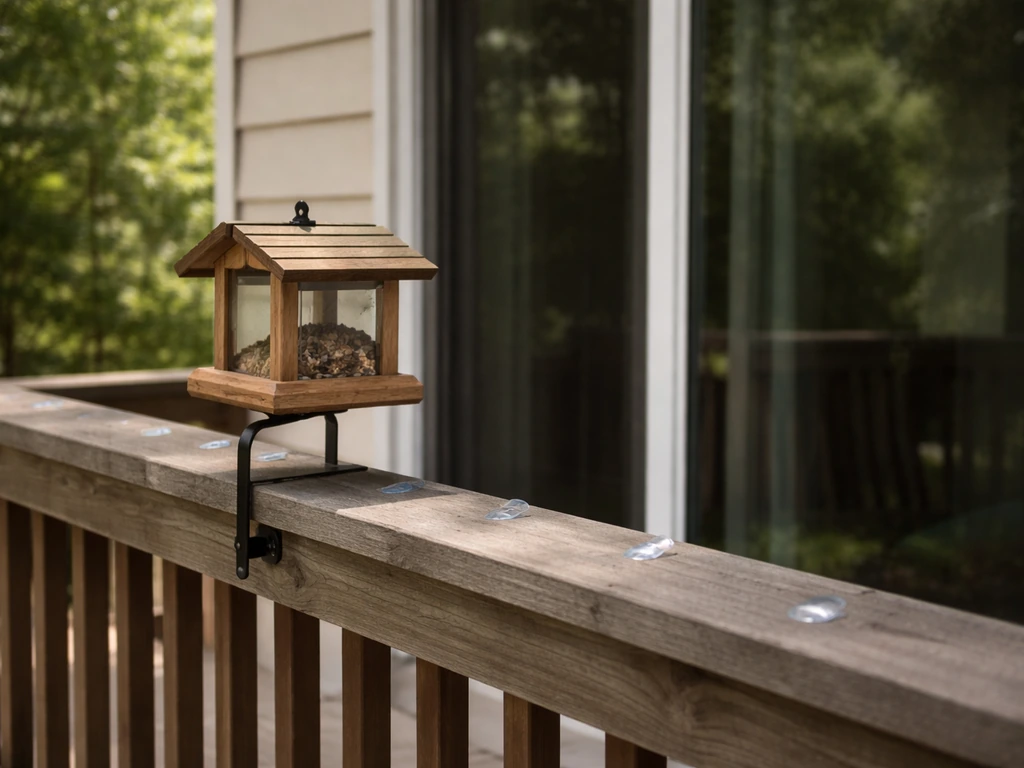
Placement is genuinely a tradeoff, and the first spot you try might not be the right one. Here's how to troubleshoot the most common ongoing problems:
Window strikes keep happening
If birds are still hitting windows after you've moved the feeder, the glass itself is the problem. Add external bird-safe window markers spaced no more than 2 inches apart both vertically and horizontally, that 2x2 inch grid standard comes from FWS and is the threshold at which birds reliably detect the surface as a barrier. UV-reflective decals can also work. Moving the feeder by even a few feet can change the flight path enough to stop strikes, so try nudging position before investing in window treatments.
Cats are getting to the birds
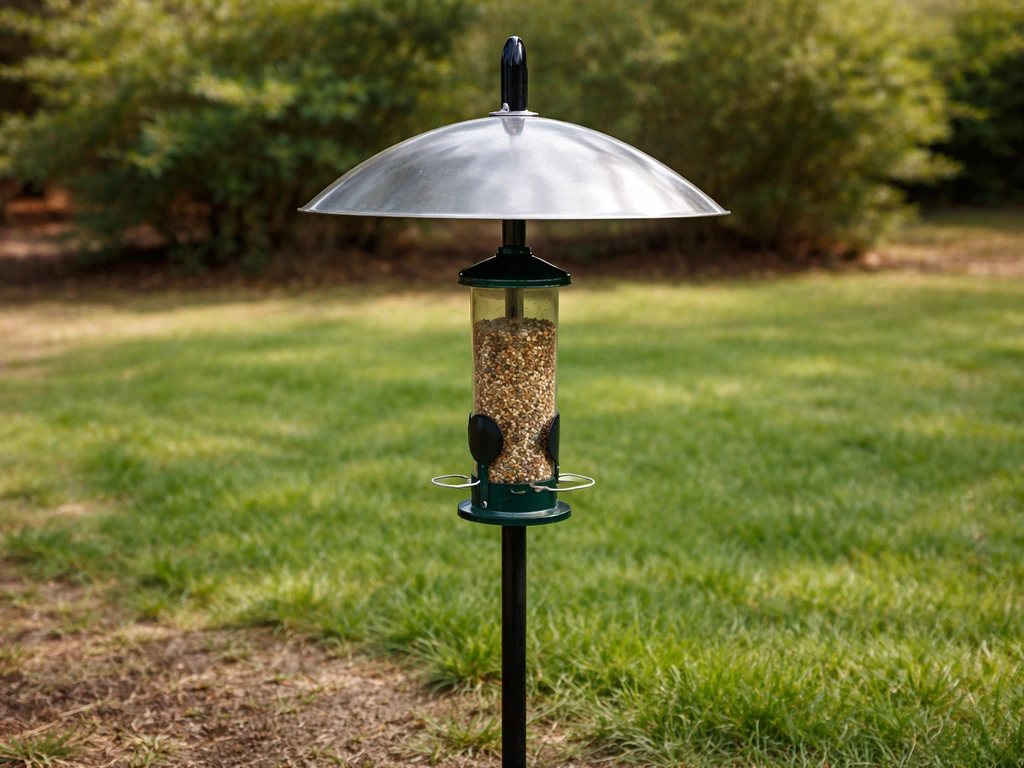
The honest answer here is that distance and baffles help, but they don't fully solve a cat problem when free-roaming cats have access to your yard. A pole-mounted feeder with a smooth metal baffle at least 4 feet off the ground removes the easiest route. Keep feeders away from any low structure that provides stalking cover. Motion-activated deterrents like sprinklers can work at discouraging cats from the feeder zone. If the cat is yours, keeping it indoors, particularly during peak feeding hours in early morning, makes more difference than any feeder repositioning.
Squirrels are eating everything
Squirrels are persistent, and distance from the house doesn't do much to stop them. What works: a baffled pole at least 10 feet away from any structure they can jump from (fence, deck, tree branch), with a feeder weight-sensitive enough to close off ports when a squirrel lands. Caged tube feeders that let smaller birds in but exclude squirrels and larger birds are genuinely effective. If squirrels are leaping from a nearby fence or branch, simply moving the feeder further from that structure by a few feet often solves it.
Too much mess and seed waste near the house
If seed hulls and droppings are accumulating where you don't want them, the fix is usually to move the feeder further from high-traffic areas and switch to no-mess seed mixes (shelled sunflower hearts, for example, leave almost no hull debris). A tray attachment under the feeder catches falling seed and significantly reduces ground mess. Clean the ground underneath every week or two, wet, rotting seed is where rodents and disease risk actually start.
Sick or dead birds near the feeder
If you're seeing sick birds or finding dead ones near the feeder, disease transmission from a dirty feeder or accumulated waste is the likely culprit. Seed feeders should be cleaned roughly once a month with a dilute bleach solution, 1 part bleach to 9 parts water is the standard ratio from Cornell Lab and Flathead Audubon. Hummingbird feeders need cleaning every 3 to 5 days in summer (hot water and dish soap is sufficient; a bleach rinse every week to 10 days per Minnesota DNR is good practice). When a disease outbreak is active in your area, the responsible call is often to take feeders down temporarily, let birds disperse, and deep-clean everything before putting them back up.
Quick placement checklist before you hang the feeder
- Is the feeder within 3 feet of a window, or more than 30 feet away from all large glass surfaces? If neither, treat the nearest window with external markers before proceeding.
- Is there dense shrub or fence cover within 6 feet that a cat could use for ambush? If yes, move the feeder or add a baffled pole.
- Is the feeder at least 10 to 15 feet from other feeders to reduce crowding and disease pressure?
- Is the feeder protected from prevailing wind (especially important for hummingbird feeders)?
- Is there an easy way to clean underneath the feeder regularly — rake access, mulch, or a catch tray?
- Is the feeder height appropriate for the type: 5 to 6 feet for most tube/hopper feeders, lower for platform feeders with a baffle?
- Do you have a cleaning schedule? Seed feeders monthly, hummingbird feeders every 3 to 5 days in summer.
FAQ
If my feeder is 30 feet from the house, can it still cause window collisions if it’s near a specific window?
A feeder that is “far” from the house, but still within about 3 to 10 feet of a window or door line of sight, can still cause strikes. Use the distance rule relative to the glass itself (and reflections), not just how close the feeder is to the main wall.
Does the “3 feet or 30 feet” rule change if birds are spooked often (hawks, cats, people walking)?
Yes, but the key is what birds see and where they fly from. If the feeder is close to a window and a hawk or cat causes frequent panic feeding, the risk behaves more like a “near” placement even if the feeder is not right on the ground.
How far should feeders be from windows in a two-story or multi-window house?
If you live in a multi-story home, treat each window as a separate hazard zone. A feeder on the first floor can still be risky for second-floor windows, especially if birds launch upward, so apply the rule to the closest window plane.
What if my yard has lots of obstacles, like fences or trees between the feeder and the house?
Distance advice assumes there is enough open space to adjust flight. If your yard has obstacles like fences, porches, or tall shrubs that funnel birds toward the house, you may need the “far” end of the range (30 feet, or more) and possibly add bird-safe window markers.
Does feeder type (platform, hopper, ground feeding) affect how you should think about distance from the house?
Some feeders create a more frequent panic landing cycle than others. Ground-feeding, platform, and clustered multiple-port setups can raise close-contact and erratic movement, which can make a marginal distance (like 10 to 20 feet) more problematic than the same distance with a single perch-style feeder.
My yard only allows about 8 to 15 feet. What’s the best next step to reduce risk?
If you can’t reach 30 feet, start by testing around 10 feet as a compromise, then add a safety layer: bird-safe window treatments and avoid placing the feeder in the worst middle zone (5 to 25 feet) where strikes are most likely.
If I add window decals or markers, do I still need to strictly follow the distance rule?
For window strikes, the most effective approach usually combines position and a visible barrier. Don’t assume cleaning or baffles replace window markers, because markers target the glass-detection problem directly.
How far should I move the feeder to fix ongoing window strikes, and should I keep adjusting it?
Moving the feeder even a few feet can change approach angles, but avoid repeated “small nudges” without checking the surrounding line of sight. Pick a direction with more open space and fewer direct reflections, then observe for a few days before making another adjustment.
Do distance recommendations apply the same way to ground feeders or seed scattering?
If you’re using a tray, ground feeder, or scatter feeding, window-distance guidance alone may not be enough because birds may repeatedly hop and restart near the house. Increase separation from both the house and any low cover, and reduce the time food sits on the ground.
Can I place a hummingbird feeder near windows for convenience, and what else should I watch for?
If you’re feeding hummingbirds near the house, the practical target is still window safety, but also choose a spot protected from strong wind so the feeder doesn’t swing toward glass. In summer, plan cleaning every 3 to 5 days, and keep the feeder accessible so you can follow both safety and hygiene.
How do I balance window safety with cat safety if my best feeder spot is near a porch, fence, or bushes?
Yes. A feeder that is “far” from the house but placed right next to a deck corner, railing, or shrub line can be easy for cats to ambush, which often leads to repeated panic runs that also increase collision risk.
If squirrels keep attacking the feeder, does repositioning it closer to the house make sense?
If squirrels are using nearby branches or fences to launch, distance from the house may not solve it. Use a baffled pole placed far from jumping points, and ensure the feeder stays stable so it doesn’t swing into a window line.
Next Articles
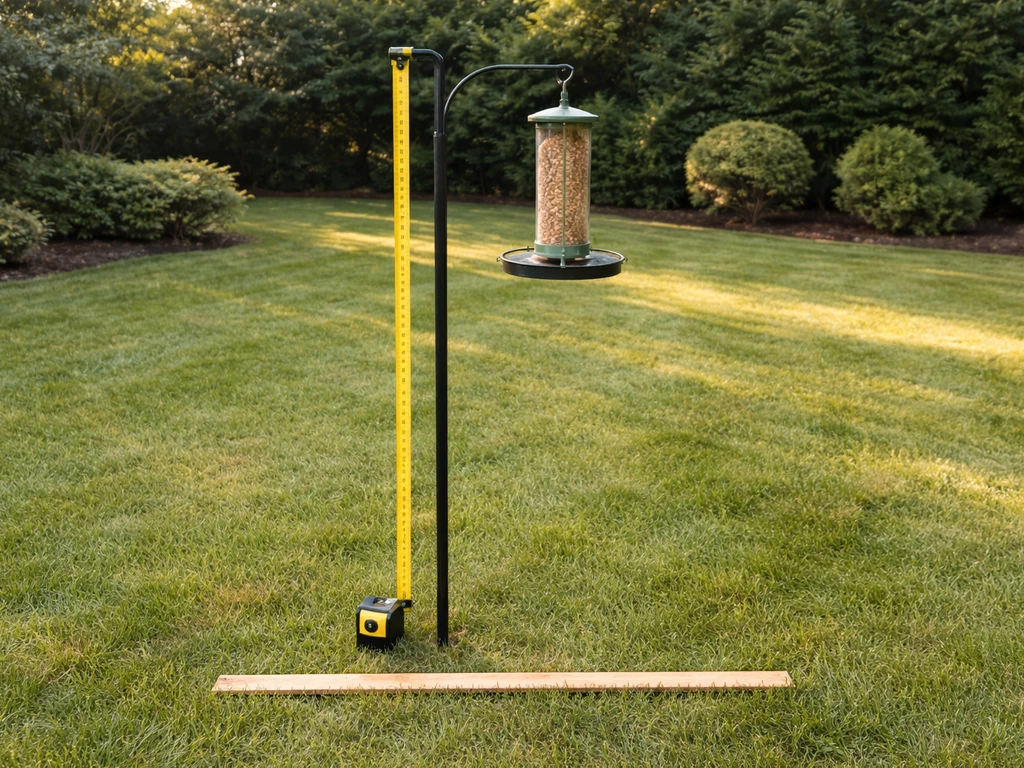
How Tall Should a Bird Feeder Be? Exact Placement Guide
Get exact feeder and pole height for your yard, with measurement steps, predator safety, and troubleshooting tips.
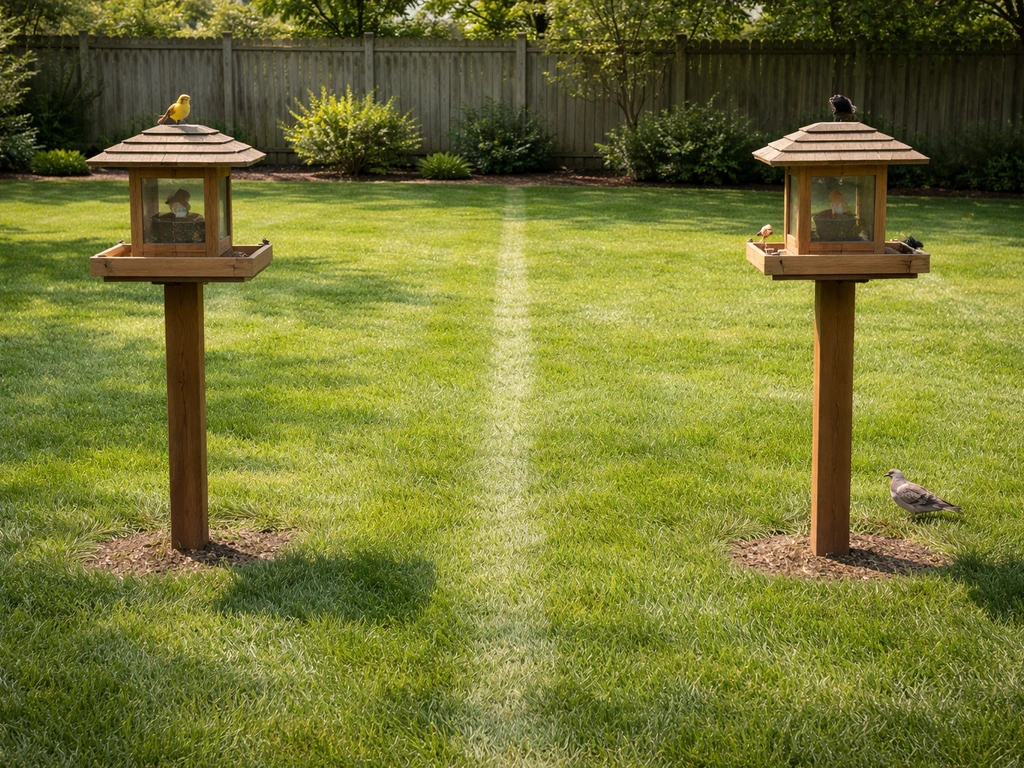
How Far Apart Should Bird Feeders Be From Each Other
Get the ideal feeder-to-feeder spacing to cut chasing, overcrowding, and mess while keeping birds safer.
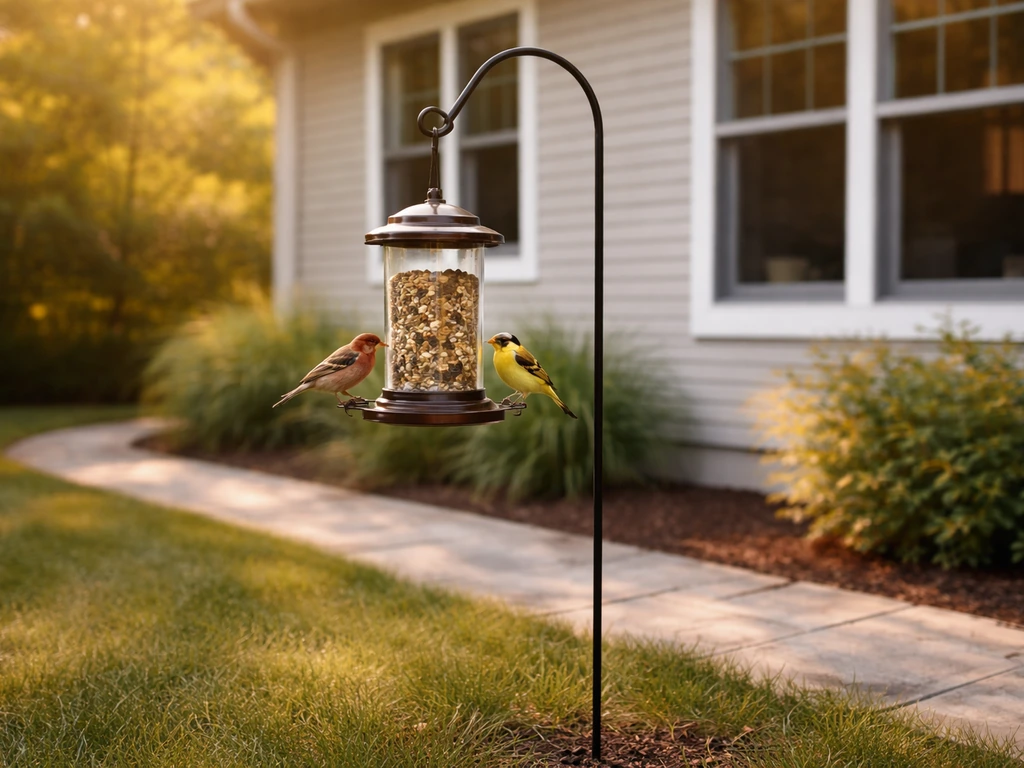
Can a Bird Feeder Be Too High? Placement Guide
Bird feeder height tips to avoid low or too-high placement, reduce cat predation and window collisions, and attract more