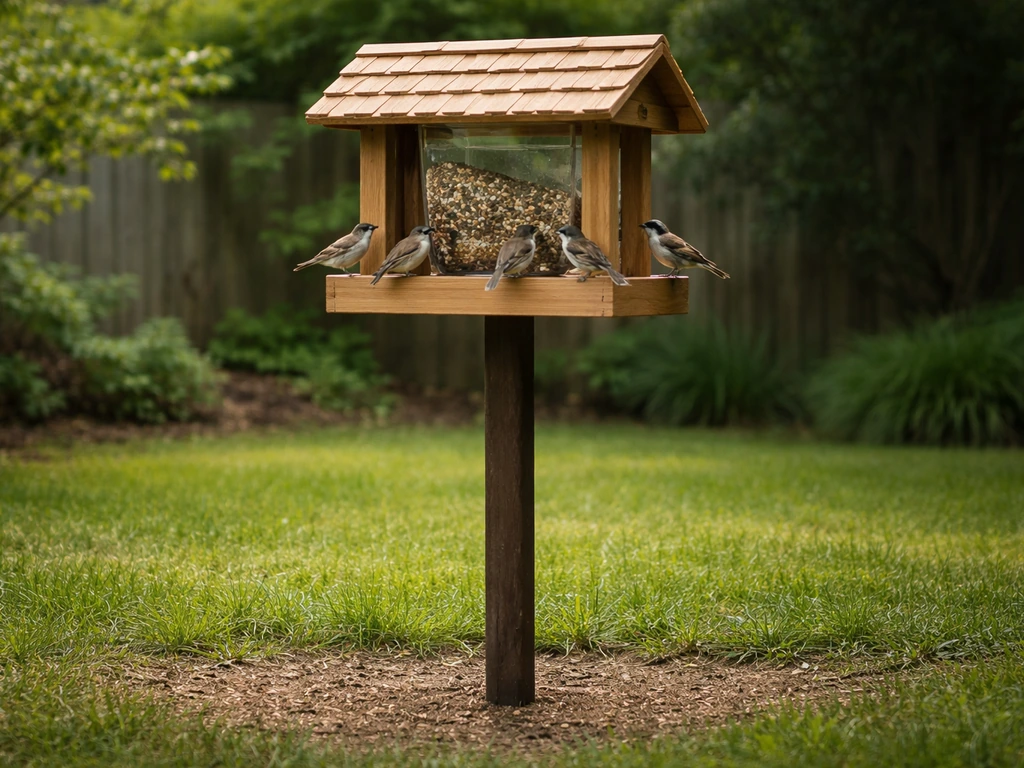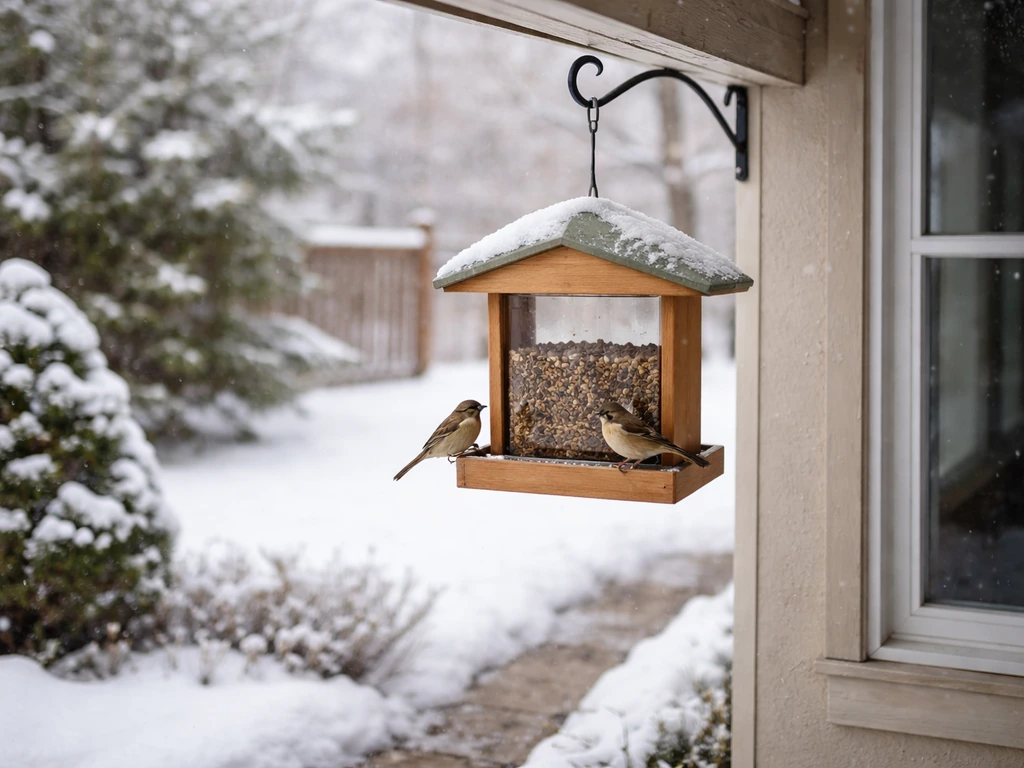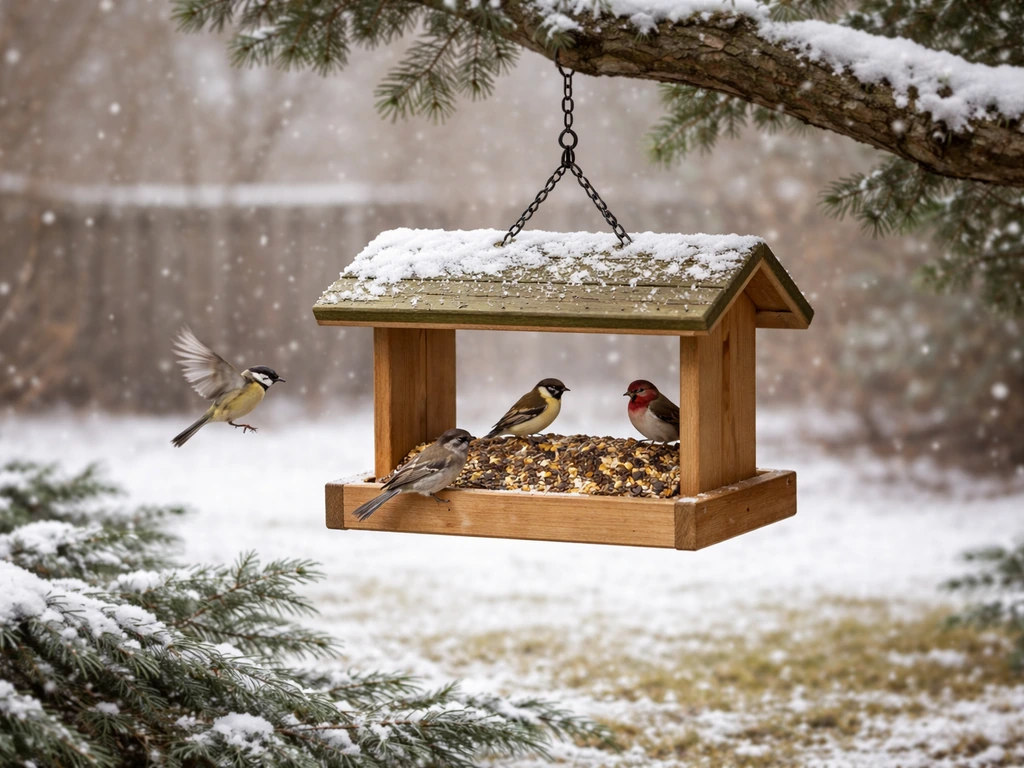
Yes, a bird feeder can absolutely be too high, and it can also be too low. The sweet spot for most setups is roughly 5 to 6 feet off the ground for hanging or pole-mounted feeders, far enough to deter cats and ground predators but low enough that birds feel comfortable approaching and you can actually maintain the thing. Going much higher than 8 or 9 feet tends to reduce visits from many common backyard species, while a feeder sitting under 4 feet is practically an invitation for cats, raccoons, and squirrels. The right height for your situation also depends on feeder type, nearby windows, and what birds you're trying to attract, so read on for the full breakdown.
Can a Bird Feeder Be Too High? Placement Guide

Eleanor Hartwick
2 May 2026
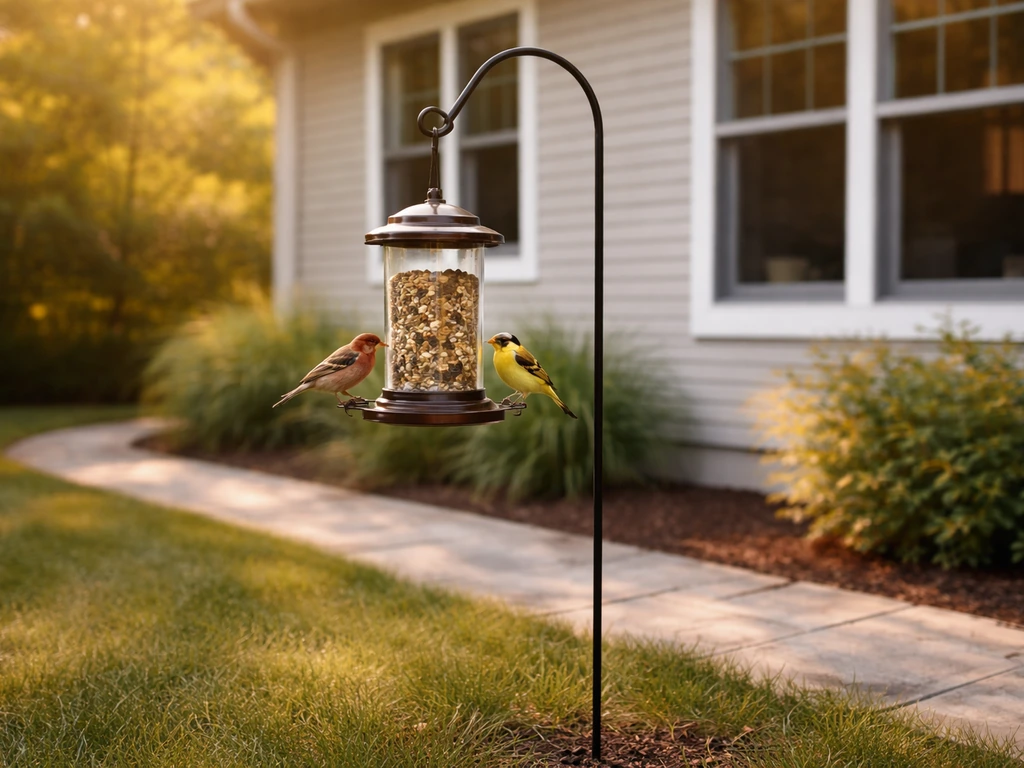
How height affects bird access and feeding comfort
Height changes the feeder's entire dynamic, not just whether squirrels can reach it. Birds that feed in the wild at mid-canopy level, like chickadees, nuthatches, and finches, feel most comfortable approaching a feeder that mimics that zone. Very high feeders (above 10 feet) can feel exposed to these species because there's no nearby cover to duck into quickly.
On the other end, some birds, including doves, juncos, towhees, cardinals, and blue jays, naturally feed at or near the ground, and they'll often ignore a feeder entirely and just eat the seed that falls underneath it. That's not a problem per se, but it means your feeder height is actually influencing which birds use the feeder directly and which ones just forage below.
Comfort matters a lot here. Birds won't use a feeder where they feel vulnerable. If a feeder is placed very high with no nearby shelter and an open drop below it, skittish species will pass it by. If it's very low and surrounded by dense ground cover, that cover helps cats and other predators stage an ambush. Height and surrounding vegetation work together, and neither factor operates in isolation.
Signs your feeder is too low vs too high
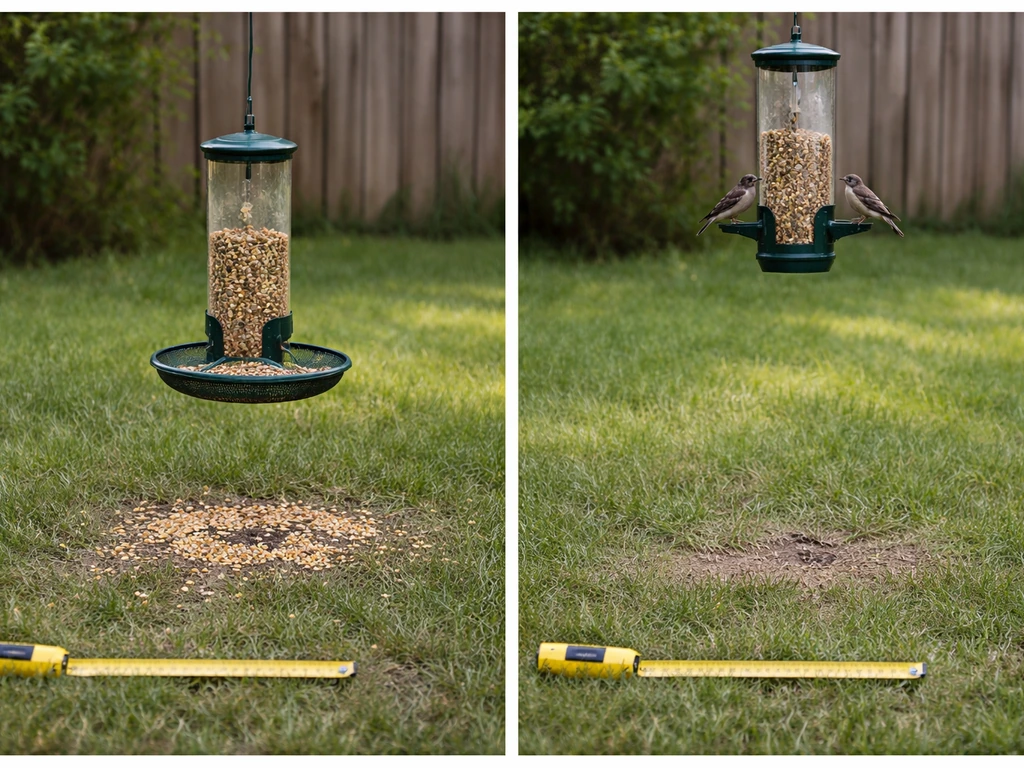
Before you move anything, watch for a few days and look for these patterns. They'll tell you more than any tape measure.
| Problem | Likely Sign | Cause |
|---|---|---|
| Feeder too low | Seed disappears overnight, feeder knocked over or damaged | Raccoons, opossums, or cats reaching it from the ground |
| Feeder too low | Birds feeding only on spilled seed below, ignoring the feeder | Ground predator activity is making the feeder feel unsafe |
| Feeder too low | You notice cat tracks or disturbance in the area around the pole | Cats stalking birds using the feeder as a hunting station |
| Feeder too high | Feeder goes untouched for days despite birds in the yard | Birds aren't comfortable making the approach or landing |
| Feeder too high | Only larger, bolder species visit (crows, starlings, grackles) | Smaller birds deterred by exposure or difficult flight path |
| Feeder too high | You can't refill or clean it easily, so maintenance slips | Practical access issue that leads to moldy, unsafe seed |
One sign that's easy to misread: birds visiting the ground under a feeder but not the feeder itself doesn't always mean height is wrong. Some species like Song Sparrows, Fox Sparrows, and towhees genuinely prefer ground-level foraging and will always eat fallen seed regardless of where you hang the feeder. But if you're seeing zero visits to the feeder from birds that should be using it, height and placement are worth revisiting.
Recommended height ranges by feeder type
There's a useful framework sometimes called the 5-7-9 rule: place feeders at least 5 feet off the ground, at least 7 feet from any structure (house, fence, deck), and at least 9 feet from overhead branches or jump points. That's a solid starting point for squirrel deterrence, and it also puts most feeders in a range birds find comfortable. Here's how that maps to specific feeder types.
Tube feeders
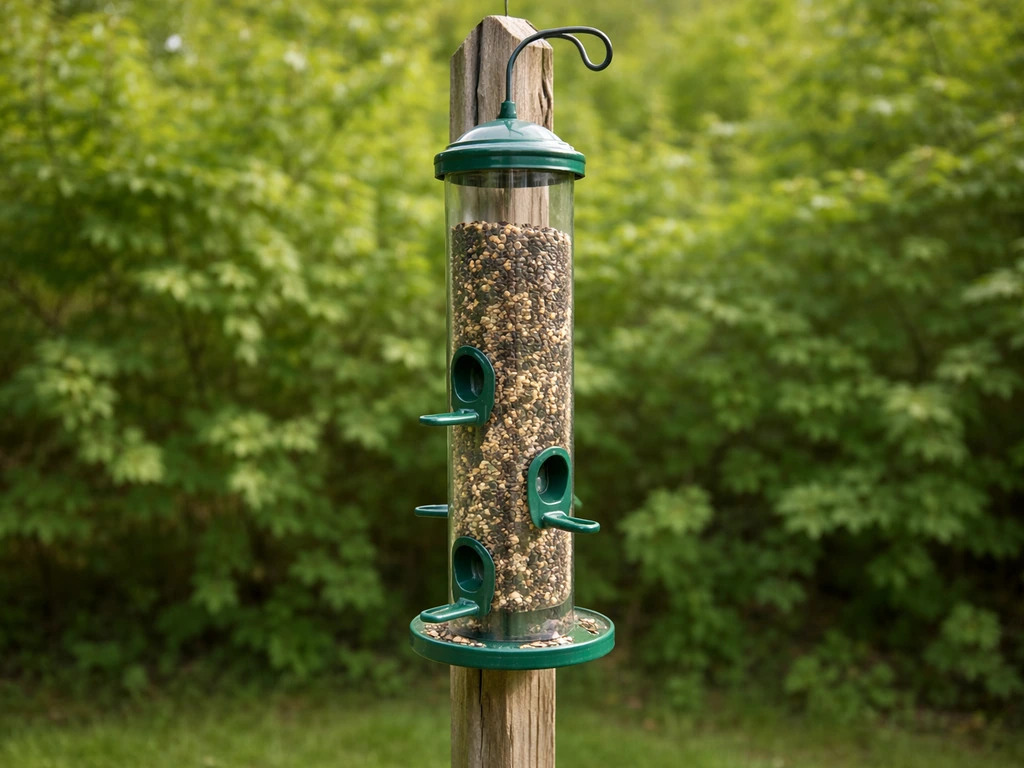
Tube feeders are typically hung from hooks or poles and are designed for clinging birds like finches, chickadees, and nuthatches. A hanging height of 5 to 6 feet works well for most yards. If you're hanging from a tree branch, aim for that 5-foot floor with 9 feet of horizontal clearance from the trunk so squirrels can't make the leap. These feeders are often the most versatile in terms of height because the birds they attract are comfortable at a range of heights, but going higher than 8 feet tends to reduce casual visits.
Hopper feeders
Hopper feeders attract a broader range of species including cardinals, woodpeckers, and jays. They're usually pole-mounted or hung, and 5 to 6 feet is again the practical sweet spot. Because hoppers tend to be heavier and bulkier, hanging them very high makes maintenance awkward and can cause swinging in wind that discourages some birds. If you're using a pole setup with a baffle, the baffle top should sit at least 4 feet from the ground with the feeder another foot or so above that.
Platform and tray feeders
Platform feeders are a special case. They're designed for ground-preferring species, and Michigan DNR recommends placing them at least 5 feet off the ground when pole-mounted, even though the birds they target naturally feed lower. The reason is predator safety: a platform at 18 inches is essentially a buffet for cats. If you want to attract doves and juncos specifically, a low platform (under 3 feet) can work, but only in an open area where cats and other predators can be spotted from a distance, and with no nearby shrubs or structures to hide behind. For most yards, keeping even platform feeders at 4 to 5 feet is the safer call.
| Feeder Type | Recommended Height | Notes |
|---|---|---|
| Tube feeder (hung) | 5–6 feet | Up to 8 feet is fine; beyond that, expect fewer visits |
| Tube feeder (pole-mounted) | 5–6 feet | Add pole baffle at 4 feet from ground |
| Hopper feeder (pole-mounted) | 5–6 feet | Keep baffle top at 4+ feet; feeder above that |
| Platform/tray feeder (pole) | 4–5 feet minimum | Open location; 10+ feet from shrubs for predator safety |
| Suet cage (hung or mounted) | 5–7 feet | Woodpeckers comfortable higher; avoid low-hanging near fences |
| Ground-level tray | Ground to 18 inches | Only in open areas; high predator risk; use with caution |
Safety factors: predators, traffic, and collisions
Cats and ground predators
Cats kill more than 2.5 billion birds per year in the U.S. and Canada. That number alone is a good reason to take feeder height seriously as a safety factor. A feeder at or below 4 feet, especially one close to shrubs, fences, or any object a cat can crouch behind, is a hunting station. blank" rel="noopener noreferrer">Audubon recommends placing feeders in open locations at least 10 feet from the nearest shrub, giving birds enough visibility and space to detect and escape an attack. Height works with that open placement: a 5-foot pole in the middle of a lawn is much safer than a 6-foot feeder hanging 2 feet from a hedge.
Window collisions
Window placement matters more than most people realize, and it interacts with feeder height if your feeder is near a window or reflected glass surface. If you're wondering whether a bird feeder is too close to the house, re-check the distance from windows and walkways as part of your placement plan. The rule here is consistent across Cornell Lab, Audubon, U. S.
Fish & Wildlife Service, and others: place feeders either within 3 feet of a window or more than 30 feet away. The reasoning is momentum-based. A bird flushed from a feeder less than 3 feet from glass won't have enough runway to hit the window fatally. A feeder more than 30 feet away is far enough that birds won't confuse the reflection for open space.
The danger zone is 3 to 30 feet: birds can build up enough speed in that range for a fatal collision. This applies vertically too. A feeder mounted high on a post near a second-story window is still dangerous if it falls in that 3-to-30-foot window zone horizontally.
High-traffic areas
A feeder hung at head height over a path, patio, or driveway is a practical hazard for the people walking by. If you're placing a feeder near a frequently used area, either go high enough to clear foot traffic comfortably (at least 7 feet if it's over a walkway) or move it to a less trafficked spot. The same logic applies to kids' play areas: a low-hanging feeder with seed debris around it attracts rodents and can become a source of conflict.
Perch design, guards, baffles, and the other factors height can't fix alone
Height is one variable, but it works much better when paired with the right hardware. A feeder at 5 feet on a smooth metal pole with a properly installed baffle is far more predator-resistant than the same feeder at 8 feet on a wooden post near a tree. Here's what actually makes the difference.
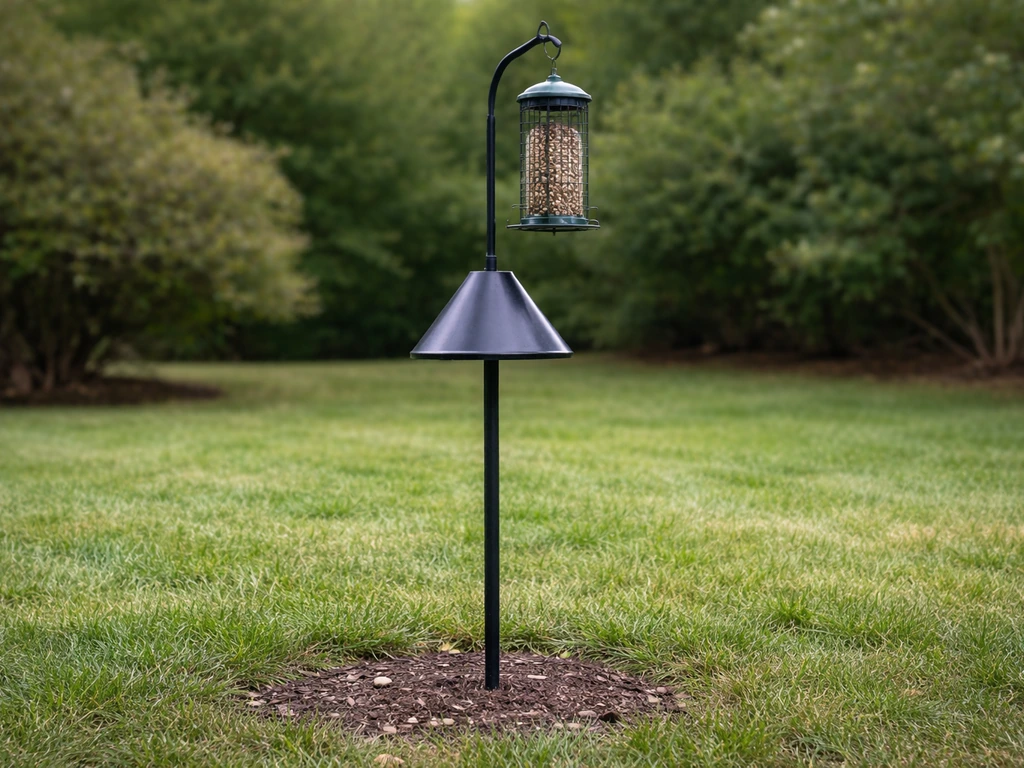
- Pole baffles: A cylindrical or dome-shaped baffle mounted on the pole below the feeder physically blocks squirrels and raccoons from climbing up. The baffle top should sit at least 4 feet from the ground, with the feeder above that. Placement matters: a baffle that's too low on the pole can still be bypassed by a jumping squirrel.
- Hanging baffles: For feeders suspended from a hook or branch, a dome baffle hung above the feeder prevents squirrels from descending to it. These need to be wide enough (at least 15–18 inches in diameter) to prevent side access.
- Ant moats and inline guards: Products like inline ant guards mount between the hook and the feeder, blocking ants before they reach the food. Correct vertical placement (above the feeder, below the hook) is essential for these to work.
- Cage-style guards: Wire cage surrounds on feeders exclude larger birds and squirrels while letting small songbirds through. These work at any height but are especially useful when height alone isn't enough to deter animals.
- Perch design: Shorter perches or weight-sensitive perches (which close under a squirrel's heavier weight) can limit who feeds regardless of height. Some birds like finches are comfortable on very short perches; others like cardinals prefer wider, more stable landing areas.
- Cover distance: Audubon recommends at least 10 feet of open space between the feeder and the nearest shrub or dense cover. This isn't about height but about giving birds a clear sightline to detect cats before they can pounce.
The distance to other feeders is worth mentioning too. If you're running multiple feeders, spacing matters for reducing competition and disease spread between birds, but that's its own placement topic. If you’re trying to support a healthier bird ecosystem, spacing multiple feeders farther apart can also help reduce crowding and the spread of disease how far apart should bird feeders be. The key point here is that height works best as part of a complete setup, not as the only adjustment you make.
How to fix your feeder height today: a step-by-step approach
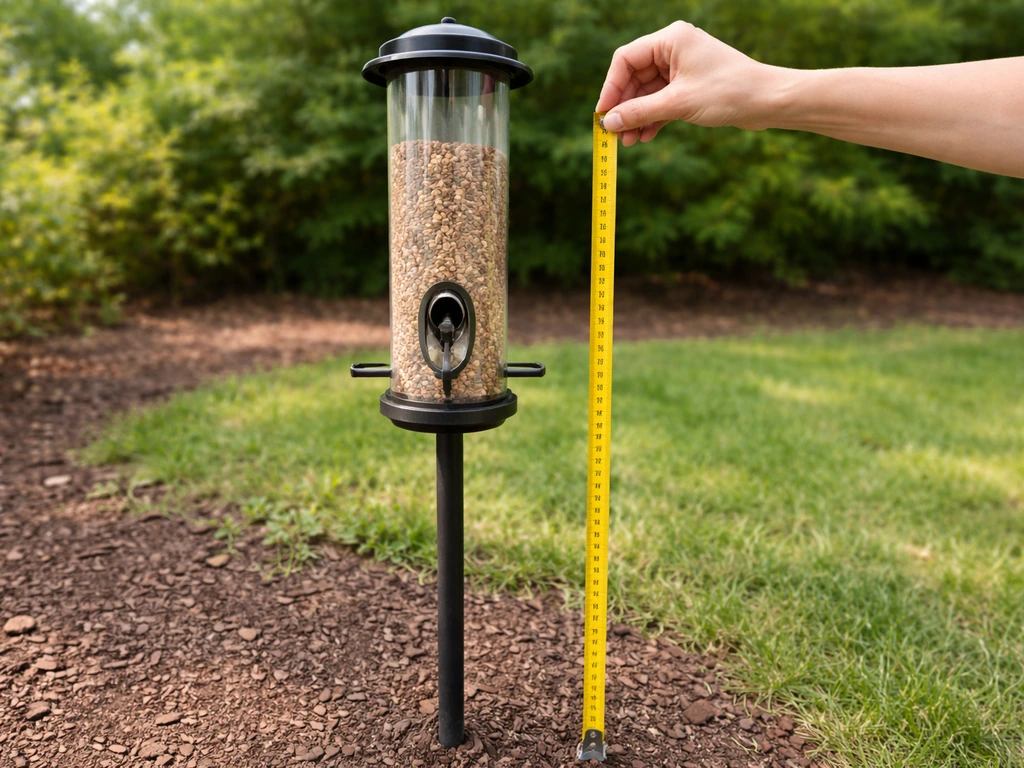
If you think your feeder is at the wrong height, here's how to diagnose and fix it without overthinking it.
- Measure the current height. Use a tape measure from the ground to the feeder's feeding ports (not the top of the hook). Write it down.
- Check the window distance. Measure horizontally from the feeder to the nearest window. If it's between 3 and 30 feet, that's your collision risk zone regardless of height. Plan to move the feeder or relocate it closer to or farther from the glass.
- Look for predator evidence. Scan the ground for cat tracks, disturbed soil, feathers, or signs of nocturnal visitors (knocked-over feeder, seed scattered in one direction). If you see these, height needs to come up and the location may need to shift.
- Check for nearby jump points. Stand at the feeder and look for branches, fences, deck railings, or roof overhangs within 9 feet horizontally and overhead. Squirrels can leap impressive distances; anything within that radius is a potential access route.
- Adjust the height. If you're on a pole, reposition the feeder to sit between 5 and 6 feet at the feeding ports. If you're hanging from a tree branch, use a longer hook or reposition to a branch that gives you 5 feet of drop clearance and at least 9 feet from the trunk.
- Install or reposition the baffle. If you have a pole baffle, confirm the top of the baffle is at least 4 feet off the ground. If you have a dome hanging baffle, make sure it's wide enough and positioned directly above the feeder.
- Watch for 3 to 5 days. New placements often take a few days for birds to find and trust. Resist moving it again in the first 48 hours unless there's an obvious safety problem.
If you're starting from scratch with a new pole setup, the 5-7-9 rule is your baseline: 5 feet off the ground, 7 feet from any structure, 9 feet from overhead branches. That gets you to a safe, functional starting point for almost any yard.
Seasonal considerations and monitoring bird response
Feeder height isn't something you set once and forget. A few seasonal factors are worth watching throughout the year.
Winter
In winter, feeders become more important to many species and bird traffic increases. Snow and ice can change predator behavior too: cats and hawks hunt more aggressively when other food is scarce. This is a good time to double-check that your feeder is still at 5 feet or above (snow accumulation can effectively raise the ground level near the pole base, shrinking the predator-deterrence gap) and that shrubs and cover near the feeder haven't become hiding spots under snow cover. Frozen ground also means spilled seed sits around longer and attracts more ground-level predators.
Spring and summer
In summer, many songbirds shift to eating more insects to feed their young, so feeder visits naturally drop even when your setup is perfect. Don't interpret a summer slowdown as a height or placement problem. What does matter in summer is vegetation: shrubs, hedges, and trees that were bare in winter are now full, which can change both the cover dynamics around your feeder and the potential jump routes for squirrels. Re-check those 9-foot clearance distances once trees leaf out. Summer is also when window reflections are strongest on sunny days, so if you're seeing increased window strikes, the feeder-to-window distance becomes more critical.
Tracking what's actually working
The most useful thing you can do is observe rather than assume. Spend a few minutes a day for the first week after any placement change and note what species visit, at what times, and whether any predator activity increases or decreases. If you move a feeder up and visits drop, consider whether surrounding cover changed at the same time, or whether the new location has lost the windbreak or shelter birds were relying on.
If visits increase after moving a feeder down closer to the ground, keep a close eye on cat and predator activity for a week before deciding that lower position is working long-term. The feeder's relationship to nearby windows is also worth checking again seasonally, since new fences, garden structures, or even a parked vehicle can change the effective sightlines and reflection patterns birds encounter.
FAQ
If my feeder is a little higher than 8 feet, will birds stop coming completely?
Not always. Many yards still get visits, but you usually see fewer “casual” species and shorter visit durations. The bigger risk with very high placement is reduced escape options, so watch whether birds pause briefly and then disappear instead of feeding repeatedly.
Does “too high” change by feeder type, or is there one height that always works?
It changes. Tube and hopper feeders often tolerate the same general range, but platform feeders behave differently because they attract ground-preferring birds and sit closer to cat attack range. If you have a platform feeder, treat 4 to 5 feet as a safer ceiling unless your setup is very open and you can deter predators.
What if I’m getting birds under the feeder but not feeding from it, is the height definitely wrong?
Not definitely. Some species naturally eat fallen seed and will ignore the feeder by design, so you may be seeing normal foraging behavior. A better test is to compare feeder usage across multiple days and weather, and see whether any birds ever land on the feeder itself after the seed supply settles.
How close to shrubs should a feeder be if I’m trying to keep it safe from cats?
Height helps, but shrub proximity matters even more. If cats can crouch near cover, a “safe” height can still create a hunting station. Use open space as your default, and if shrubs are unavoidable, increase the distance and add a baffle on the supporting pole.
Can a tall feeder be safer for predators but still dangerous for window collisions?
Yes. Window safety depends on distance to glass (including reflections), not just height. A feeder that is high on a post near a window can still be in the 3 to 30 foot danger band if the horizontal distance puts birds into a collision-prone runway.
What height should I use if the ground around the pole is uneven or covered in snow?
Account for the effective ground level. Snow and drift can raise the “approach surface” for ground predators, shrinking your deterrence gap even if the pole height is correct, so re-check placement after heavy snow and ensure base clearances stay similar.
Is it better to raise the feeder or add a baffle if I’m getting squirrels climbing it?
Add a properly installed baffle first if the feeder is on a smooth pole, because it blocks the climb path rather than relying on birds adjusting to a higher, more exposed perch. If you change height, do it gradually and verify that the new location still has adequate clearance from branches and structures.
How can I tell whether my feeder height is causing less bird activity versus just seasonal changes?
Look at timing and species mix before changing anything. If winter traffic increases but summer feeder visits drop, that often reflects seasonal diet shifts rather than placement. Only treat height as the suspect if bird behavior changes immediately after a move and persists for several days.
Should feeder height be adjusted for kids, pets, or walkways in the area?
Yes. If the feeder hangs over a frequently used path, low placement creates a people hazard and can also increase seed debris that attracts rodents. Either move the feeder to a less trafficked spot or raise it to clear foot traffic comfortably (at least about 7 feet over walkways).
If I have multiple feeders, does height affect disease risk or competition?
Height alone cannot solve disease spread, but it can influence how closely birds congregate at one spot. When spacing multiple feeders, keep both vertical and horizontal separation in mind so birds do not cluster at the same access points, and monitor whether one feeder becomes the dominant crowding location.