
About 10 feet between feeders is the sweet spot most bird feeding researchers and experienced backyard birders land on. Cornell Lab's Project FeederWatch calls it "a good compromise," and in practice it's enough distance that a dominant bird can't easily guard two feeders at once, but close enough that you can fit multiple stations in a typical yard without spreading them across half an acre.
How Far Apart Should Bird Feeders Be From Each Other

Eleanor Hartwick
14 May 2026
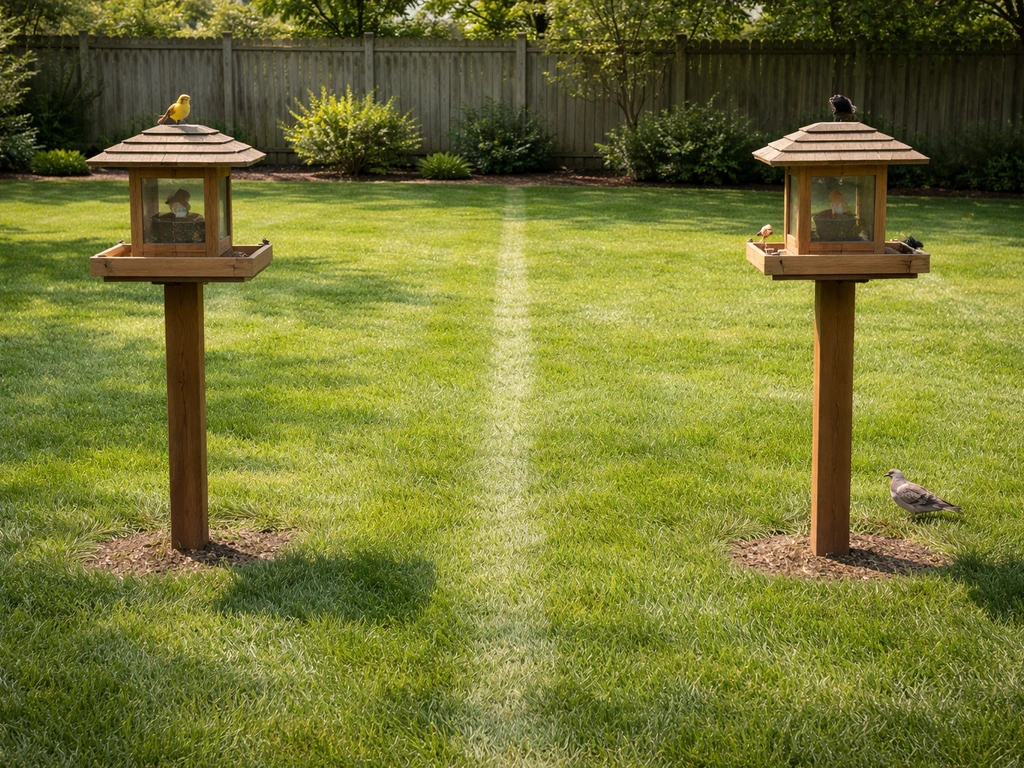
The 10-foot rule and when to stretch it
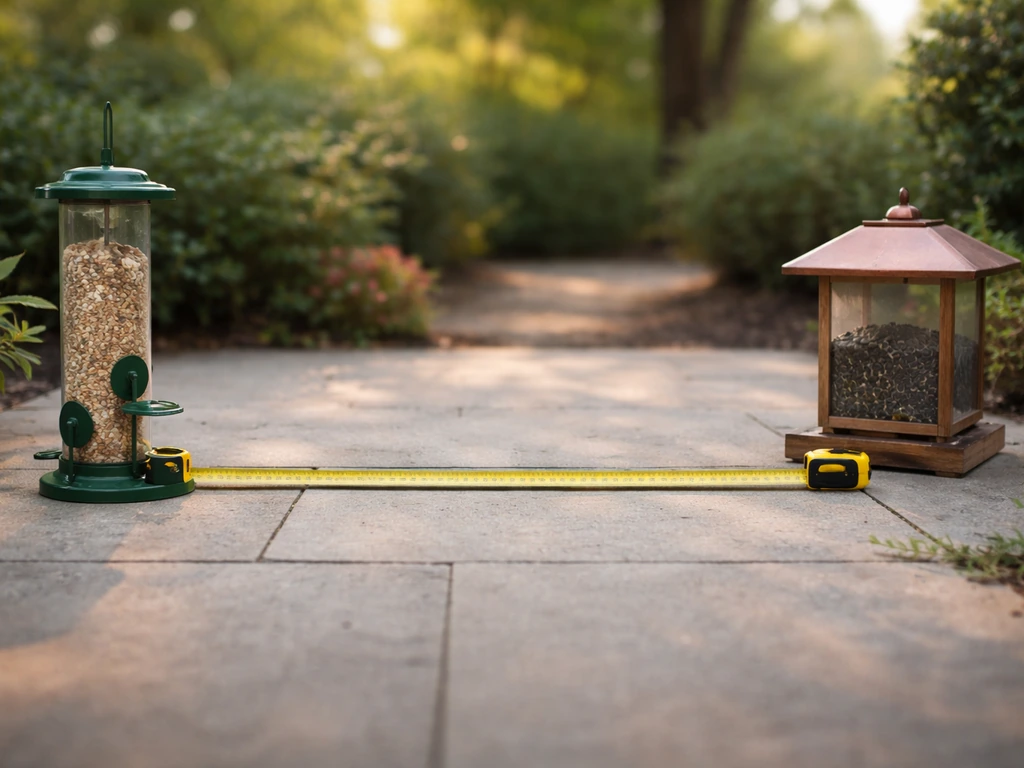
Ten feet is a starting point, not a law. The reason it works is behavioral: most feeder-dominant birds (house sparrows, starlings, blue jays, red-bellied woodpeckers) will claim one feeder and attempt to defend a small radius around it. At 10 feet, a second feeder sits just outside what they can realistically patrol, so smaller or subordinate birds get a fair shot at the other one. Go much closer than 6 to 8 feet and one aggressive bird can bounce between feeders fast enough to bully everything else. Push past 15 to 20 feet and you're essentially running separate feeding stations with independent bird populations, which is fine if you have the room, but unnecessary if space is tight.
If you're dealing with especially territorial species, like mockingbirds or certain woodpeckers, bumping spacing to 15 feet helps a lot. For milder, flock-oriented birds like finches or chickadees, tighter spacing around 8 feet usually works fine because they don't defend feeders the same way.
Matching spacing to feeder type and bird behavior
Feeder type matters almost as much as raw distance. A tube feeder full of nyjer seed and a suet cage draw completely different birds with completely different social behaviors. Finches at a tube feeder are relatively tolerant of crowding, while woodpeckers at a suet cage can be proprietary and aggressive. Pairing those two feeder types and putting them 10 feet apart almost always works well, because you're not pitting the same species against itself.
Where you run into trouble is putting two identical feeders loaded with the same food side by side. If both feeders have black-oil sunflower seed, you'll attract the same dominant species to both, and the more aggressive birds will spend their time patrolling between the two rather than eating. Either vary what you put in each feeder or increase the spacing to at least 15 feet so the territory is genuinely too large to defend.
| Feeder pairing | Recommended minimum spacing | Why it works |
|---|---|---|
| Tube (nyjer) + Suet cage | 8 feet | Different species, low competition |
| Two platform feeders (same seed) | 15+ feet | Same dominant birds compete heavily |
| Tube feeder + Platform feeder | 10 feet | Partial species overlap, moderate competition |
| Hummingbird feeder + Seed feeder | 6 feet | Totally separate birds, minimal conflict |
| Two hummingbird feeders | 10–15 feet | Hummers are highly territorial with each other |
Hummingbird feeders deserve a special note: hummingbirds are among the most aggressive feeder defenders pound for pound. If you hang two nectar feeders within 6 feet of each other, one bird will often try to own both. Space them 10 to 15 feet apart, or even better, place them so they can't see each other (around a corner or on opposite sides of a shrub). Out of sight really does mean out of mind for hummingbirds.
Working with small yards and odd layouts
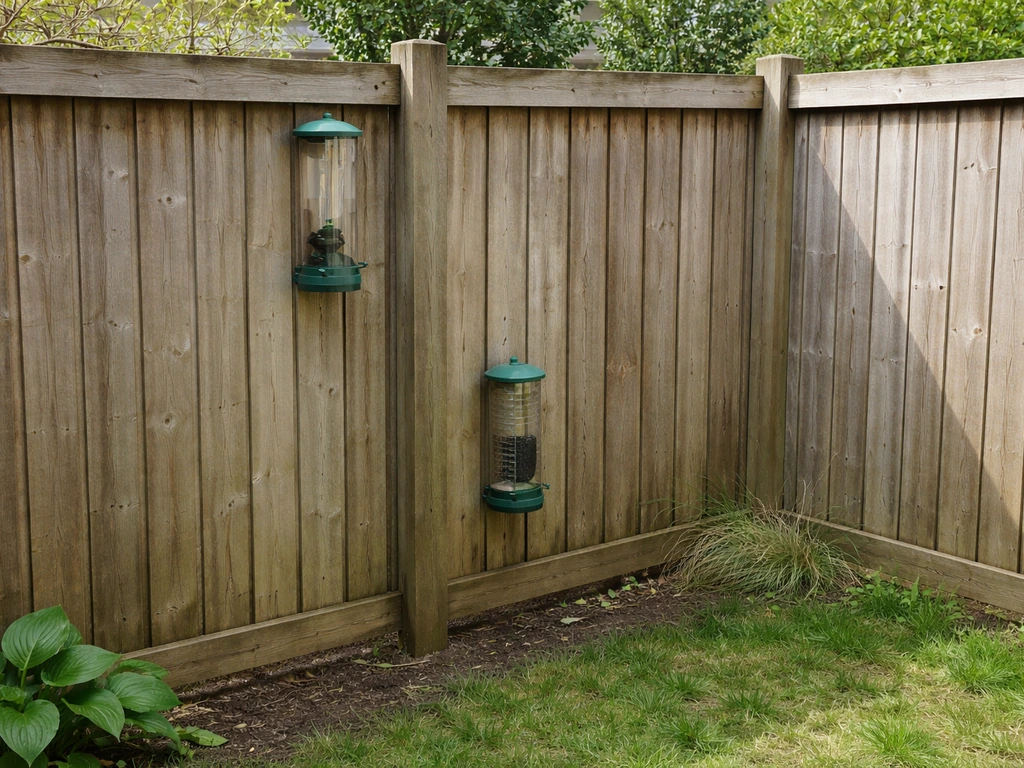
Not everyone has a sprawling backyard to work with. If your space is small or irregular, 10 feet between every feeder simply isn't possible. Here's how to make the best of it.
- Use vertical separation: mount one feeder higher than another. Birds treat height as distinct territory, so a feeder at 5 feet and one at 10 feet feel more separate than two at the same height side by side.
- Use vegetation as a visual barrier: a dense shrub or trellis between two feeders that are only 6 or 7 feet apart can break line of sight and significantly reduce territorial behavior.
- Place feeders on different structures: one on a pole in the yard, one hanging from an eave or fence. The different positioning cues feel like separate feeding zones to the birds.
- Stick to complementary feeder types (different seeds, different designs) so you're not inviting the same species to compete for the same resource in tight quarters.
- Along a fence line, stagger feeder heights rather than spacing them all at the same level and distance.
One thing worth flagging: if you're placing feeders near windows, the spacing question overlaps with window collision safety. A feeder very close to a window (within about 3 feet) is actually safer from a collision standpoint because birds can't build up dangerous speed, while a feeder 10 to 30 feet away is the danger zone for impacts. Beyond 30 feet is considered safe. So if your small yard means feeders end up close to the house, that's actually not the worst outcome for bird safety, but it does raise other issues like mess near doors and windows. In general, you should also consider how far the feeders are from the house to balance bird comfort and safety. That's a whole separate topic worth thinking through alongside spacing.
How to measure and place multiple feeders step by step
- Start with one feeder in your best existing spot, somewhere with nearby cover (a shrub or tree within 10 feet for shelter) and good visibility for you. This becomes your anchor feeder.
- Measure 10 feet out from that feeder in the direction you want to place the next one. A tape measure works, but pacing it out (roughly 3 to 4 adult steps) is close enough for practical purposes.
- Check that the new location has its own landing zone: a branch, shepherd's hook, or fence post where birds can perch and wait their turn. A feeder with no nearby perch gets less traffic.
- If you're adding a third feeder, measure 10 feet from the second, not from the first. You're creating a chain or cluster, not radiating out from a single center point.
- Before you finalize a location, note the window distances. If a feeder ends up 10 to 30 feet from a large window, consider adding window decals or moving the feeder slightly closer or farther to get out of the collision risk zone.
- Mark each spot loosely (a garden stake works) and live with the layout for a week before committing to permanent poles or hooks. Bird traffic will tell you quickly whether a location is actually good.
Fine-tuning once birds start showing up
The first placement is always a hypothesis. Watch what actually happens for a few days after you set up multiple feeders and you'll learn more than any guideline can tell you. All About Birds (Cornell Lab) similarly recommends experimenting with feeder placement by observing how birds respond after you set up multiple stations watch what actually happens. Here's what to look for and what to do about it.
If one feeder is packed and the other is ignored, the ignored feeder is probably in a less comfortable location: too exposed, too close to foot traffic, too far from cover, or simply offering food the birds at that site don't prefer. Try moving it closer to natural cover or switching the seed type before increasing spacing.
If you see a lot of chasing and birds being driven off repeatedly, that's a sign your spacing is still too tight for the dominant species in your yard, or that you have two feeders with too much food overlap. Increase spacing by 3 to 5 feet, or swap one feeder's seed for something the bully species isn't interested in (nyjer attracts finches but most sparrows and jays ignore it).
If you notice birds clustering on the ground beneath one feeder but ignoring it directly, the feeder perches might be too small or too crowded. Ground feeding isn't necessarily bad, but a pile of waste seed on the ground under a single feeder is a disease risk and can attract rodents. Spreading feeders out distributes the mess and reduces that buildup under any one spot.
Traffic will also shift by season. In winter, more birds concentrate at feeders and spacing that was fine in summer may feel cramped. In spring and early summer, territorial behavior peaks for resident birds and your spacing may need to increase temporarily. Check your setup again as seasons change rather than treating it as a one-time decision.
Common mistakes that mess up feeder spacing
Clustering too many feeders in one zone
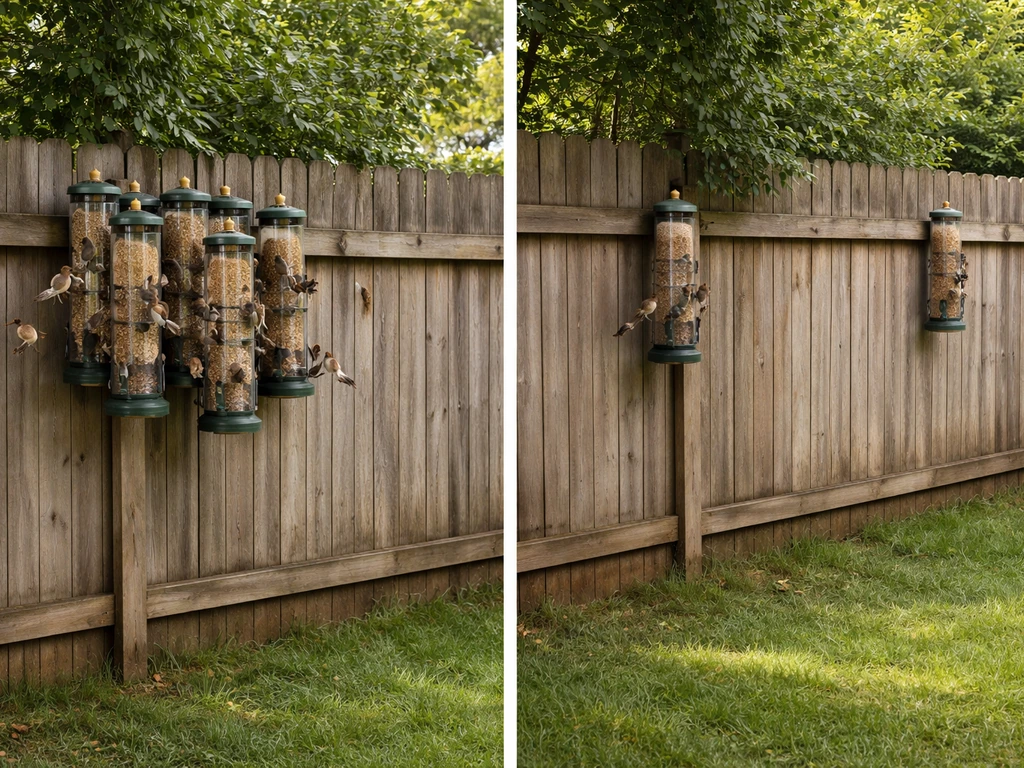
It's tempting to hang four or five feeders in the most convenient corner of the yard, but concentrating everything in one area defeats the purpose of having multiple feeders. Disease spreads more easily when many birds gather at a tight cluster of feeders: droppings and seed hulls accumulate in one spot, and sick birds can expose every feeder visitor in a short time. Penn State Extension and other university-based guidance on feeder hygiene consistently points to crowding as a key disease risk factor. Spreading feeders across your yard distributes the traffic and the mess.
Identical feeders with identical food
Two identical feeders 10 feet apart, both filled with sunflower seeds, will still see a dominant bird trying to control both. Vary the feeder types and contents so you're drawing different species or at least reducing the motivation for any one bird to guard multiple feeders.
Ignoring height as a variable
Most spacing advice focuses on horizontal distance, but vertical distance matters too. Two feeders at the same height feel closer to birds than two feeders at different heights, even if the horizontal gap is the same. Mixing heights is especially useful in small yards where horizontal spacing is limited. How high a feeder should be off the ground is worth thinking through separately, since height affects both species access and predator safety. If you find yourself asking can a bird feeder be too high, it helps to balance bird access with safety from predators and how much the feeder is sheltered from wind. In general, aim to place your bird feeder at a height that keeps it reachable for birds but discourages predators from getting close How high a feeder should be off the ground.
Setting it and forgetting it
Placement isn't a one-time task. Feeders that work beautifully in October may cause constant conflict in April when territorial behavior ramps up. Plan to reassess your layout at least twice a year, and move things around when you notice problems rather than waiting for the situation to stabilize on its own. Most spacing issues are fixable with a 3 to 5 foot adjustment in the right direction.
FAQ
If I have only a few feet of space, what spacing strategy works best for multiple feeders?
Start by using fewer feeders at once, then spread them as far apart as you can while also varying feeder types or food. If horizontal distance is tight, try placing feeders at different heights and, when possible, break lines of sight with shrubs or by positioning them on different sides of an object so birds cannot easily patrol both.
How do I know my feeders are too close, even if I followed the 10-foot rule?
Watch for repeated chasing at the feeders (not just one brief scuffle), dominant birds spending long periods hovering near one feeder and then rapidly switching to the other, and one feeder staying consistently underused. If the underused feeder stays ignored for several days, adjust spacing by 3 to 5 feet or change seed so the dominant species has less reason to defend both.
Does distance matter less if I use different food types in each feeder?
Distance still matters, but different food can reduce “guarding motivation.” Pairing distinct feeder types helps, because birds that compete at one feeder may not be equally interested in the other. If both feeders use very similar foods, even 10 feet may be insufficient for the most aggressive species to stop trying to control both.
Can two feeders be close if they are not visible to each other?
Yes, that can make close spacing more workable, especially for hummingbirds. Using vegetation, corners of a fence, or placing feeders on opposite sides of a shrub can reduce line of sight, which lowers the chance a defender will attempt to own multiple stations.
Should I measure feeder spacing from the hanging point, the tray edge, or the closest seed ports?
Measure the distance between the nearest parts the birds use, typically the perches or where they access the food. For overlapping “patrol zones,” the relevant distance is how close the feeding points are, not the distance between hooks or supports.
Does spacing advice change for feeder stations that include ground feeding trays or spilled seed?
Yes. If seed waste accumulates under one feeder, it concentrates food and increases crowding, which can raise disease and rodent risk. In that case, prioritize spreading the feeders so waste is distributed, and keep platforms and trays cleaned regularly rather than relying on spacing alone.
What should I do if dominant birds keep chasing at both feeders, but I cannot increase spacing?
Reduce overlap by changing one feeder’s food or feeder style so the bully species is less attracted to both. You can also reduce the time birds spend at your site by keeping feeders clean, avoiding overfilling, and adjusting what you offer so smaller or subordinate species have a reason to visit the less defended station.
Is it better to use more spacing or more feeders in the same area?
More spacing across the yard is usually better than stacking many feeders into one cluster. When birds gather tightly, droppings and hulls build up in one spot, increasing disease risk and making it easier for dominant birds to coordinate control. If you must cluster, consider fewer feeders per cluster and clean more frequently.
How often should I re-evaluate feeder spacing after moving them?
Reassess after a few days of normal activity, then again as seasons shift. Territorial intensity changes in spring and early summer, and winter crowds can make spacing that felt fine in summer suddenly feel cramped, so plan at least two checks per year and adjust when conflict starts.