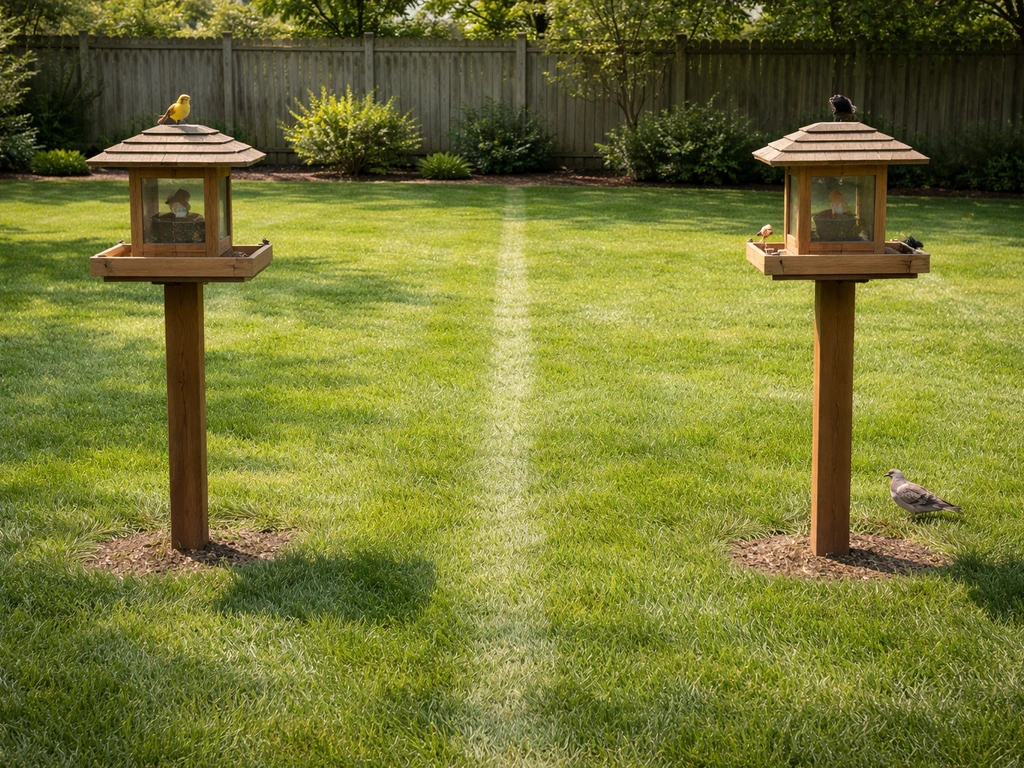
For most setups, aim to position the bottom of your feeder somewhere between 4 and 6 feet off the ground. That puts it out of easy reach for ground-level predators, within comfortable sightlines for the birds you want to attract, and at the right height for a squirrel baffle to actually work. If you're using a pole, a 5-foot pole with about a foot buried in the ground gets you right into that sweet spot. Those numbers won't be perfect for every yard or every feeder type, but they're a reliable starting point you can adjust from.
How Tall Should a Bird Feeder Be? Exact Placement Guide
Eleanor Hartwick
22 May 2026
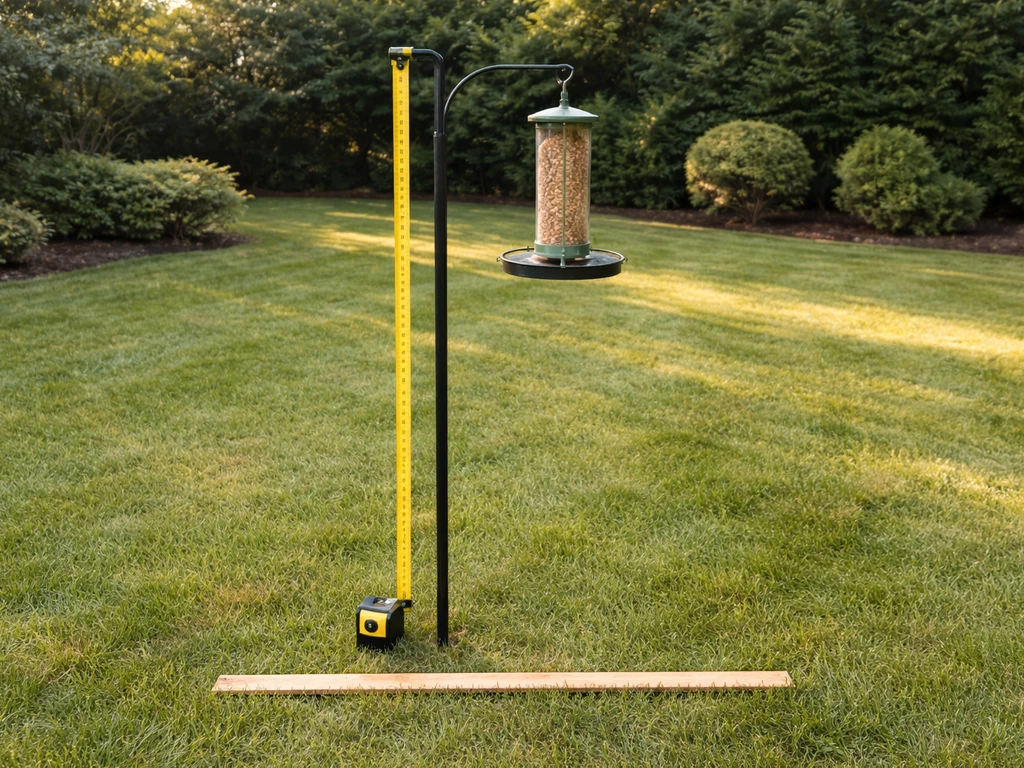
The numbers: feeder height and pole height at a glance
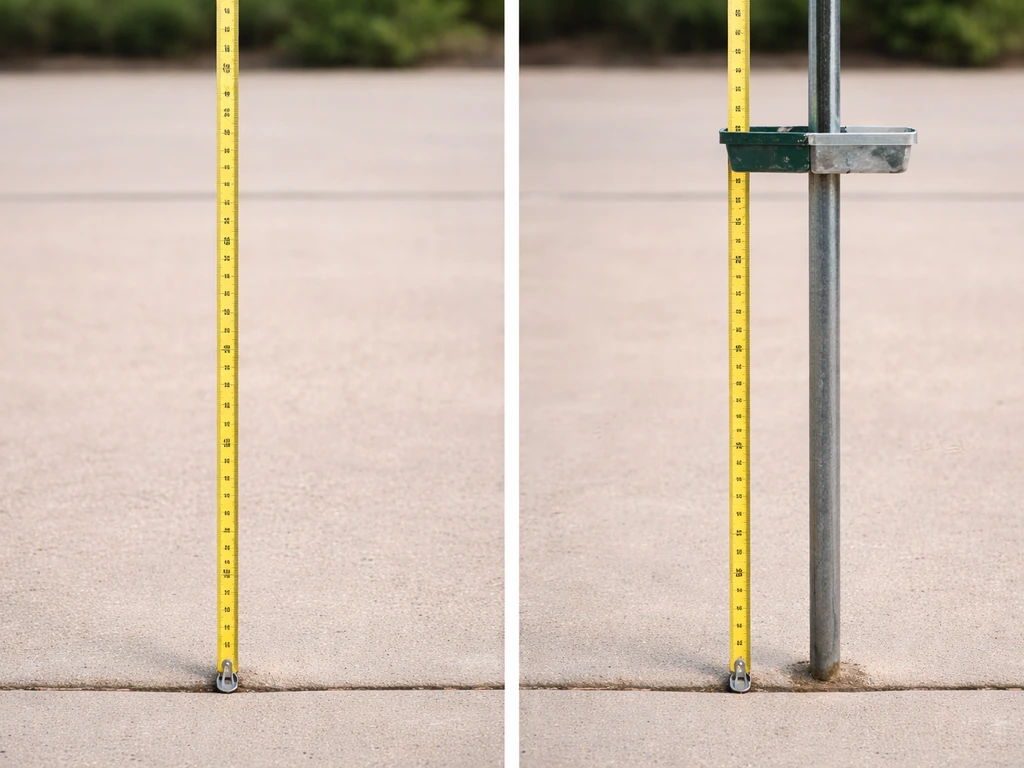
There are two measurements people mean when they ask about feeder height: the height of the feeder above the ground, and the length of the pole or hook you need to get there. They're related, but they're not the same thing, and it helps to keep them separate in your head.
For the feeder itself, 4 to 6 feet off the ground is the practical target for most seed feeders. The bottom of the feeder (not the top, not the hook) should sit in that range. Five feet is a good default if you're not sure where to start. For hummingbird feeders, 4 to 7 feet works well, with 5 to 6 feet being the most commonly recommended range for easy access and predator deterrence.
For the pole, a commonly sold 5-foot shepherds hook or mounting pole gets you close if you're setting it directly into soft ground. But most poles need to be set about a foot into the ground for stability, which means a 5-foot pole leaves the mounting point at roughly 4 feet, and your feeder ends up a bit higher once you add the feeder body itself. If you want the bottom of the feeder at 5 feet, plan on a pole that's closer to 6 feet total before it goes in the ground. Always measure from the ground to the bottom of the feeder body, not to the top of the pole.
| Feeder Type | Recommended Height (bottom of feeder) | Notes |
|---|---|---|
| Standard seed feeder (pole-mounted) | 4–6 feet | 5 feet is a reliable default; pairs well with a baffle |
| Thistle / nyjer feeder | ~5 feet | Audubon specifically cites a 5-foot pole for thistle feeders |
| Hummingbird feeder | 4–7 feet | 5–6 feet is the sweet spot for most yards |
| Suet cage | 5–6 feet | Slightly higher helps woodpeckers feel secure |
| Ground or tray feeder | Ground level to 2 feet | Use thorny branch barriers or wire mesh around base |
How to measure correctly before you install
A lot of people measure to the top of the pole or the top of the feeder and then wonder why birds seem uncomfortable or squirrels keep getting in. The measurement that matters is from the ground to the bottom of the feeder body. That's the point closest to the ground, which determines whether a cat can bat at birds landing on it and whether a squirrel baffle will work.
- Decide on your target feeder-bottom height (start with 5 feet if you're unsure).
- Measure the length of your feeder from the hanging hook down to the lowest point of the body.
- Subtract that feeder length from your target height to find where the hook or mounting point needs to be.
- Add about 12 inches to your pole length to account for the section buried in the ground.
- Mark that height on your pole before you drive it in, and verify the final measurement with a tape measure once installed.
- If using a squirrel baffle, confirm the top of the baffle sits at least 4 to 5 feet above ground after everything is in place.
It sounds fussier than it is. Once you do it once, it takes about five minutes. The key habit is always measuring from the ground to the feeder bottom, not to any other point on the setup.
Adjusting height by bird type and feeder style
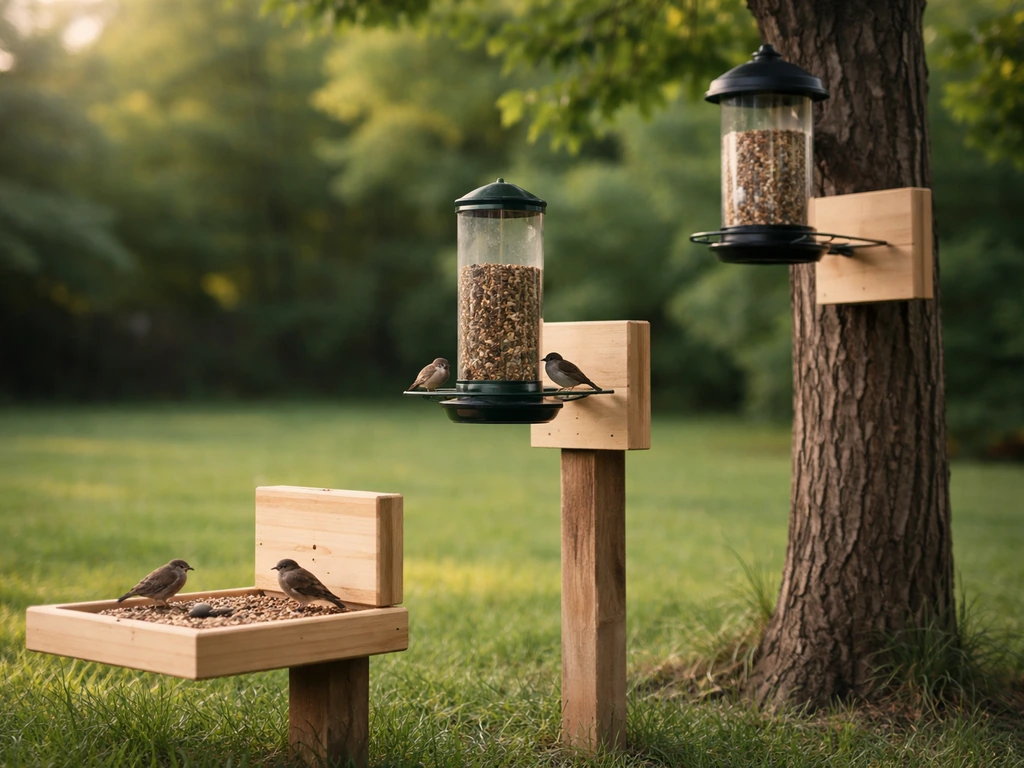
Different birds naturally feed at different heights in the wild, and your feeder height can influence which species show up. Ground-feeding birds like mourning doves, sparrows, towhees, and juncos prefer to feed at or near ground level. You can use a low tray or scatter seed on the ground for them, but if you do, protect the area with thorny branches or low wire mesh to give birds a moment to react to approaching predators.
Most songbirds, including chickadees, nuthatches, finches, and cardinals, will use feeders comfortably at 4 to 6 feet. Cardinals in particular seem more relaxed at mid-height with some shrub cover nearby. Woodpeckers often prefer suet cages mounted a bit higher, around 5 to 6 feet, and against or near a tree trunk if possible since that mirrors how they naturally forage.
Hummingbirds are flexible but benefit from feeders positioned at eye level or slightly above, roughly 4 to 7 feet, in a spot where you can watch them easily (they seem to tolerate human proximity better than most birds). If you're hanging from a porch overhang or tree branch, check that the feeder swings freely and won't bang against a wall or trunk in a breeze.
Hanging feeders from a tree branch introduce a different challenge: squirrel access. If you go the tree-branch route, you need at least 12 feet of clear horizontal distance from the nearest trunk or limb, which is genuinely hard to achieve in most yards. A freestanding pole in the open is usually easier to squirrel-proof than anything hanging from a tree.
Using height to keep cats out and squirrels off
Height alone won't solve your predator problems, but it helps a lot when combined with the right accessories and spacing. Here's what the research and experience actually support.
Cats and ground predators
A feeder at 4 to 5 feet gives birds enough elevation that a cat can't easily swat at them while they feed. But height only protects feeding birds, not birds that land nearby. The stronger protection comes from location: keep feeders at least 10 feet from shrubs, dense plantings, or anything a cat could use to crouch and ambush.
A good rule of thumb is to keep feeders at least 10 feet away from the kind of hiding cover near the house that cats and other predators can use at least 10 feet away from shrubs, dense plantings, or anything a cat could use. Open ground around the feeder gives birds time to see and react to a predator on approach.
Squirrels
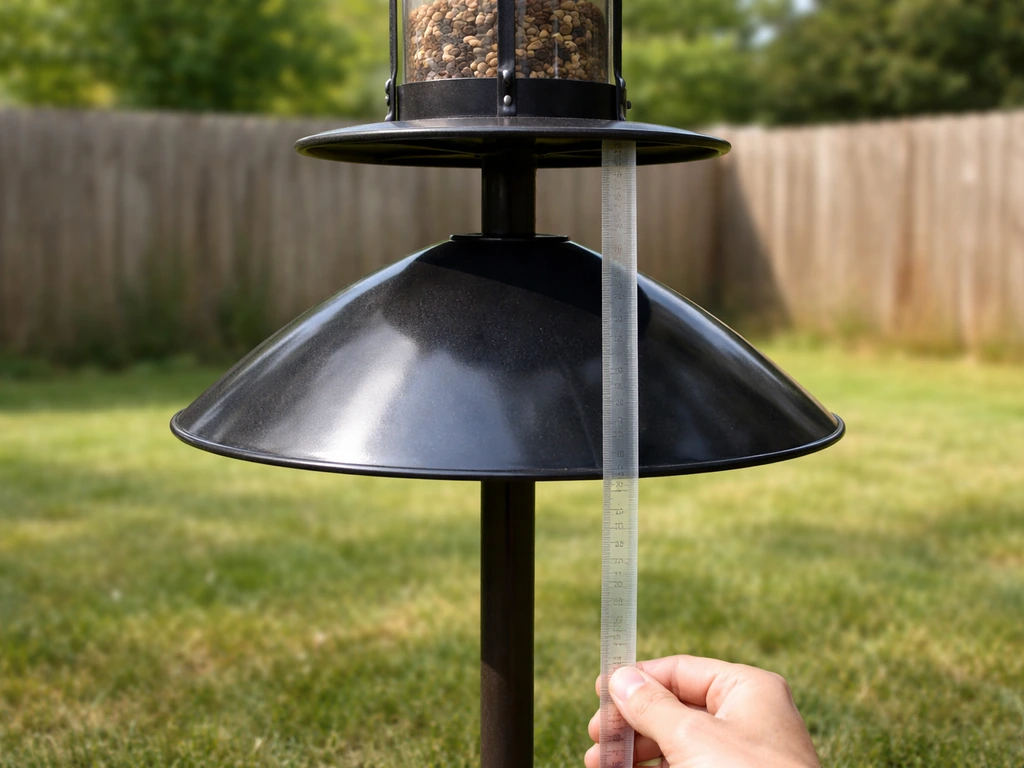
Squirrels are genuinely impressive athletes, and no height is truly squirrel-proof on its own. That said, the 5-7-9 rule is a practical framework worth knowing: position the feeder 5 feet off the ground, 7 feet away from any structure a squirrel could jump from (fences, decks, sheds), and 9 feet away from overhanging branches. Hit all three numbers and you're making their job much harder.
A squirrel baffle is really where height earns its keep. For a baffle to work, the top of the baffle needs to be at least 4 to 5 feet off the ground, otherwise a squirrel can simply leap over it from a standing position. The baffle also needs to be wide enough that they can't reach around it, which is where the geometry of the guard matters as much as its existence. The RSPB is honest about this: no guard is fully squirrel-proof, but the right setup makes access genuinely difficult rather than trivially easy.
If squirrels are still overwhelming the feeder even with a baffle and correct height, consider placing a separate ground-level supply of corn or cheap seed at a distance to give them an easier target. It doesn't always work, but it can reduce feeder competition without requiring constant intervention.
Placement rules that work alongside height
Height is one axis of placement. If you also have more than one feeder, spacing becomes important too, including how far apart should bird feeders be. The others, including distance from windows, proximity to cover, and clearance from structures, all interact with it. Spacing matters too, including whether feeders are too close together for safe, comfortable feeding feeders too close together. Getting the height right but ignoring the others can still leave you with birds that won't come or windows that keep getting struck.
Window distance
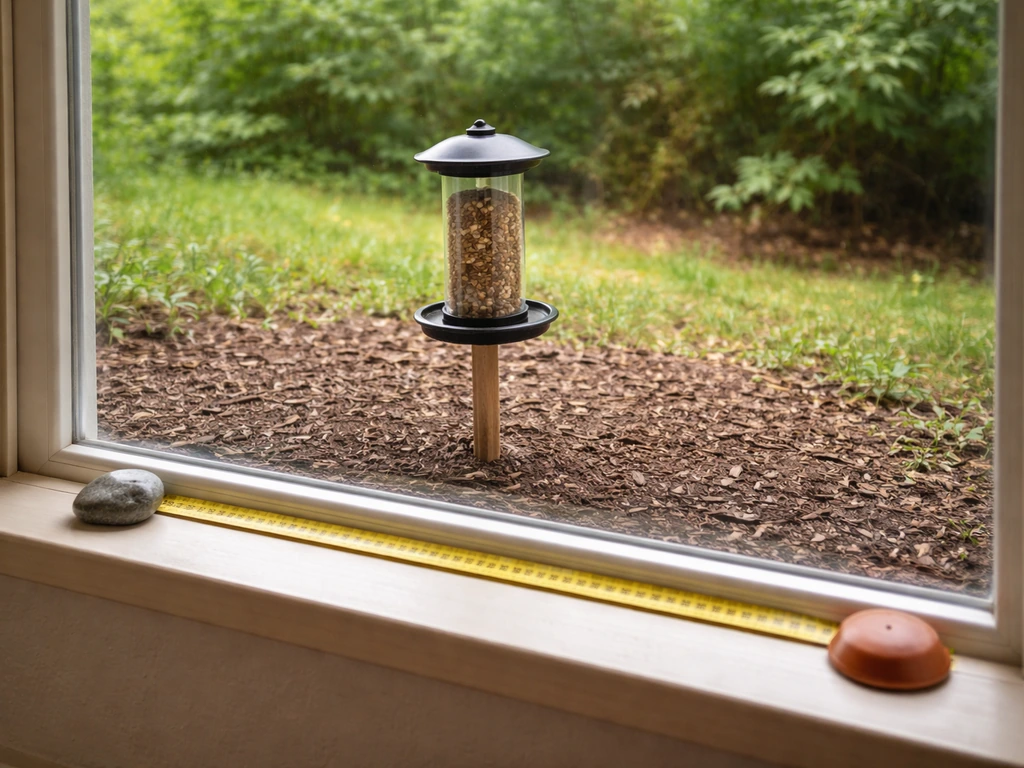
The Cornell Lab guidance on window collisions is specific and worth following: place feeders either within 3 feet of a window or more than 30 feet away. The reasoning is counterintuitive. If a feeder is 5 to 30 feet from a window, birds are traveling fast enough when they flush to hit the glass with serious force.
National Park Service guidance emphasizes that feeder placement and proper product placement are key steps for reducing bird-window collisions feeder placement and product placement are critical to reducing bird-window collisions.
Closer than 3 feet, they haven't built up speed yet. Beyond 30 feet, they're less likely to fly directly toward the house. The worst zone is somewhere in the middle, which is exactly where a lot of feeders end up. Height doesn't change this rule, but it's a placement factor that has to be considered at the same time as height.
Cover and escape routes
Birds need nearby cover to feel safe enough to use a feeder consistently, but that cover shouldn't be so close that it becomes a hiding spot for predators. A rough guideline: keep natural shrubs or brush piles within 10 to 12 feet so a startled bird can reach safety quickly, but make sure the immediate area around the feeder (within about 10 feet) is open.
Tufts Wildlife Clinic also emphasizes a predator-and-escape principle: birds may be able to fly quickly to nearby safe cover, while some predators cannot reach cover within striking range make sure the immediate area around the feeder (within about 10 feet) is open. .
That gap gives birds enough visual warning to react before a cat or hawk closes the distance.
Clearance from structures
Beyond the squirrel-jump clearance already mentioned, think about wind exposure and your own access for refilling and cleaning. A feeder that's perfectly placed for birds but requires a ladder every time you refill it will get neglected. Set it at a height and location where you can comfortably reach it with both hands, even in winter when paths may be slippery. Somewhere between 4 and 6 feet handles this for most adults without extra equipment.
Birds still not showing up? Here's what to check
Give a new feeder at least two weeks before drawing conclusions, especially if it's freshly installed. If you suspect the feeder is too high, reassess the height and measure from the ground to the feeder bottom feeder at least two weeks before drawing conclusions. Birds are cautious about new objects in their territory. But if a few weeks have passed and you're still seeing no activity, work through this checklist.
- Height too low or too exposed: If the feeder is below 4 feet or in the open with no nearby cover within 15 to 20 feet, birds may feel too vulnerable. Try raising it or moving it closer to a natural windbreak or tree line.
- Squirrels are monopolizing it: Even if birds want to use the feeder, constant squirrel activity will drive them off. Verify your baffle is installed at the right height and that the feeder clears the 7-foot side-jump zone.
- Wrong food for local birds: Height matters less if the food isn't right. Black oil sunflower seed attracts the widest variety of species. If you're using a mix with lots of milo or filler, switch and see if that changes activity.
- Too close to a high-traffic area: Foot traffic, dogs, or a frequently opened door nearby can deter birds. Try moving the feeder to a quieter side of the yard, even if the height stays the same.
- Feeder is dirty or seed is old: Stale or moldy seed gets ignored. Clean the feeder and replace the seed, then reassess over the next week.
- Competition from nearby feeders: If you have multiple feeders very close together, dominant species can block others from feeding. Spacing feeders further apart (at least 10 to 15 feet) can help, and adjusting heights between feeders lets different species feel less crowded.
- Season and local bird presence: If you've just set up in late summer or early winter, local populations may be in transition. Track what birds are actually present in your area before assuming the setup is the problem.
If you've adjusted height, food, and location and birds are still avoiding the feeder, spend a few mornings watching the area quietly from inside. You'll often spot the actual issue, whether it's a neighborhood cat patrolling underneath, a hawk perching nearby, or simply that the feeder is positioned so birds can't see it from their usual flight paths. Active observation tells you more than any checklist.
FAQ
I measured to the top of the pole. Why might that make my feeder height feel wrong, and how should I adjust it?
Re-measure from the ground to the bottom of the feeder body, then adjust in small steps (about 6 to 12 inches at a time). If you move it upward, confirm you still have an open approach area around the feeder, otherwise birds may see predators approach too late even though the feeder is higher.
If the birds I want are not using my feeder, should I raise it or lower it?
Start by checking that the birds you want are not being crowded out by the feeder height. If you mostly see ground-feeding birds (sparrows, doves, juncos) hovering and not landing, drop the feeder slightly (or use a low tray nearby) and keep that immediate area protected so predators do not ambush them.
Will increasing feeder height completely solve cat and other predator issues?
If cats can reach the feeder from a standing position or if there is hiding cover within about 10 feet, height alone often will not fix the problem. Improve safety by increasing distance from shrubs or dense plantings, using a baffle, and creating open ground around the feeder so birds have time to react.
My squirrel baffle is installed, but squirrels still get the food. What should I check first?
No guard is perfect. If squirrels are still getting in, verify that the baffle’s top is high enough and that its diameter and angle leave no easy reach-around. Also remove any nearby jump points, like stacked wood, planters, or low fences, because squirrels can climb and then bypass the intended clearance.
Can I place one feeder height that works for both ground-feeding birds and tree-feeding birds?
For mixed-species yards, you may get better results by offering a secondary feeding option rather than trying to satisfy everything with one height. Keep seed feeders in the 4 to 6 foot range, and provide a separate ground-level option for species that prefer to feed near the ground.
How do I account for pole depth if I use different mounting methods (screw-in, ground stake, or shepherd’s hook)?
Yes. If you use a pole system, the buried portion matters. Two setups with the same total pole length can place the feeder bottom at different heights depending on how deep it is planted, so always measure from the ground to the feeder bottom after installation.
My birds visit, but they won’t stay. What placement or height problem causes that?
If birds show up briefly but leave quickly, the issue is often visibility or approach routes. Try repositioning so the feeder is visible from typical flight paths and keep the area right around the feeder more open than nearby cover, which the article suggests for predator reaction time.
I changed the feeder height and activity dropped immediately. Should I keep adjusting?
If birds stop using the feeder after you change the height, revert to the last working height and make one change at a time. Birds are cautious about new objects and positions, so give it a short window to settle, then adjust gradually rather than jumping by a full foot.
If I have more than one feeder, does the height recommendation change or do spacing rules matter more?
When using multiple feeders, keep spacing so birds can feed without aggressive crowding and so you do not create a cluttered “perch and pounce” route for predators. Even if each feeder is at the right height, feeders too close together can still lead to unsafe, uncomfortable feeding.
What height should I choose if I need to refill and clean the feeder in winter without a ladder every time?
In winter, accessibility matters because you will refill more often and path conditions may be slippery. If you cannot reach the feeder comfortably without risking slips, consider a height that fits your reach rather than stretching, because neglected feeders end up producing worse results even when placement is otherwise correct.
Next Article
How Far Apart Should Bird Feeders Be From Each Other
Get the ideal feeder-to-feeder spacing to cut chasing, overcrowding, and mess while keeping birds safer.