Yes, birds absolutely poop near bird feeders, and if you've set one up recently, you've probably already noticed the evidence. This is completely normal, and it doesn't mean you've done anything wrong. But it does mean there are real things you can do, starting today, to keep the mess manageable and the area safe for birds and your family alike.
Do Birds Poop Near Bird Feeders? What to Expect and Fix

Eleanor Hartwick
23 Mar 2026
What to expect under and around your feeder
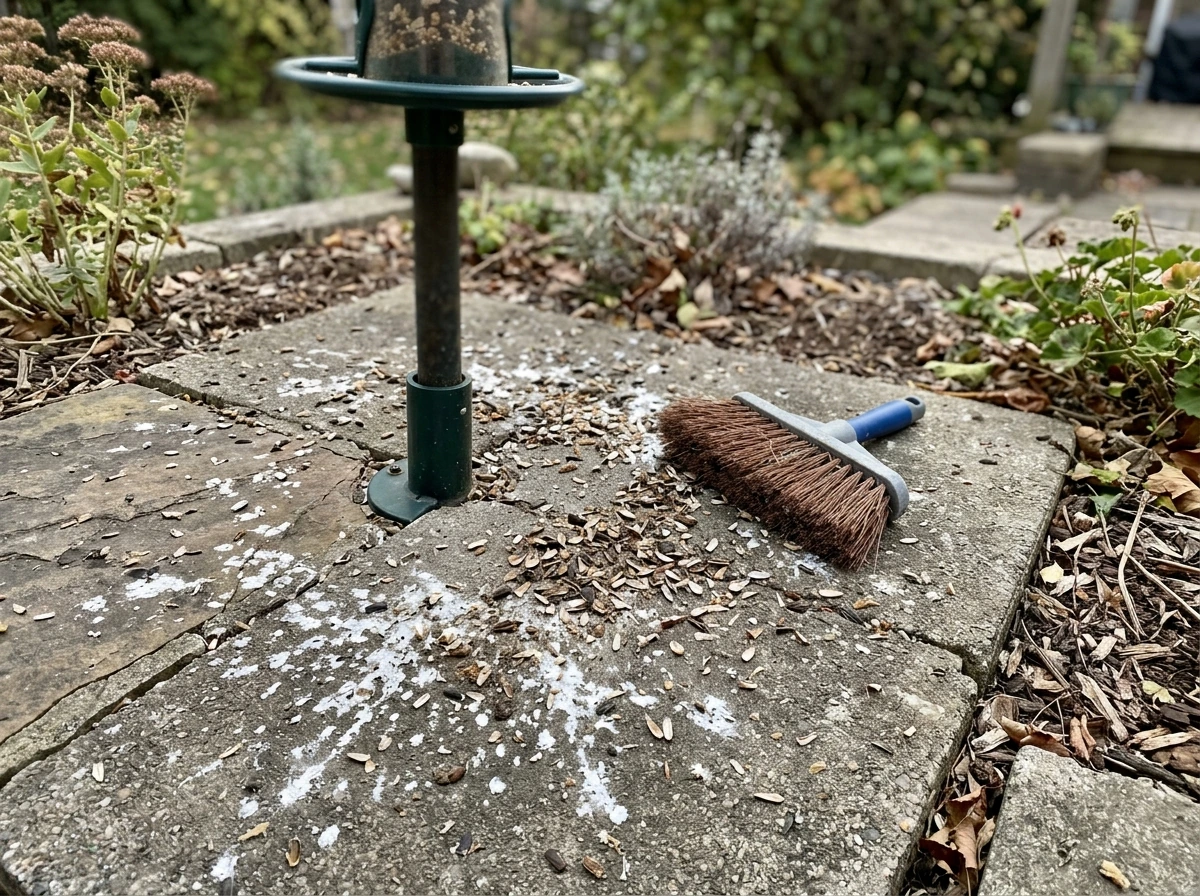
If you have an active feeder, droppings underneath it are essentially guaranteed. Birds visit repeatedly throughout the day, and every time one lands, perches, or waits its turn, there's a good chance it relieves itself. On a busy feeder with steady traffic from sparrows, finches, or juncos, you can end up with a visible concentration of droppings directly underneath within just a few days. Add seed hulls, spilled seed, and the occasional dead bug, and the ground below a feeder can get pretty grim pretty quickly.
What you're typically seeing is a mix of uric acid (the white, chalky paste) and fecal matter, which birds expel together in one motion. The splatter radius depends on feeder height and whether birds are perching on the feeder itself, on nearby branches, or on a pole. Most of the mess lands within two to three feet directly below the feeder, but you'll often find scattered droppings on nearby decking, fencing, or furniture if the feeder is close to a structure.
Why the mess concentrates here
Birds are creatures of habit. Once a feeder is established and they've found it (which can take anywhere from a day to a few weeks depending on the species and your location), they treat it like a regular stop on their daily route. So if you're wondering whether birds will find my bird feeder, expect it to happen as they discover and return to a reliable food stop will birds find my bird feeder. If you notice finches or other small visitors becoming regulars, it can help to understand how do finches find bird feeders and why they keep returning. That kind of repeated return traffic to a single spot is what creates the accumulation problem. A bird that would otherwise be spreading droppings across a half-acre of yard is now depositing a good chunk of its output in a three-square-foot zone. how do hummingbirds find bird feeders
There's also a behavioral piece here. Birds don't just fly in, grab a seed, and leave. They perch. They wait. Dominant birds guard feeding spots and stay put for longer periods, while less confident birds hover nervously nearby. All that stationary time adds up. Tube feeders with multiple perches, platform feeders, and feeders near good perching shrubs tend to generate more concentrated droppings because birds are lingering longer in a tight area.
The approach and departure flight paths matter too. Birds typically approach from the same trees or shrubs and take the same exit routes, so you'll often see droppings not just under the feeder but in a loose arc around it reflecting those flight lines.
When droppings are just a mess versus when they're a real problem
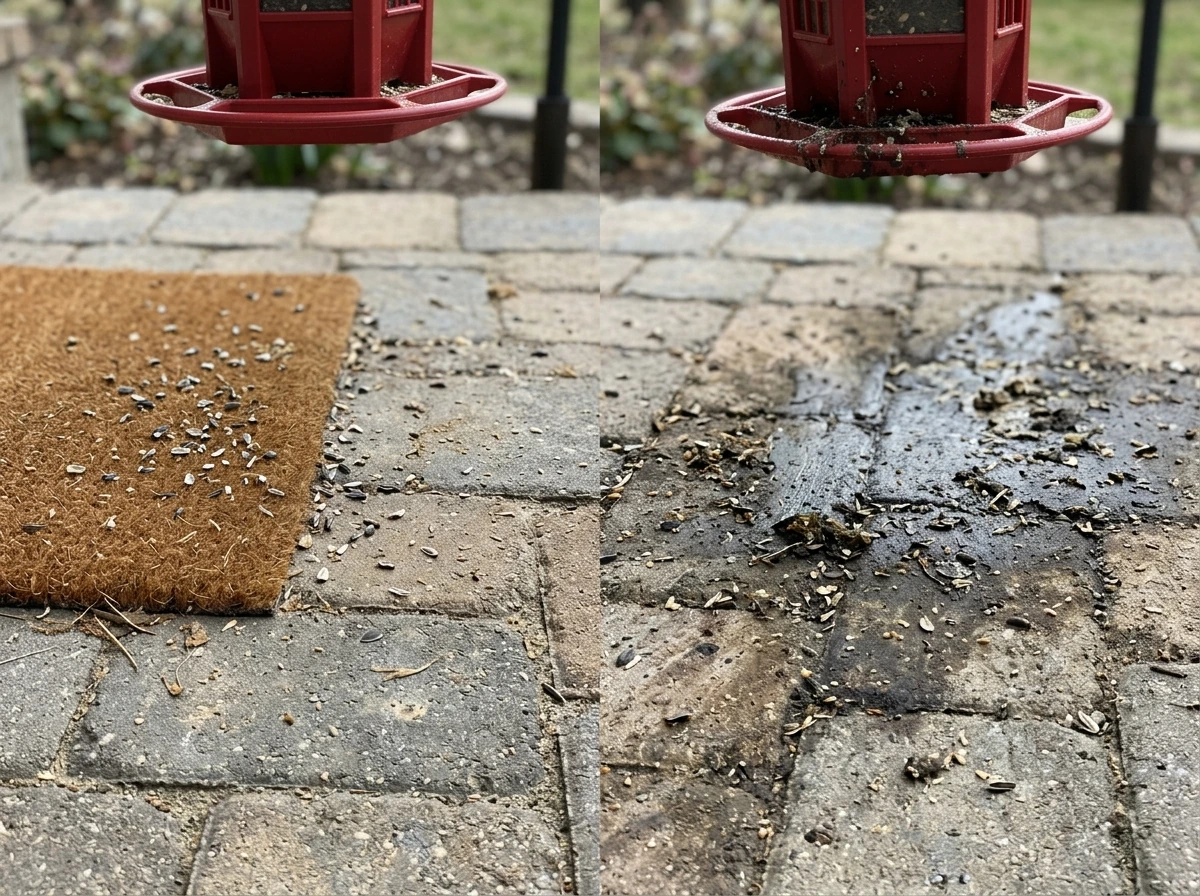
Most of the time, droppings near a backyard feeder are an aesthetic nuisance and nothing more. They stain decking, sidewalks, and patio furniture. They look bad. If the feeder is above a high-traffic walkway or a spot where kids play, that's a genuine quality-of-life issue worth solving. But the mess alone, while annoying, isn't typically a health emergency.
That said, there are real health concerns you should know about. Salmonellosis is probably the most common disease risk at backyard feeders. It spreads when birds ingest food or water contaminated with feces from infected birds. The Washington State Department of Fish and Wildlife specifically calls out the ground below feeders as a transmission hotspot, and the Pennsylvania Game Commission recommends a 10% bleach solution and regular removal of feces and discarded seed from the ground as standard prevention. It's not just about your family, it's about the birds themselves. Sick birds at your feeder can pass disease to healthy ones if conditions are dirty enough. can birds smell bird feed
Other diseases on the radar for feeder birds include house finch eye disease (mycoplasmal conjunctivitis), aspergillosis (a respiratory fungal disease that thrives in wet, decomposing seed and droppings), avian pox, and, more recently, avian flu. The Audubon Society flags all of these as reasons to keep feeders and the area around them clean. To help keep feeder birds healthy, Audubon recommends removing and disposing of feces and spoiled or wet seed hulls and habitats under feeders, such as raking or shoveling when moldy or wet blank" rel="noopener noreferrer">removing and disposing of feces and spoiled or wet seed hulls under feeders. One specific thing worth watching for: blank" rel="noopener noreferrer">Audubon advises checking for bright green droppings on or around your feeder, which can be a sign of illness in the birds visiting.
There's also a histoplasmosis consideration. The CDC notes that the fungus responsible (Histoplasma capsulatum) can grow in accumulated bird droppings, and that preventing accumulation in the first place is the best line of defense. For a typical backyard feeder maintained regularly, the risk is low. But if droppings have been building up for months under a feeder without any cleaning, that changes the calculation, especially if you're disturbing or raking the area dry. Wetting droppings before cleanup reduces the chance of inhaling disturbed particles.
One more practical concern: droppings and seed hulls together attract rodents. Project FeederWatch at the Cornell Lab of Ornithology notes this directly, and it's something I hear about constantly from readers who didn't realize their feeder was part of why they suddenly had mice.
How to reduce droppings near your feeder
Placement makes the biggest difference
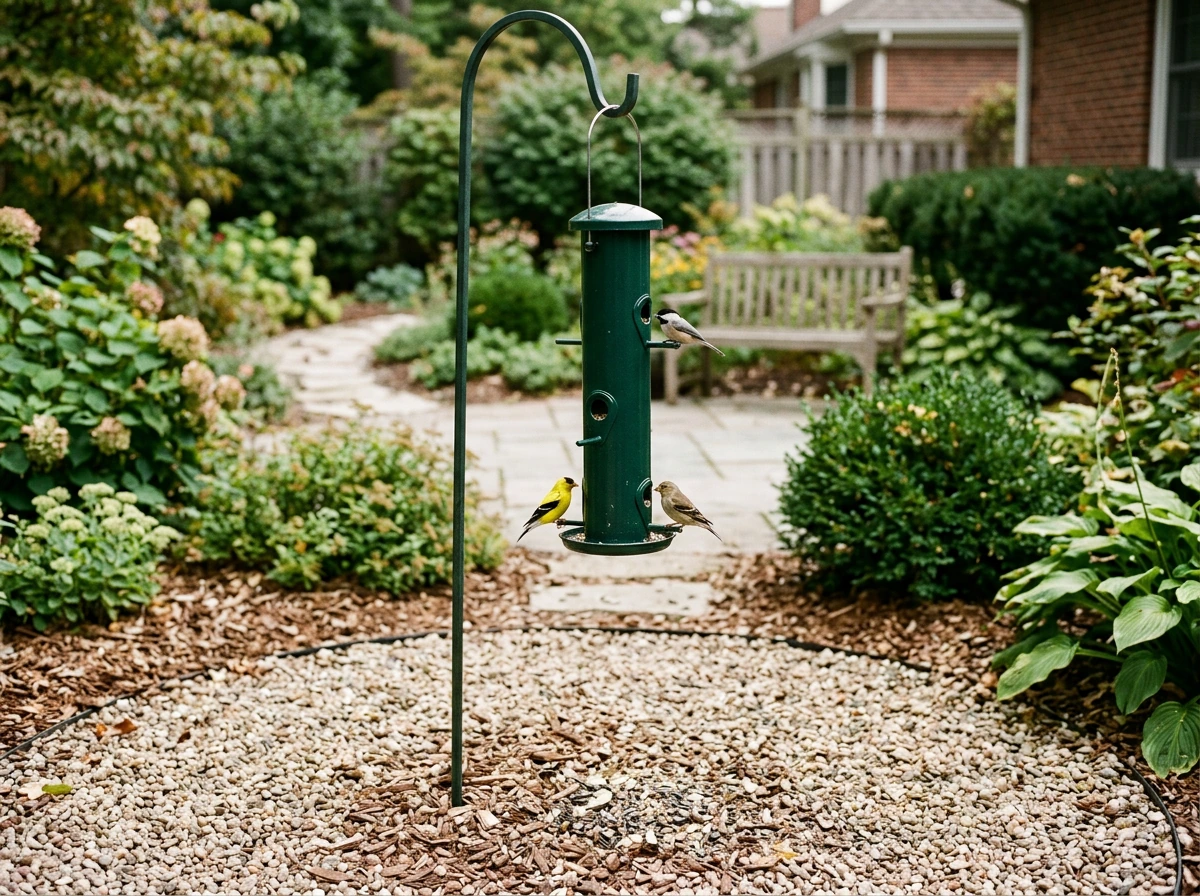
The single most effective thing you can do is place your feeder away from areas where droppings create actual problems. Keep feeders at least eight to ten feet from walkways, patios, decks, and outdoor furniture. If you can position the feeder over a bed of mulch, bare dirt, or gravel rather than concrete or wood, cleanup becomes dramatically easier, and the visual impact of droppings fades naturally.
Height matters too. A feeder mounted too low (say, below four feet) tends to create a more concentrated splatter zone directly underneath. A feeder at five to six feet distributes the fall pattern slightly more broadly and makes it harder for ground-based predators or pests to access spilled seed. That said, going very high (above seven or eight feet) can make it harder for you to refill and monitor the feeder, and doesn't meaningfully reduce the dropping issue on the ground below.
What to put on the ground underneath
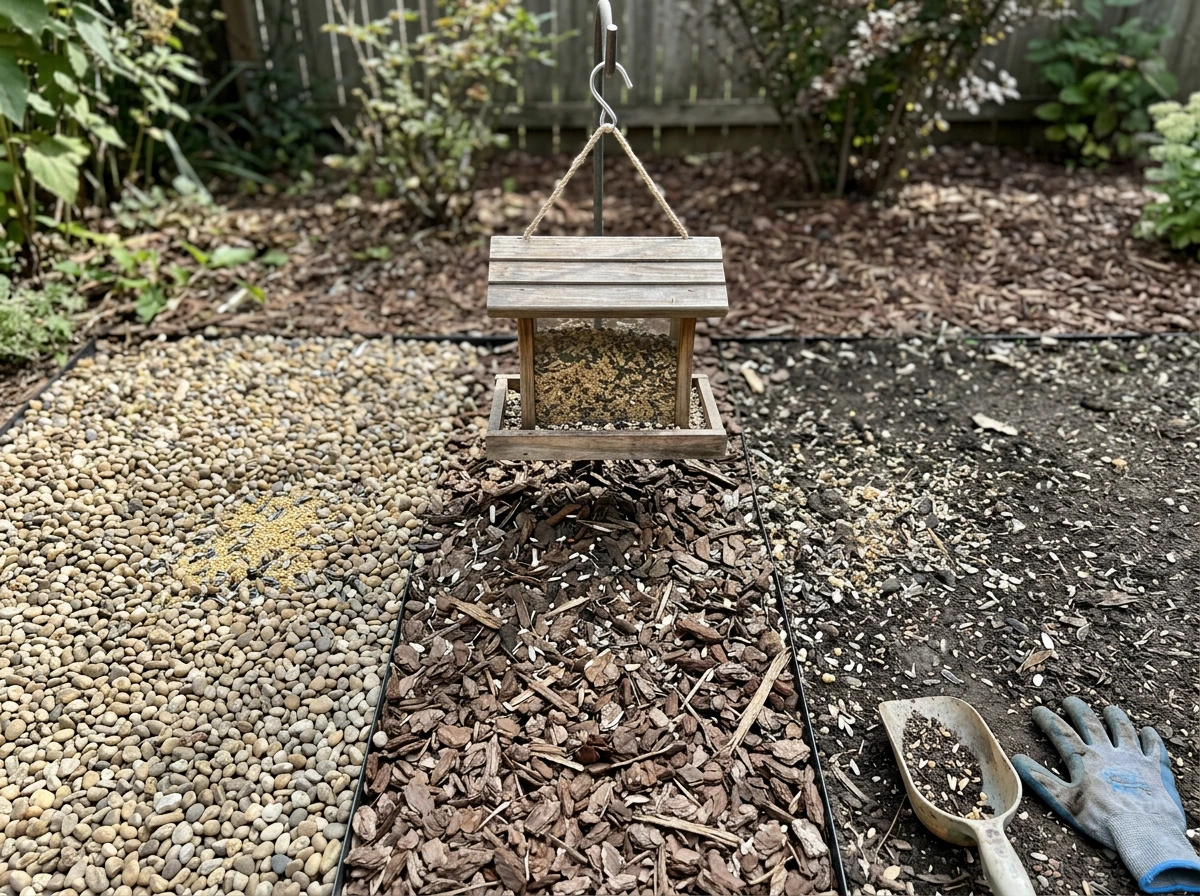
Bare soil, wood chip mulch, and pea gravel are all easier to manage than concrete, wood decking, or grass. Concrete stains and holds bacteria. Grass gets matted and develops dead patches quickly. Mulch can be raked through and replaced seasonally. Gravel can be hosed down. If you're setting up a new feeder or moving an existing one, think about the surface underneath before you plant the pole.
A catch tray or drop cloth positioned under the feeder is another option some people use. These are easier to clean than large ground areas, but they do require more frequent attention, and if you let them go too long, they concentrate the mess rather than dispersing it.
Feeder setup upgrades
Some feeders come with built-in seed trays underneath the main feeder body. These catch hulls and reduce ground scatter significantly, but they also catch droppings from birds perching on the feeder above, which means they need cleaning just as often as the feeder itself. If you add a seed tray, commit to cleaning it at the same time as your feeder.
Moving the feeder occasionally, which Oregon State University Extension recommends specifically, prevents any single patch of ground from becoming heavily contaminated. Even shifting it a foot or two every few weeks helps distribute the accumulation and gives the previous spot time to recover.
A cleaning routine that actually protects birds (and you)
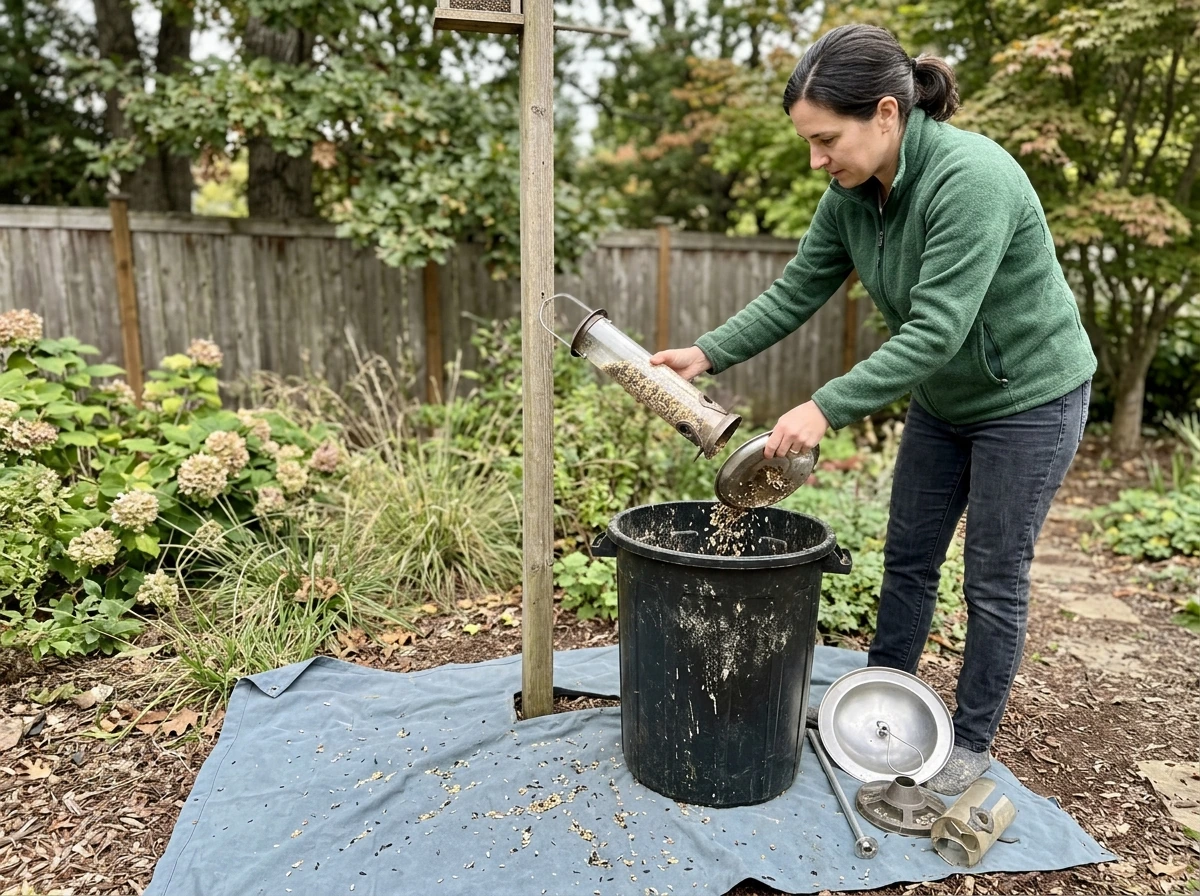
Project FeederWatch recommends cleaning seed feeders about every two weeks, and that's the guidance I'd pass along as a baseline. During heavy use periods (winter, migration season), you might need to clean more often. During slow periods, every three weeks is probably fine.
Here's a routine that works:
- Empty the feeder completely. Don't just top it off, dump it out and check for clumped, wet, or moldy seed.
- Scrub the feeder with a stiff brush and hot water. For a thorough disinfection, use a 9-parts-water to 1-part-bleach solution, which is the National Wildlife Health Center recommendation as cited by Audubon. Let it soak for a few minutes.
- Rinse thoroughly and let it dry completely before refilling. Wet feeders encourage mold growth and aspergillosis risk.
- Clean the perches specifically. Oregon State University Extension recommends scraping off droppings and wiping perches down with a vinegar solution as a lighter-duty between-cleanings option.
- Rake or scrape the ground underneath the feeder. Remove seed hulls, waste, and droppings. Wet the area slightly before raking if it's dry and dusty to reduce particle inhalation.
- If you use a seed tray, clean it at the same time as the feeder body.
- Wash your hands thoroughly afterward. The CDC is clear on this, and it's the simplest protection available.
For tools, you don't need anything fancy: a stiff-bristle brush, a bucket, rubber gloves, a spray bottle for the bleach solution, and a garden rake for the ground. Some people put their plastic feeders through the dishwasher on a hot cycle, which Project FeederWatch says is effective if the feeder material can handle the heat.
Reducing mess without discouraging birds
Baffles are typically discussed as squirrel deterrents, but they serve a secondary purpose here. A dome baffle above a hanging feeder or below a pole-mounted feeder changes where birds can land and approach from. Fewer perching spots directly above a surface means fewer droppings landing on it. If you're fighting droppings on a specific piece of furniture or a section of deck, repositioning the feeder with a baffle above it can redirect where birds approach from.
Switching seed type can also make a difference. No-mess seed mixes (hulled sunflower, hulled millet, and similar products) eliminate seed shell debris, which reduces the ground mess significantly and also means less wet, decomposing material mixing with droppings. Less organic material on the ground means fewer pests and a cleaner zone overall.
If you feed on the ground intentionally (scatter feeding for ground-feeding species like doves, sparrows, or juncos), Penn State Extension recommends rotating the feeding area regularly and raking it frequently. Don't use the same three square feet of lawn indefinitely.
How species and seasons change the picture
Not all birds are equally messy at feeders, and the time of year changes both visitor volume and dropping volume. Here's a quick breakdown of what to watch for:
| Factor | What changes | What to do differently |
|---|---|---|
| Winter feeding | Higher traffic, more species, more droppings overall as birds concentrate at food sources during cold months | Clean more frequently, at least every two weeks or sooner if you see buildup |
| Spring migration | Surge in new species and visitor numbers passing through; short-term spike in mess | Check underneath daily during peak migration weeks; consider temporarily moving the feeder away from sensitive surfaces |
| Summer | Lower feeder traffic in many regions as natural food is abundant; droppings decrease | You can extend cleaning intervals slightly, but don't skip them |
| Large flocks (starlings, grackles, house sparrows) | These species arrive in numbers and can generate an extraordinary amount of droppings in a short time | Consider feeder design changes (tube feeders without trays deter larger birds) or temporarily removing the feeder during peak flock activity |
| Ground feeders (doves, juncos, towhees) | Feed and defecate on or very near the ground, concentrating mess in one spot | Rotate feeding location regularly and rake frequently |
| Hummingbirds | Liquid feeders; less visible dropping issue, but the feeder itself needs cleaning every 2-3 days in warm weather to prevent mold and fermentation | Establish a feeder-specific cleaning schedule separate from seed feeders |
Winter is genuinely the most intense period for feeder mess in most of North America. Birds are stressed, feeding heavily, and your feeder may be one of the only reliable food sources in the area. That's exactly when disease risk is also highest because more birds are congregating in one spot. It's worth knowing that the birds finding your feeder in winter are probably the same individuals returning day after day, which is actually a point in favor of keeping things clean for them, not just for you.
Your practical starting point
If you're dealing with a mess under your feeder right now, here's where to start: move or confirm the feeder location is away from walkways and surfaces you care about, rake and wet-clean the ground underneath today, and set a recurring reminder to clean the feeder itself every two weeks. Those three steps handle the vast majority of the problem for most people. If you're still wondering whether birds will find my bird feeder, focus on placement and keep the area clean so they keep coming back. After that, it's mostly about consistency. A clean, well-placed feeder generates far less mess than one that's been neglected for a month, and your birds will be healthier for it too.
FAQ
Do birds poop near bird feeders immediately after you put the feeder up, or does it take time?
It can be quick, but it often takes a little longer. Many feeders sit unused for a day to a few weeks while birds scout the area, then once they start returning routinely, droppings build rapidly under the same perching and waiting spots. If you see no droppings at first, that doesn't mean birds won't use it, it may mean they have not established a visit pattern yet.
Is the white chalky stuff the main concern, or is it mostly the darker droppings?
Both matter. Birds excrete waste as a mix of uric acid (often white and chalky) and fecal material, and the infectious risk comes from contaminated soil and discarded seed particles, not only from the visible “white” part. The practical takeaway is to clean both droppings and fallen seed regularly, even if the area looks only lightly soiled.
Can I just hose down the area instead of cleaning?
Hosing can temporarily reduce visible mess, but it often spreads contaminated debris into nearby cracks, soil, or grass, which can increase exposure when it dries and gets disturbed later. A better approach is to wet the area first, remove droppings and hulls with a rake and brush, then disinfect surfaces you can reach. For porous areas like mulch and bare soil, focus on removal and replacement or targeted spot cleaning rather than only spraying.
What’s the safest way to clean under a feeder if I’m worried about germs?
Wear disposable or washable gloves and consider a mask if you’ll be raking dry debris, since disturbed particles are the main inhalation concern for some pathogens. Wetting droppings before cleanup helps. After cleaning, sanitize tools and wash hands thoroughly, and keep children and pets away until the area is dry.
How often should I clean if multiple feeder types are in use (tube feeder, platform, suet)?
Use a “most demanding feeder sets the pace” rule. Tube and platform feeders usually create more localized dropping under perches, and suet or tray feeders often get heavy traffic during cold snaps. If you clean only every few weeks, droppings can build up even if the feeder looks “fine.” In practice, plan for at least every two weeks during busy seasons, and more often during winter when traffic peaks.
Does the feeder height really change where droppings land?
Yes. Lower mounting increases the chance of a concentrated splatter zone directly underneath, while modestly higher placement often spreads the fallout slightly and makes it harder for ground-based pests to access spilled seed. However, going very high usually makes refilling and monitoring harder, and it does not fully eliminate droppings near the feeder, it mainly shifts the distribution.
Will a seed tray or catch pan stop poop from landing near the feeder?
It can reduce seed hull scatter, but it does not eliminate droppings because birds still perch and relieve themselves above the tray area. Expect to clean the tray on the same schedule as the feeder. If the tray fills up and is left too long, the mess becomes more contained but also more concentrated.
Are there birds that are less likely to create a heavy mess?
Mess level varies by species and by how long they perch. Birds that hover briefly or feed while moving through the area typically create less concentrated accumulation than birds that wait on perches for extended periods. Even within a species, winter congestion can make any feeder busier and increase dropping volume.
How do I stop rodents if the main issue is droppings and spilled seed, not the feeder itself?
Rodents are attracted to the combined food sources, seed hulls, and contaminated debris. Clean under the feeder more frequently, remove discarded seed quickly, and consider switching to hulled or “no-mess” seed to reduce waste. Also, avoid placing feeders over easy cover and remove any spilled seed from a wider ring than you think you need.
Is it safe for pets or kids to be near the area under a feeder?
It can be safe with boundaries, but you should treat the zone under and around the feeder as a contamination area. Keep children and pets from playing on the ground beneath the feeder, and choose a placement that avoids walkways and high-traffic spots. Once cleaned and dried, the risk drops, but consistent prevention matters more than occasional deep cleaning.
If I feed on the ground instead of using a feeder, will there still be health concerns?
Yes. Ground feeding creates more direct contact between droppings, spilled seed, and the surface where birds and other animals congregate. The fix is rotation and frequent raking or removal of old feed and droppings, so you are not maintaining the same contaminated patch indefinitely.