Bees show up at bird feeders because feeders offer exactly what bees are looking for: a concentrated sugar source in an easy-to-find location. Whether it's hummingbird nectar, fruit, or sugar water, your feeder is essentially advertising a free meal. This is most common when natural floral resources are scarce, but some bee species will exploit a good feeder year-round if given the chance. The good news is that a handful of targeted changes, to feeder design, placement, and cleaning routine, can dramatically cut down on bee traffic without harming the bees or your birds.
Why Are Bees in My Bird Feeder? Causes and Solutions for Backyards

Eleanor Hartwick
13 Jul 2026
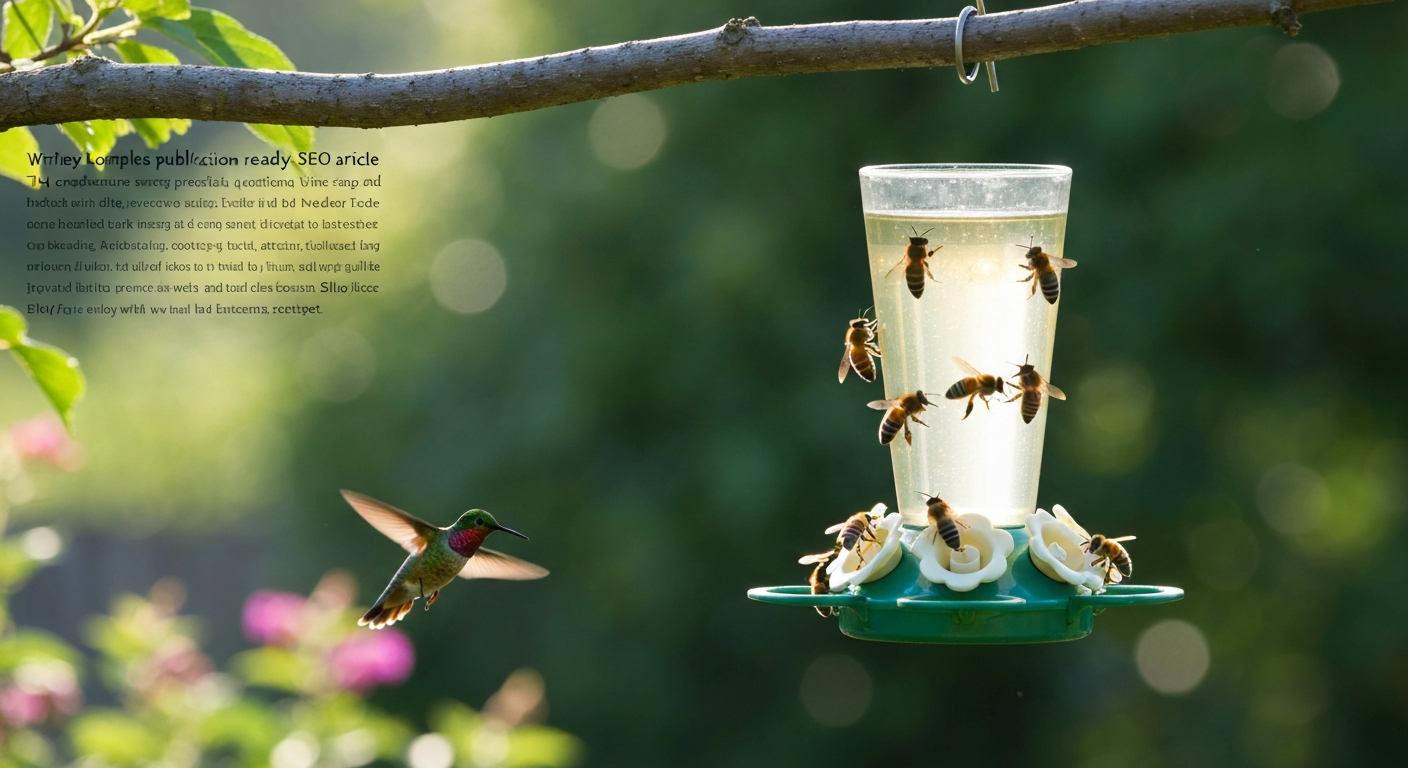
Why bees are drawn to your feeder in the first place
Bees are foragers, and foragers follow energy gradients. A hummingbird feeder filled with a 1:4 sugar-to-water solution sits at roughly 20–25% sugar by weight, well within the range of natural flower nectar that hummingbird-pollinated plants produce. Honey bees and bumblebees have evolved to detect and exploit exactly this kind of resource. Add fruit feeders or open tray setups where juices pool and ferment, and you have something even more attractive, because fermenting sugars become more concentrated and the smell carries farther.
I hear this question constantly from people who assumed bees only bothered hummingbird feeders. In practice, any feeder with exposed sugar, fruit platforms, oriole feeders filled with jelly or orange halves, nectar trays, will pull in bees when the conditions are right. The trigger is usually a combination of feeder accessibility and a temporary shortage of flowers nearby, which is why you often see the problem spike in mid-to-late summer after the main flowering flush dies back.
Bees, wasps, or something else? How to tell them apart
Before you start troubleshooting, it pays to know what you're actually dealing with, because honey bees, bumblebees, and yellow jackets each respond a little differently to deterrents. Misidentifying a yellow jacket colony as honey bees, for example, changes both the urgency and the appropriate response.
| Visitor | Appearance | Behavior at feeder | Risk level |
|---|---|---|---|
| Honey bee | Golden-brown, fuzzy, about 15 mm, banded abdomen | Steady, calm feeding; often recruits others over time | Low if undisturbed |
| Bumblebee | Larger, very fuzzy, often black-and-yellow or black-and-orange | Slower, deliberate; frequently seen on fruit feeders | Low if undisturbed |
| Yellow jacket (wasp) | Smooth, bright yellow and black, narrow waist, fast movements | Aggressive feeding; defends feeder from other insects and birds | Moderate to high; stings readily |
| Paper wasp | Slender, long-legged, dangles legs in flight | Less aggressive than yellow jackets but territorial | Moderate |
| Hoverfly | Bee-mimic coloring, hovering flight, no visible waist | Hovers near ports, rarely lands long | None; does not sting |
The quickest field check: look at the waist. Bees have a broader connection between thorax and abdomen and are covered in fuzzy hair. Wasps have a pinched waist and a smooth, shiny body. Hoverflies hover in place and have large compound eyes that nearly meet at the top of the head. If you're seeing fast, aggressive insects that defend the feeder from birds and don't back down, you're almost certainly dealing with yellow jackets rather than bees, and that changes how urgently you should act.
Which feeders and foods pull in the most bees
Not all feeders are equally attractive to bees. Open platform feeders and flat fruit trays are the most bee-friendly designs you can buy, sugary juices pool, exposed surfaces are easy to land on, and there's nothing to stop a bee from walking right up to the food. Tube feeders are better, but the ports still need to be deep enough to keep nectar out of bee-tongue range. Saucer-style hummingbird feeders, where the nectar sits at the base rather than pooling near the ports, are consistently the least bee-prone option I've used.
- Hummingbird nectar (standard 1: 4 sugar-water): moderate bee attraction at 20–25% sugar; accessible in feeders with shallow or wide ports
- Fruit (oranges, apples, berries): high bee attraction as juices concentrate and ferment, especially in warm weather
- Grape jelly and sweet syrups: very high bee attraction due to high sugar density and strong scent
- Sugar-water in open trays or dishes: extremely high bee attraction; surface is fully exposed
- Seed feeders (sunflower, safflower, millet): low bee attraction unless sugar water or sap drips near ports
One thing worth knowing: research on honey bee feeding preferences shows they're most attracted to sucrose solutions in the 30–50% range, which is notably higher than the standard 1:4 nectar recipe. That means concentrating your nectar to "make it taste better for hummingbirds" actually makes it more attractive to bees, not less. Research on bumblebees shows nectar sugar concentration and viscosity jointly determine feeding intake, with viscosity rising at higher concentrations and reducing imbibition above roughly 1.5–1.6 mPa·s, producing optimal concentration windows (Effect of sugar solution type, sugar concentration and viscosity on bumblebee imbibition). Stick with the standard recipe.
How bees affect your birds, and you
The practical effects depend a lot on what species you're dealing with. Honey bees and bumblebees are relatively calm and will usually give ground when a hummingbird approaches at speed. The bigger issue is sheer numbers: if a feeder gets scouted and recruited to, you can end up with dozens of bees covering the ports, which effectively shuts the feeder down for birds regardless of how politely the bees behave.
Wasps, particularly yellow jackets, are a different story. They're territorial, they'll actively chase hummingbirds and small songbirds away, and they can make a feeder genuinely dangerous to approach for birds and people alike. Stings to people typically happen when someone reaches in to refill a feeder that's been claimed by a yellow jacket colony. If you have young children in the yard or anyone with a bee sting allergy, a wasp-dominated feeder is a real safety concern that warrants faster action.
Do bees actually keep birds away?
Yes, but the degree depends on the species and the volume. A few honey bees circling a hummingbird feeder will not stop a determined hummingbird, hummingbirds are bold and fast, and they've been sharing flowers with bees since long before anyone put up a backyard feeder. What does deter birds is a feeder that is physically covered in insects, a situation where every port is blocked and landing areas are occupied. I've watched hummingbirds make repeated approach runs at bee-covered feeders, get frustrated, and leave for 30–45 minutes before trying again.
For larger songbirds visiting fruit or platform feeders, a few bees rarely cause them to leave at all. Cardinals, orioles, and thrushes generally ignore bees unless wasps are actively aggressive. If you're already wondering why birds aren't visiting or why certain species have stopped coming, bees are one factor worth ruling out, but feeder placement, food freshness, and nearby predators are usually higher on the list of causes. For a focused troubleshooting checklist on why aren't birds coming to my bird feeder, see our guide.
How to deter bees: fixes ranked from quickest to most involved
I recommend working through these in order. The quick wins solve the problem for most people, and you'll know within a day or two whether a given change is working.
- Clean and change nectar immediately: cloudy, fermented, or warm nectar smells stronger and attracts more insects. Dump it, scrub the feeder, and refill with fresh 1:4 solution before trying anything else.
- Move the feeder to a shadier spot: nectar stays cooler, ferments more slowly, smells less, and is less accessible to sun-seeking bees. Even 6–8 feet of shade makes a measurable difference in how quickly bees locate a feeder.
- Add bee guards to existing ports: small mesh or plastic shields that slide over ports; they block bee entry while allowing hummingbird beaks through.
- Switch to a saucer-style feeder: nectar sits at the bottom, well below port level, physically out of reach for most bee proboscises (honey bee tongues average around 5 mm; saucer feeders typically keep nectar 12+ mm from the port opening).
- Remove perches: perch rings give bees a stable platform to land and probe from. Perchless feeders are harder for insects to use.
- Temporarily take the feeder down for 1–3 days: breaks the scout-recruit cycle that builds large bee populations at a feeder. Hummingbirds will return faster than bees will relocate to the feeder once you rehang it.
- Set up a dedicated bee water/sugar station away from the feeder: redirects foragers before they find the bird feeder (more on this below).
- Replace open fruit trays with covered fruit holders or mesh cups: reduces exposed juice surface and slows fermentation.
Feeder design: what to look for when buying or upgrading
If you're shopping for a new feeder or replacing one that's been persistently invaded, a few design features make a genuine difference. This isn't about marketing claims, it's about the physical dimensions that determine whether a bee can reach the nectar.
- Port diameter at or below 1/4 inch (6 mm): limits physical access for larger insects while still accommodating hummingbird beaks
- Port depth of at least 1/2 inch (12 mm): keeps nectar below the reach of most bee proboscises, which average around 5 mm
- Saucer or dish style: nectar level is kept at the base, typically 1–2 cm below any port — effectively bee-proof under normal conditions
- Integrated or compatible bee guards: small flower-shaped or mesh port covers sold as accessories or built into the feeder
- No perch ring: removes the landing platform that makes ports accessible to insects
- Wide, easy-clean basin: makes the cleaning routine faster and more likely to actually happen on schedule
- Red coloring only (no yellow): yellow feeder components attract bees and wasps more than red ones do
One thing I'd push back on: some feeders are marketed as "bee-proof" but still have wide, shallow ports where nectar sits close to the opening. Check the actual port depth in the product specs before buying, not just the marketing copy. A saucer feeder with a clear base so you can see the nectar level is easier to monitor and almost always outperforms a vertical bottle-style feeder for bee deterrence.
Placement and timing to reduce bee visits
Where and when you put feeders out matters more than most people realize. Bees are most active in warm, sunny conditions, mid-morning to mid-afternoon on days above about 55°F (13°C). Placing a feeder in deep shade reduces both the heat that speeds fermentation and the sunny exposure that attracts foraging bees. North or east-facing sides of trees or structures work well because they stay shaded through the hottest part of the day.
On timing: if you refill feeders early in the morning before bee foraging ramps up, you minimize the window when bees can detect fresh nectar being poured. Avoid refilling in mid-afternoon on hot days, that's peak bee activity and the nectar will warm up fastest. If you're in a region with very hot summers (consistently above 90°F/32°C), consider moving to smaller-capacity feeders that you can refresh more often rather than large-volume feeders that sit out all day.
Distance from flowering plants cuts both ways. Placing feeders near flowering gardens gives hummingbirds a rich foraging corridor, but it also puts them in the middle of bee territory. A feeder hung at least 10–15 feet from the nearest flowering plants is less likely to be picked up by bees already working that area. The trade-off is that hummingbirds may take slightly longer to discover a more isolated feeder, something to keep in mind if you're also troubleshooting why birds aren't coming at all.
Redirecting pollinators: bee feeders, fruit stations, and native plants
Deterring bees from bird feeders doesn't have to mean removing resources from your yard entirely. Bees are pollinators and belong in a healthy garden, the goal is to redirect them, not eliminate them. The most effective approach I've found is to give bees something they prefer, placed far enough away from bird feeders that they don't make the connection between the two food sources.
- Dedicated bee water station: a shallow dish with pebbles or corks for landing surfaces, kept 20–30 feet from bird feeders; helps especially in hot weather when bees are seeking water
- Separate fruit station: if you're feeding orioles or thrushes, place orange halves and grape jelly well away from hummingbird feeders to concentrate insect activity in one area
- Native flowering plants: the single best long-term redirect; native plants matched to your region provide species-appropriate nectar in concentrations and plant structures that bees are adapted to exploit, reducing their reliance on feeders
- Bee-specific sugar water station (used selectively): a dish of 1:1 sugar water placed far from bird feeders; useful during midsummer gaps in floral resources, but should be positioned where it won't become a nuisance itself
Native plants are the least maintenance-intensive long-term solution. A patch of native salvias, monarda, or native clovers, species appropriate to your region, provides natural nectar at natural concentrations, reduces bee pressure on feeders, and supports a much wider range of pollinator species than any feeder can. It takes a season or two to establish, but once it does, bee pressure on my feeders drops noticeably every year in early summer compared to late summer, which tracks directly with when those plants are in bloom.
Maintenance and cleaning: the schedule that actually protects birds
Dirty feeders don't just attract more bees, they're a genuine bird health risk. Fermenting nectar can cause fungal infections in hummingbirds, and moldy fruit or seed residue can carry bacteria that harm any bird that feeds on it. The cleaning schedule that bird health organizations recommend is more frequent than most people expect, especially in summer.
| Temperature range | Change nectar every | Clean feeder every | Notes |
|---|---|---|---|
| Below 60°F (15°C) | 5–7 days | Each refill | Cooler temps slow fermentation significantly |
| 60–70°F (15–21°C) | 3–5 days | Each refill | Monitor for cloudiness daily |
| 70–80°F (21–27°C) | 2–3 days | Each refill | Peak bee-attraction window; fresher is better |
| Above 80°F (27°C) | 1–2 days (daily ideal) | Every refill, minimum | Nectar can ferment in under 24 hours in direct sun |
| Above 90°F (32°C) | Daily | Daily | Consider shaded placement or smaller feeders |
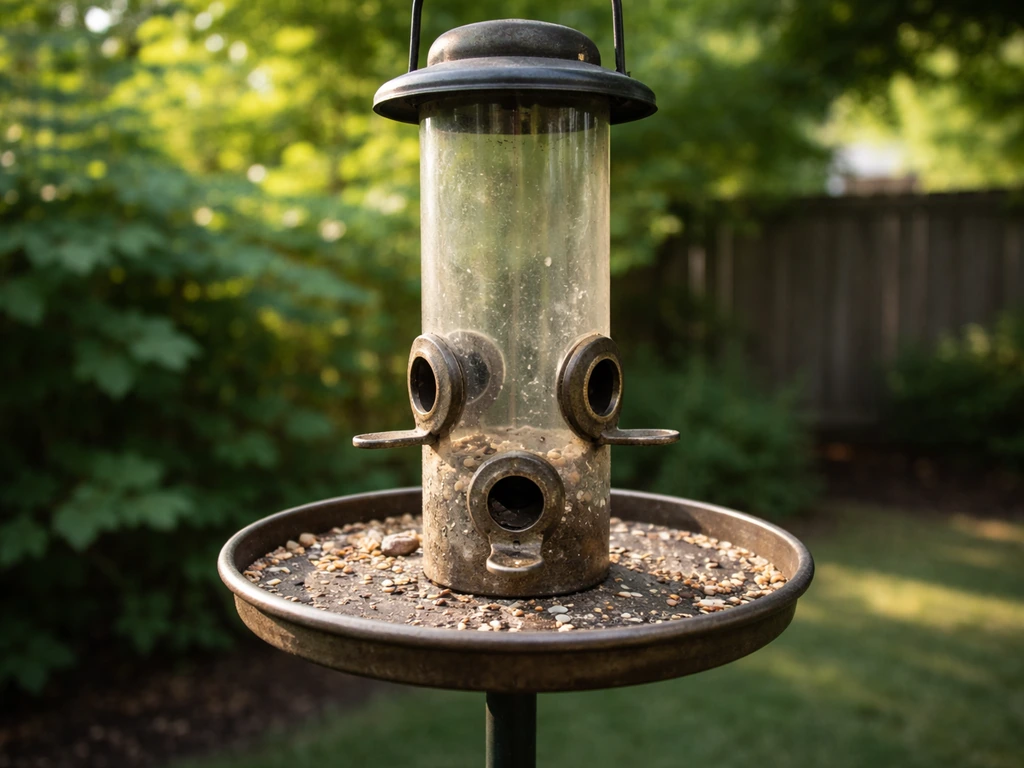
The cleaning method matters too. A hot water rinse and scrub with a bottle brush at every refill is the baseline. For a deeper clean, which I do every 1–2 weeks in summer, use diluted white vinegar or a 1:9 bleach-to-water solution. If you use bleach, rinse extremely thoroughly (multiple full rinse cycles) until no smell remains before refilling. Residual bleach is harmful to birds. The visual cue to act immediately, regardless of schedule: if nectar looks cloudy, foamy, or smells sour, dump it and clean the feeder right away. Don't top it off or add fresh nectar on top of old.
How your feeder choices affect which bird species show up
Feeder type and fill have a big effect on the bird community that develops in your yard, and some of those choices also influence bee pressure. It's worth thinking about this as a system rather than individual feeder decisions.
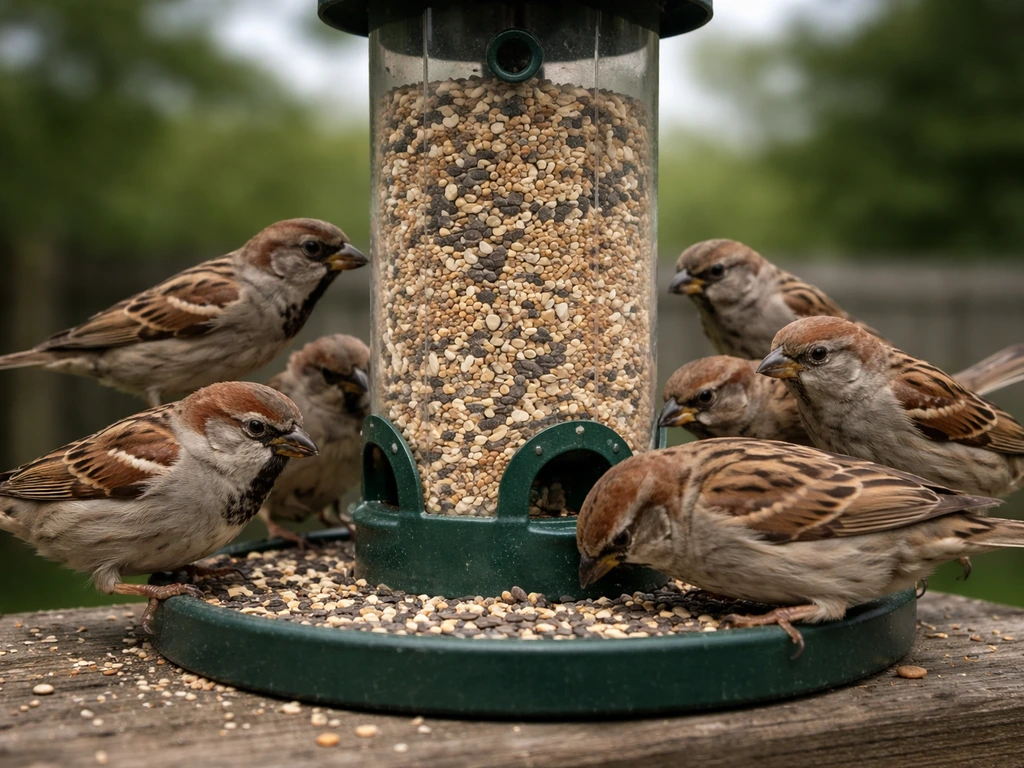
Platform feeders and open tray setups attract the widest variety of birds, including sparrows, grackles, and starlings, but they also create the most bee and insect problems because everything is exposed. If you're asking "Why do I only get sparrows in my bird feeder?", see our guide on why feeders attract sparrows and practical changes to seed and feeder design to discourage them. For guidance on expected timelines and what to watch for after changes, see the section on will birds come to a bird feeder for more on when and why different species return. For targeted advice on discouraging common grackles at bird feeder, see our guide. If you're finding your feeder dominated by house sparrows or common grackles and you also have a bee problem, switching from a platform or tray to a tube or saucer feeder addresses both issues at once: tube feeders with smaller ports and perchless designs are harder for large-bodied species to use effectively.
Hummingbird feeders, by design, are species-specific tools that exclude most other birds when port size is appropriately small. The bee problem on these feeders is almost entirely a port-depth and feeder-design issue. Switching to a saucer-style hummingbird feeder with no perch ring and proper port depth will typically cut bee visits dramatically while having no meaningful effect on hummingbird access. For seed feeders, safflower seed is one of the more effective ways to reduce house sparrow and starling pressure without reducing appeal to cardinals, chickadees, and nuthatches, and it has no bee relevance at all.
Adjusting feed and design to favor the birds you want
If your goal is to reduce sparrow or grackle dominance while keeping a diverse feeder, a few targeted swaps work well. Nyjer (thistle) feeders with small ports attract goldfinches and pine siskins and are almost completely ignored by house sparrows and grackles. Peanut feeders in mesh cylinders favor larger corvids, nuthatches, and woodpeckers but exclude sparrows by design. Cylinder-style suet cages that require birds to cling upside down tend to exclude starlings (which prefer an upright posture) while remaining accessible to woodpeckers and chickadees.
On the nectar side: stick to the standard 1:4 recipe and avoid honey, brown sugar, or commercial nectar mixes with artificial dyes or preservatives. Recommended hummingbird nectar recipe (to mimic natural flower nectar): 1 part white table sugar to 4 parts water (≈20–25% sugar by weight/volume); extensions and bird organizations state this matches typical hummingbird-pollinated flower concentrations and advise against additives (honey, dyes) blank" rel="noopener noreferrer">Texas Parks & Wildlife: Hummingbirds (nectar recipe guidance) recommends a 1:4 white sugar to water nectar to mimic natural flower nectar and advises against additives.. Honey can promote fungal growth in feeders, dyes have no nutritional value, and higher sugar concentrations don't help hummingbirds but do attract bees. Clean, plain white sugar at the right concentration is what works.
Seasonal patterns: when bee pressure peaks and what to do
Bee activity at feeders isn't constant through the year. Understanding the seasonal rhythm helps you anticipate problems before they develop.
- Spring (March–May in most of North America): low bee pressure at feeders; spring flowers are blooming and natural nectar is abundant; this is a good time to establish feeder placement before bee colonies build up
- Early summer (June): moderate pressure; bee colonies are growing rapidly and beginning to scout more aggressively as local flower resources start to be competed for
- Mid-to-late summer (July–August): peak bee pressure; main flowering flush has ended in many regions, natural nectar is scarce, and bee colonies are at maximum size and foraging intensity; this is when most feeder problems occur
- Fall (September–October): pressure decreases as bee colonies contract; yellow jacket populations peak in early fall and can be aggressive around feeders; hummingbirds are migrating south
- Winter: honey bees are clustered and not foraging; bumblebee colonies have died back (only new queens overwinter); bee pressure at feeders is essentially zero in most of North America
If you're in a region where hummingbirds are present year-round (parts of the Southwest, coastal California, and the Gulf Coast), the midsummer deterrence strategies apply for a longer window. Everywhere else, the main intervention period is roughly July through early September. Timing your feeder upgrades or cleanouts before that window, rather than reacting to a full-blown bee takeover, makes the whole thing much easier to manage.
When to call a beekeeper or pest control
Most bee visits to feeders don't require professional intervention. A handful of honey bees working a nectar feeder is not a crisis, it's foraging behavior, and the design and placement fixes above will usually resolve it. The threshold for calling someone else is specific.
Call a local beekeeper (often for free) if: you notice a large cluster of bees forming on or near your property that isn't dispersing over 24–48 hours, this is likely a swarm looking for a nest site, not a feeder problem. Beekeepers will often collect swarms at no charge because swarms represent a new colony. This is not a dangerous situation as long as you give the swarm space, but it does need to be relocated.
Call a licensed pest control professional if: you have a confirmed wasp nest (paper wasps or yellow jackets) within 10 feet of a feeder or frequently-used outdoor area; if yellow jackets are entering a structure (wall voids, attic spaces, or under eaves); or if someone in your household has a bee/wasp sting allergy and wasps are actively aggressive around the yard. Yellow jacket nests in the ground or in walls are not something to handle without proper protective equipment, and the nests can contain thousands of individuals by late summer.
When will birds come back after you make changes?
This is one of the most common follow-up questions I get, and the honest answer is: it depends on how established the bee presence had become and which bird species you're waiting for. Hummingbirds have excellent spatial memory and will return to a feeder location within a day or two of changes being made, sometimes within hours if they've been actively visiting. If the feeder was completely inaccessible for several days due to bees, expect 2–5 days for hummingbirds to re-establish routine visits.
Songbirds are similar, most regular visitors will return to a cleaned, repositioned, or redesigned feeder within a few days, especially if they live in the area year-round. Migratory visitors are less predictable; if you've changed feeder type, they may need to re-evaluate the new setup. One thing worth watching: if birds still aren't returning within a week after changes, the issue may not have been bees in the first place. Nearby predator activity, feeder location, food type, and neighborhood cat presence are all worth investigating. See our guide why aren't the birds using my bird feeder for a focused checklist on feeder placement, food choices, and predator checks.
Quick troubleshooting checklist
- Identify what's visiting: bees (fuzzy, calm) or wasps (smooth, aggressive)? Different problems need different solutions.
- Check nectar freshness: dump and replace anything cloudy, foamy, or sour-smelling immediately.
- Check feeder placement: is it in direct sun? Move it to shade.
- Check port depth: is nectar visible or close to the port opening? Switch to a saucer-style feeder or add bee guards.
- Remove yellow feeder components: replace with red or neutral-colored parts if possible.
- Remove perches on hummingbird feeders if present.
- Adjust your cleaning schedule to match current temperatures (see table above).
- Consider temporarily removing the feeder for 1–3 days to break the scout-recruit cycle.
- Set up a redirect: water dish or fruit station well away from bird feeders.
- If you see a swarm (cluster of hundreds of bees, not just foragers), contact a local beekeeper.
- If wasps are nesting near the feeder or are actively aggressive, contact pest control.
- After making changes, give birds 2–5 days to return before concluding the problem is something else.
The broader takeaway here is that bees at a feeder are almost always a solvable problem, and solving it well means understanding what's attracting them rather than just reacting to their presence. A few thoughtful changes to feeder design, cleaning frequency, and placement will handle the vast majority of cases without harming the bees, the birds, or the time you spend enjoying your yard.
FAQ
Why are bees visiting my bird feeder?
Bees visit bird feeders because many feeders provide high-reward sugar solutions (hummingbird nectar, sugar water, syrups), fermenting fruit juices, or open water—resources bees use when floral nectar is scarce or easier to access. Honey bees and bumblebees are especially attracted to mid-to-high sugar concentrations and open surfaces where they can feed easily.
How can I tell if the insect at the feeder is a bee or a wasp?
Bees are typically hairy, more robust, and have a fuzzy appearance with stocky bodies and relatively short, stout legs; honey bees and bumblebees are slow-moving while feeding. Wasps (yellowjackets) are smoother, more slender, have narrower waists, and often more aggressive, fast, and persistent around food. Behavior: bees probe flowers/ports for nectar; wasps scavenge exposed food and can chew to enlarge access points.
Do bees keep birds away or harm the birds at feeders?
Usually no. Small numbers of bees rarely keep most birds from feeders; hummingbirds often tolerate or chase bees at nectar ports. Problems arise when feeders are heavily occupied by bees or wasps (competition for nectar), or when large perching insects deter birds from landing. Open fruit/platform feeders are more likely to attract many bees and can reduce bird use.
Which feeder types and foods attract the most bees?
Most attractive: open/platform fruit and tray feeders, feeders with exposed syrup or fermenting fruit, and shallow saucers. Hummingbird-style feeders with shallow accessible ports also attract bees if nectar is reachable. Least attractive: tube feeders with small, deep ports; feeders that place nectar out of reach of typical bee proboscides; perchless designs and sealed ports that only allow a bird’s tongue to access nectar.
How does sugar concentration influence bee visits?
Honey bees prefer mid-range sucrose concentrations and often show strong acceptance near ~30–50% (w/w); bumblebees often favor even higher concentrations (~35–60%). Typical hummingbird nectar (1:4 sugar-to-water, ≈20–25% sugar) is less ideal for honey bees but still attractive. Higher concentrations can increase bee interest; lower concentrations reduce bee attractiveness but may be less favored by hummingbirds.
What are prioritized, practical steps to deter bees while protecting birds and pollinators?
1) Change feeder design first: use feeders with small ports (≤6 mm) and/or keep nectar ≥12 mm below the port to exceed most bee proboscis reach. 2) Remove perches or choose perchless feeders so bees and larger birds can’t sit next to ports. 3) Use saucer-style or covered ports that require a hummingbird’s tongue to enter rather than open pools. 4) Move feeders away from flowering plants or bee pathways; hang feeders where birds can approach but bees have less landing surface. 5) Offer alternative bee food sources (native nectar plants, sugar water in a separate, shallow bee-friendly tray well away from bird feeders). 6) Use bee guards or mesh that allows bird bill access but blocks insect reach. 7) Time feeding: refill late in afternoon rather than morning (bees forage most actively at warmer, brighter parts of day). Prioritize design and placement changes before lethal controls to protect pollinators.