Bird feeders can contribute to bird deaths, but in most backyard situations, a well-maintained feeder does more good than harm. The real risks are disease transmission from dirty feeders, window collisions, and cat predation near feeding areas. None of those risks are fixed or inevitable. With the right feeder placement, a regular cleaning routine, and a few simple precautions, you can dramatically reduce the chance your feeder is hurting the birds you're trying to help.
Are Bird Feeders Killing Birds? Evidence, Risks & Fixes

Eleanor Hartwick
16 Jul 2026
At a Glance: Risks vs. Benefits
Before diving into the evidence, here's a quick honest picture of what feeders actually do and don't do to bird populations.
| Risk | Severity | Preventable? | Benefit | Evidence Strength |
|---|---|---|---|---|
| Disease spread (MG, Salmonella) | Moderate to high during outbreaks | Largely yes, with cleaning and feeder removal | Supplemental nutrition in winter | Strong (meta-analysis) |
| Window collisions | High if feeder placed 5–10 m from glass | Yes, with placement rules | Improved bird body condition | Strong (field studies) |
| Cat predation near feeders | Very high (1.3–4.0 billion kills/yr in U.S.) | Partially, with deterrents and placement | Supports species struggling with natural food scarcity | Moderate |
| Mold and contaminated seed | Moderate | Yes, with regular cleaning and dry storage | Pest control in gardens (insect-eating species attracted) | Moderate |
| Altered species composition | Low to moderate, long-term | Partially, with feeder choice | Education, wellbeing, and citizen science | Well documented |
| Dependency on feeders | Low (little evidence of catastrophic dependence) | Not a primary concern | Positive effects on reproduction in many species | Mixed but generally positive |
What the Research Actually Shows
I hear this question constantly, and the honest answer is that the science is nuanced. Bird feeders are neither harmless garden accessories nor ecological disasters. The most thoroughly documented harm is disease transmission, particularly mycoplasmal conjunctivitis caused by Mycoplasma gallisepticum (MG). This bacterial infection first appeared at backyard feeders in the U.S. during the winter of 1993–94 and has been killing house finches and other songbirds at feeding stations ever since. Experimental work is unambiguous: individual feeder use predicts both acquisition and transmission of MG, and contaminated feeder surfaces can pass the infection between birds even without direct contact.
A 2026 experimental study added useful detail. Routine surface cleaning with commercial bleach wipes successfully prevented MG transmission through contaminated surfaces alone. However, when infected birds were continuously present and re-contaminating the feeder, cleaning did not stop spread. That finding matters in practice: if sick birds are actively visiting your feeder, cleaning alone won't protect healthy birds. You need to take the feeder down temporarily, which is what public health agencies and wildlife health centers recommend anyway.
Salmonellosis is the other well-documented feeder-linked disease. Mass die-offs in passerines have been repeatedly associated with feeding stations. Prevalence is geographically and seasonally variable though, and some surveillance studies found no Salmonella on sampled feeders. The risk is real but not uniform. A large multi-year field study by Wilcoxen and colleagues found birds at feeder sites were generally in better body condition than birds at non-feeder sites, but also showed higher disease prevalence. It's a genuine trade-off, not a clean verdict either way.
Window strikes are the second most documented harm linked to feeders. Klem et al. found no collision fatalities when feeders were placed within about one metre of a window, while collisions increased sharply when feeders were positioned 5–10 metres away. Birds approaching from that middle distance are travelling fast enough to sustain fatal impact. This is entirely a placement problem, and it's entirely fixable.
On the ecological side, a Galbraith et al. Supplementary feeding restructures urban bird communities (Galbraith et al., PNAS 2015). study published in PNAS found supplementary feeding restructures urban bird communities, tending to increase generalist and synanthropic species at the expense of specialist ones. Long-term, that's worth taking seriously. On the other hand, a meta-analysis of around 82 studies by Ruffino et al. found generally positive short-term effects of supplementary feeding on reproductive parameters and body condition across a wide range of species. The picture isn't uniformly good or bad. It depends heavily on which species, which location, and what you're feeding.
Specific Harms Linked to Bird Feeders
- Disease transmission: Feeders concentrate birds that would not otherwise interact, creating ideal conditions for spreading respiratory and gastrointestinal pathogens including Mycoplasma gallisepticum, Salmonella, Trichomoniasis (Trichomonas gallinae), and avian pox.
- Mold and mycotoxins: Wet or spoiled seed, particularly in tray feeders and platform feeders, grows mold quickly. Aflatoxins from moldy peanuts and corn are toxic to birds and can be lethal.
- Window collisions: Feeders placed 5–10 metres from windows put birds at serious collision risk. Glass strikes are one of the largest sources of human-caused bird mortality in North America.
- Cat predation: Feeders attract birds to ground level and to predictable locations. Free-ranging domestic cats in the U.S. kill an estimated 1.3–4.0 billion birds per year. A feeder near ground cover used by cats increases that exposure.
- Altered community composition: Persistent supplementary feeding tends to benefit adaptable generalist species and can disadvantage less competitive or specialist species over time.
- Increased predator attraction: Concentrated bird activity at feeders can attract hawks, falcons, and other avian predators. This is natural predation, not a human-caused harm, but it is something to be aware of.
- Contamination from toxic or inappropriate foods: Foods such as avocado, chocolate, onion, raw dough, and heavily salted seeds are toxic to birds. Spoiled fat/suet going rancid in summer heat can also cause harm.
- Hygiene risk to humans: Salmonella and Campylobacter can be transferred from feeders to humans, particularly children who handle feeders without washing hands afterward.
- Disruption of migration timing: There is limited but plausible evidence that reliable food sources at feeders may affect migratory cues or departure timing for some species, though this is still debated.
Real Benefits of Feeding Backyard Birds
- Nutritional support during scarcity: In winter, during cold snaps, or when natural food sources fail, supplementary feeding measurably improves bird survival and body condition across many species.
- Improved reproductive outcomes: The Ruffino et al. meta-analysis found positive effects of supplementary feeding on reproductive success in the majority of studies reviewed, including increased clutch sizes and improved chick survival in some species.
- Garden pest control: Attracting insectivorous species like tits, wrens, and nuthatches to gardens can reduce populations of aphids, caterpillars, and other invertebrate garden pests.
- Supporting species under pressure: For birds already dealing with habitat loss or food scarcity, supplementary feeding can provide a meaningful buffer, particularly in highly urbanised areas with limited foraging habitat.
- Citizen science and monitoring: Feeding stations underpin major monitoring programs like Project FeederWatch (Cornell Lab of Ornithology) and the RSPB Big Garden Birdwatch, generating population data that would otherwise be impossible to collect at scale.
- Human wellbeing and education: Documented benefits include reduced stress and improved wellbeing from watching birds. Feeders also provide accessible first contact with wildlife for children and urban residents.
- Helping during extreme weather events: Temporary feeding during ice storms, droughts, or prolonged freezes is widely accepted as genuinely beneficial and lower risk than year-round feeding.
How Disease Spreads at Feeders
There are three main transmission pathways at a bird feeder, and understanding them changes how you respond. The first is direct contact between birds: a sick bird touches a healthy bird at the feeder, perch, or water source. This is the hardest pathway to interrupt without removing the feeder entirely. The second is fomite transmission: an infected bird contaminates the feeder surface with nasal discharge, saliva, or feces, and a healthy bird picks up the pathogen from that surface later. This is the pathway that cleaning actually disrupts. The third is fecal-oral transmission: birds defecate into or near open feeders, contaminating food or water that other birds then consume. This is primarily a problem with tray and platform feeders.
Several factors increase disease risk at feeders. High bird density at a small number of feeding points is the biggest one. If ten birds are crammed onto one small tray, the contact rate is high. Wet conditions accelerate pathogen survival on surfaces. Feeders placed close to the ground or near water sources where birds bathe and then feed increase fecal contamination. Tray and platform feeders accumulate hulls, feces, and moisture far more than enclosed tube feeders. And seasonal crowding during winter, when natural food is scarce and birds are more stressed, creates peak transmission conditions.
Signs a Bird at Your Feeder is Sick
- Swollen, crusty, or weeping eyes (classic MG sign in house finches)
- Fluffed feathers while perched, especially during daylight
- Lethargy or unusual tameness (allowing close approach)
- Laboured or open-mouth breathing
- Inability to fly or maintain balance
- Loose, watery droppings or discolored feces near the feeder
- Multiple dead or dying birds near the feeder in a short period
If you observe any of these signs, the recommended response from the CDC and most wildlife health authorities is the same: take the feeder down for at least two weeks, clean and disinfect it thoroughly, monitor the area, and report the event to your state or local wildlife agency. If you find multiple dead birds, contact your state wildlife disease program or the USGS National Wildlife Health Center. Do not handle sick or dead birds without gloves.
How to Clean Your Feeder: A Simple Schedule
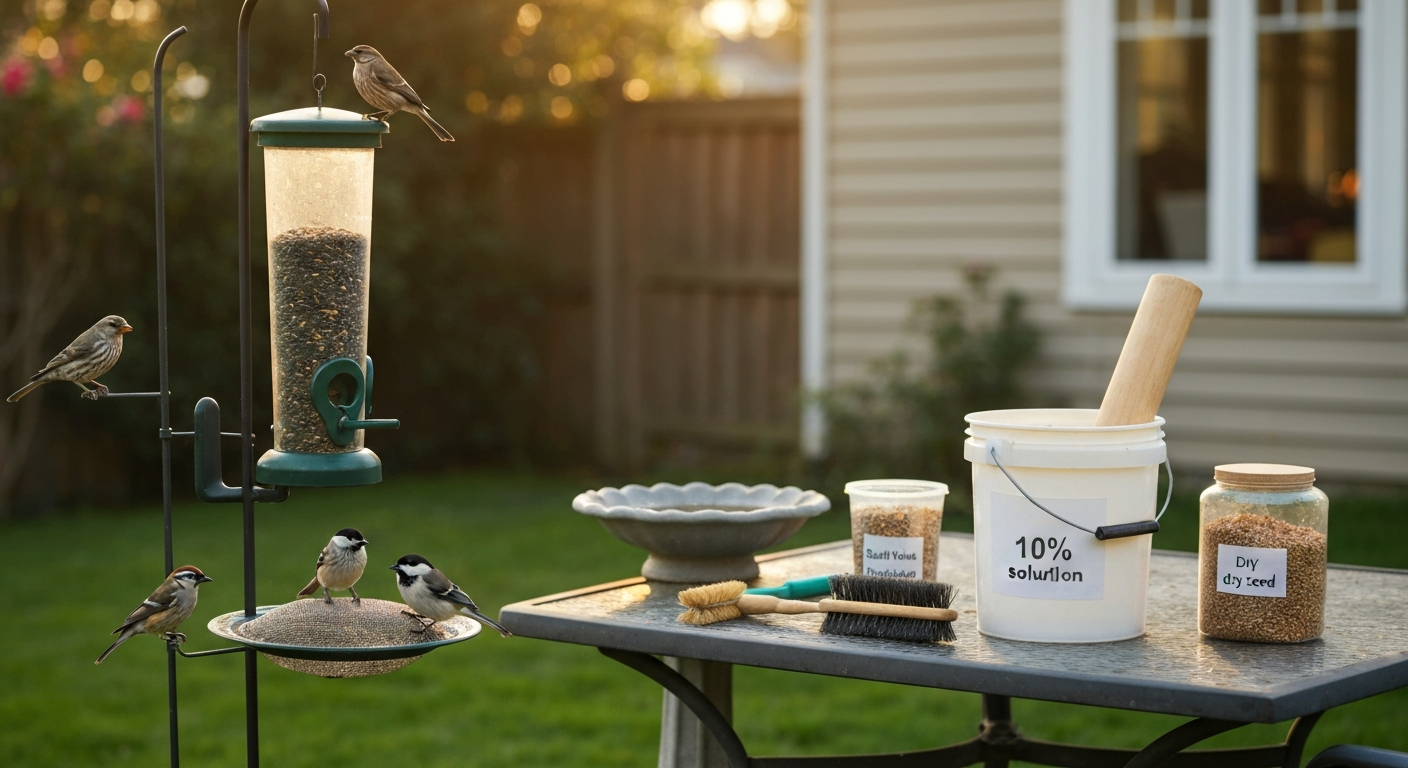
The standard disinfection recipe cited by Project FeederWatch (Cornell Lab of Ornithology), the CDC, and most state wildlife agencies is one part household bleach to nine parts water, approximately a 10% bleach solution. Soak cleaned feeder parts in this solution for about 10 minutes, then rinse thoroughly and allow to air-dry completely before refilling. Never refill a feeder that is still wet inside, as moisture accelerates mold and bacterial growth.
- Empty the feeder completely. Discard any wet, clumped, or visibly moldy seed in a sealed bag, not your compost.
- Rinse the feeder under running water to remove loose debris, husks, and feces.
- Scrub all surfaces, including perches, ports, and the base, with a brush and hot soapy water. A bottle brush works well for tube feeders.
- Prepare a 10% bleach solution: one part bleach to nine parts water in a bucket or sink.
- Submerge the feeder parts and soak for 10 minutes.
- Rinse thoroughly under running water until no bleach smell remains.
- Allow to air-dry completely, ideally in sunlight.
- Refill only when fully dry. Store seed in a cool, dry, sealed container.
Cleaning Frequency by Situation
| Situation | Recommended Frequency | Notes |
|---|---|---|
| Normal year-round use, dry conditions | At minimum monthly | Spot-clean between full cleans |
| Heavy use, wet or humid weather | Every 1–2 weeks | Moisture accelerates pathogen growth |
| Summer (suet and fruit feeders) | Every 1–2 days in hot weather | Suet goes rancid quickly above 20°C (68°F) |
| Active disease outbreak in your area | Weekly full clean, daily spot-check | Consider temporary removal if sick birds present |
| After finding a sick or dead bird at feeder | Immediate full clean, then remove feeder for 2 weeks | Reintroduce only after no further sick birds observed |
| Birdbaths | Water refresh every 3–4 days minimum, full scrub weekly | Birdbaths carry equal or higher disease risk than feeders |
Feeder Types and Design Features That Reduce Harm
Not all feeders carry equal risk. Tray and open platform feeders are the most problematic from a disease and contamination standpoint. They concentrate seeds, husks, and feces in a single exposed surface, stay wet during rain, and offer no protection from bird droppings landing directly in the food. The RSPB has gone as far as withdrawing some tray feeders from sale due to disease concerns. If you use a tray feeder, look for one with a mesh base that allows water and debris to fall through, and clean it more frequently than any other feeder type.
Enclosed tube feeders are a significantly better design. They limit seed exposure to small access ports, reduce fecal contamination of uneaten seed, and dry out faster between uses. Look for tube feeders with removable bases (for proper cleaning) and wide seed ports that don't crack seed against the feeder edge, since cracked wet seed is a mold risk.
Design Features to Look For
- Removable, dishwasher-safe components: Makes thorough cleaning practical rather than aspirational.
- Mesh or drainage holes in the base: Prevents water pooling and seed rot.
- Enclosed seed reservoir: Limits direct fecal contamination of uneaten seed.
- UV-resistant or non-porous materials: Easier to disinfect than wood or rough-surfaced feeders; wood is very difficult to fully sanitize.
- Squirrel baffles and mounting poles: Reduce ground disturbance and cat access near the feeder.
- Adjustable perch length: Shorter perches on tube feeders can favour small songbirds over larger, more dominant species.
- Window feeder suction cups (for close placement): Placing a feeder within 1 metre of a window is a proven collision-reduction strategy; dedicated window feeders with suction cups make this practical.
- Weight-sensitive or cage-protected ports: Limit access to target species and reduce crowding from larger birds.
Feeder Placement Rules That Prevent Window Strikes
Place feeders either within 1 metre of a window or more than 10 metres away. The dangerous zone is the 1–10 metre range, where birds build enough speed to sustain a fatal collision but are still close enough to glass to strike it. At under 1 metre, birds that do contact the glass are moving too slowly to be seriously injured. If you can't achieve either of those distances, apply window collision tape, frosted film, or external netting to the nearest glass surface. Horizontal tape strips placed every 5 cm or less are the minimum effective density.
Placement and Deterrents for Cat Predation
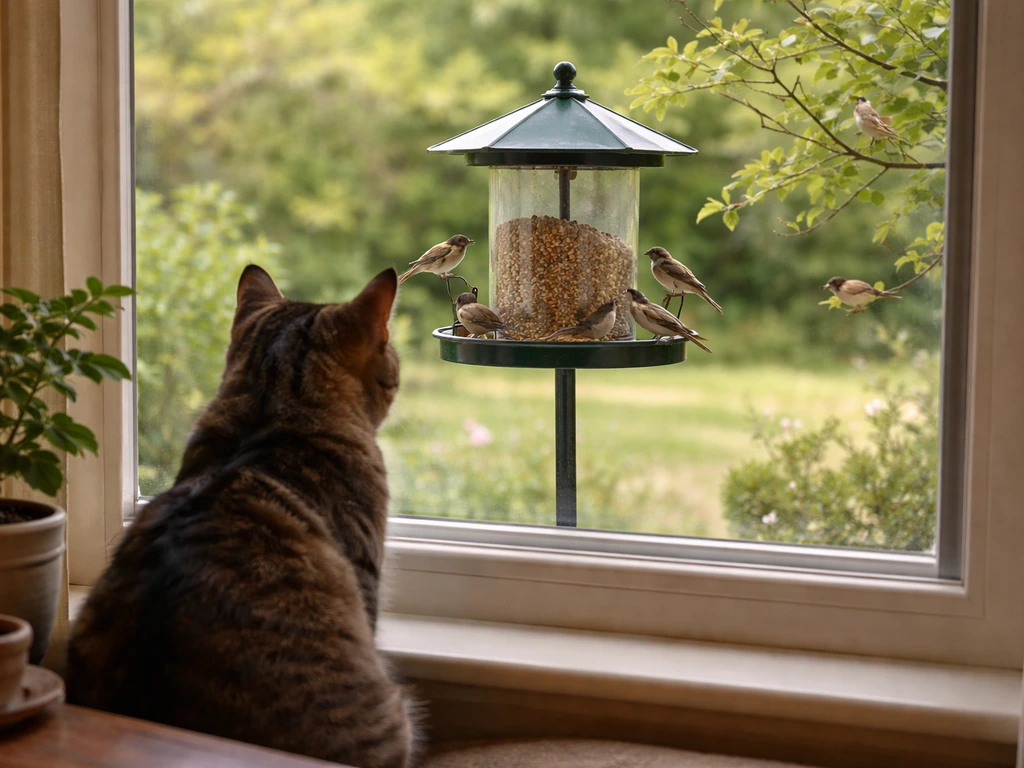
Mount feeders at least 1.5 metres off the ground on a pole with a baffle, positioned away from fences, shrubs, or structures cats can use to launch an ambush. If you have an outdoor cat, fitted anti-predation collar covers (brightly coloured designs like the Birdsbesafe collar) have shown substantial reductions in bird predation in multiple studies, including a ZSL Journal of Zoology study by Pemberton in 2020. Bells alone are less effective, particularly for experienced hunters. Keeping cats indoors during dawn and dusk, when birds are most active at feeders, is the single highest-impact change a cat owner can make.
When to Pause Feeding Entirely
There are clear situations where the right call is to take the feeder down rather than manage around the problem. Decision rules are straightforward: if you find one or more dead birds at your feeder, take it down immediately, clean it, and wait at least two weeks before reintroducing it. If you observe multiple sick birds over a short period, the same applies. During a confirmed regional disease outbreak, your local wildlife agency may advise suspending feeding entirely for a period, as happened with the 2021–22 multi-state mystery songbird illness in the eastern U.S. Check with your state wildlife agency or the USGS National Wildlife Health Center for current outbreak alerts in your area.
Outside of disease events, late spring and summer are often the best time to scale back or pause feeding in temperate regions. Natural food abundance is high, dependent fledglings benefit more from learning to forage naturally, and heat makes suet, fruit, and nectar feeders hazardous without daily management. Pausing in summer also reduces the risk of inadvertently altering migratory timing for species that should be moving on.
Do Feeders Make Birds Dependent?
This concern comes up often, and it's worth addressing directly. For a deeper look, see our guide on whether bird feeders make birds dependent. The Wilcoxen et al. field study found no evidence that established wild birds became catastrophically dependent on feeders when feeders were removed. Birds are flexible foragers, not obligate feeder users. That said, there are subtler effects worth knowing about: a Plummer et al. study found winter feeding reduced subsequent breeding performance in blue tits, which suggests that the type, timing, and nutritional content of what you provide matters. High-fat, low-protein supplementary food in late winter may interfere with natural condition-building for breeding. Using species-appropriate, high-quality seed and limiting provision in the run-up to breeding season is a reasonable precaution.
Evaluating What You Read About Bird Feeders
If you've been reading Reddit threads or social media posts about feeders killing birds, you'll find both extremes: people dismissing all risk as overblown and people insisting feeders are an ecological disaster. For a sampler of public concern and practical tips, see Reddit threads asking 'Are bird feeders bad?', which illustrate common worries and practical solutions. The peer-reviewed evidence sits somewhere in the middle and is considerably more useful. Risks are real but mostly preventable. Benefits are real and well documented. Before acting on any specific claim, look for whether it's based on a controlled study, a field observation, or an anecdote. The disease and placement risks described here have solid experimental backing. Claims about feeders catastrophically harming local ecosystems at the backyard scale generally do not. A balanced view of the evidence is the most useful tool you have.
If you're interested in going further, there are related questions worth exploring: whether feeders affect garden ecology and pest control, how feeding intersects with cat behaviour and safety, and the dependency question in more depth. If you want a focused discussion on whether bird feeders are good for gardens, see our guide Are bird feeders good for gardens, which reviews effects on pest control, pollination, and plant health. For detailed guidance on feeding and cat safety, see our piece "Are bird feeders good for cats.". Each of those topics has its own evidence base and practical implications for how and whether you choose to feed.
FAQ
Short answer: are bird feeders killing birds?
No — properly managed bird feeders are not a major cause of bird mortality by themselves. Feeders can increase some risks (disease spread, collisions, predation, contamination, altered local ecology), but many of those risks are identifiable and largely preventable with evidence‑based practices. When feeders are dirty, poorly placed, or paired with outdoor cats, they can contribute to harm. Clean feeders, sensible placement, responsible cat management, and good monitoring reduce risks while keeping the clear benefits of supplemental food, pest control and education.
What does the scientific evidence say about feeders and disease?
Strong evidence shows feeders can act as fomites and congregation points for disease transmission (e.g., Mycoplasma gallisepticum in house finches and documented salmonellosis outbreaks). Experimental and field studies link feeder use to acquisition and spread of pathogens; cleaning reduces surface transmission risk but cannot stop direct bird‑to‑bird transmission when infected birds repeatedly visit feeders. Overall, feeders increase contact rates and environmental contamination, which raises disease risk unless mitigated.
Which diseases are of most concern at feeders?
Key concerns: • Mycoplasma gallisepticum (MG) — causes conjunctivitis in finches; strongly linked to feeders. • Salmonella spp. — causes gastrointestinal disease and mass die‑offs in passerines in some outbreaks. • Fecal–oral parasites and bacteria (coccidia, E. coli) — prevalence varies. Severity and occurrence are regionally and seasonally variable.
What are the benefits of feeding birds?
Evidence‑based benefits include: • Supplemental nutrition during harsh seasons or urban food gaps. • Improved short‑term body condition and sometimes reproductive parameters. • Garden pest control (some insectivores). • Educational, mental‑health and citizen‑science benefits (birdwatching, learning). • Supporting urban wildlife and connecting people to nature — which can encourage conservation actions.
Complete list: specific harms feeders can cause
• Disease transmission and localized outbreaks (MG, Salmonella, parasites). • Increased window collisions if feeders attract birds into risky locations. • Increased predation by cats and other predators if feeders are accessible. • Contaminated/rotten food causing illness or toxicity (moldy seeds, rancid fat). • Altered local species composition (favoring generalists/competitive species). • Increased human–wildlife conflict (e.g., nuisance birds). • Possible small behavioral changes (e.g., reduced foraging range) but not clearly catastrophic dependency in most studies.
Complete list: specific benefits of feeders
• Supplemental calories in winter or migration. • Better short‑term body condition for some species. • Support for juvenile survival in some contexts. • Attraction of birds for monitoring, education and wellbeing. • Indirect benefits for gardens via insectivorous species and seed dispersal in some cases.
Next Articles
Are Bird Feeders Good for Cats? Pros, Cons, and Safety Tips
Find out if bird feeders are good for cats, with risks, pros, and safety tips for placement and hygiene.
Where to Hang Bird Feeders in Winter: Exact Placement Tips
Exact winter feeder placement tips for birds and safety: height, window distance, shelter, and troubleshooting.
Do You Leave Bird Feeders Out All Year? Seasonal Guide
Should you leave bird feeders out all year? Get seasonal tips, safe feeding, and cleaning to prevent disease and pests.