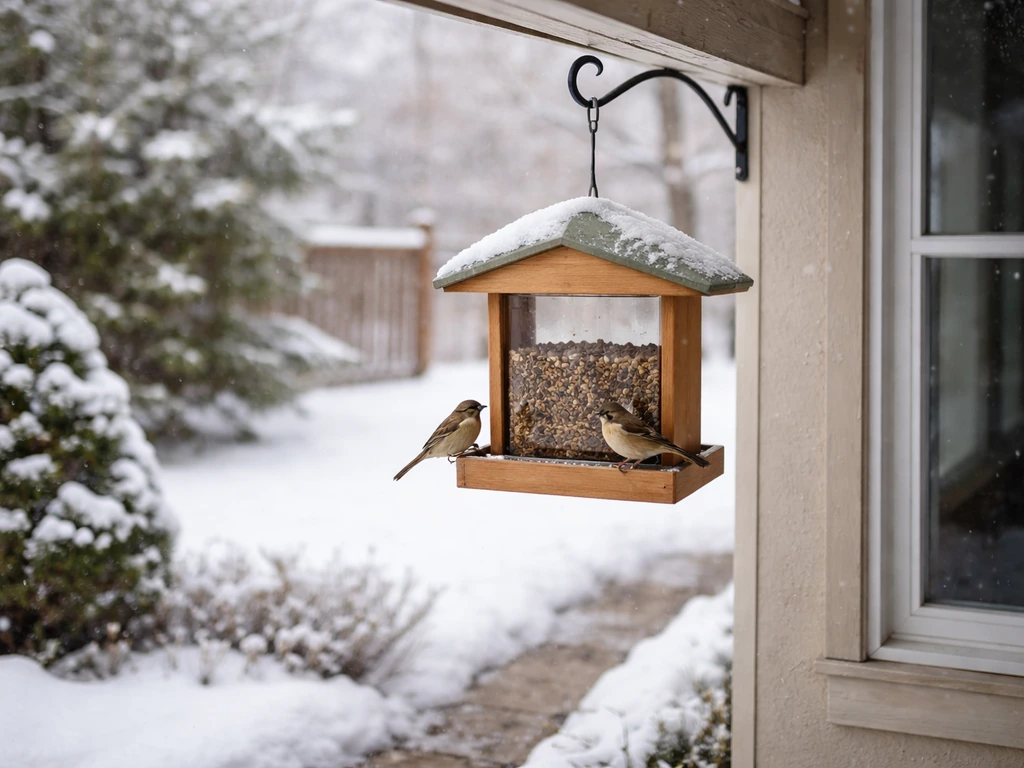
Bird feeders are not inherently good or bad for cats, it really depends on your cat's temperament, your yard setup, and how closely you manage the situation. For an indoor cat watching birds through a window, a feeder can be genuinely enriching. For a free-roaming outdoor cat with strong prey drive, a feeder is basically a stocked hunting ground. The honest answer is that bird feeders and cats can coexist, but only if you're willing to make a few smart changes to placement, feeder type, and your own supervision habits.
Are Bird Feeders Good for Cats? Pros, Cons, and Safety Tips

Eleanor Hartwick
11 Jul 2026
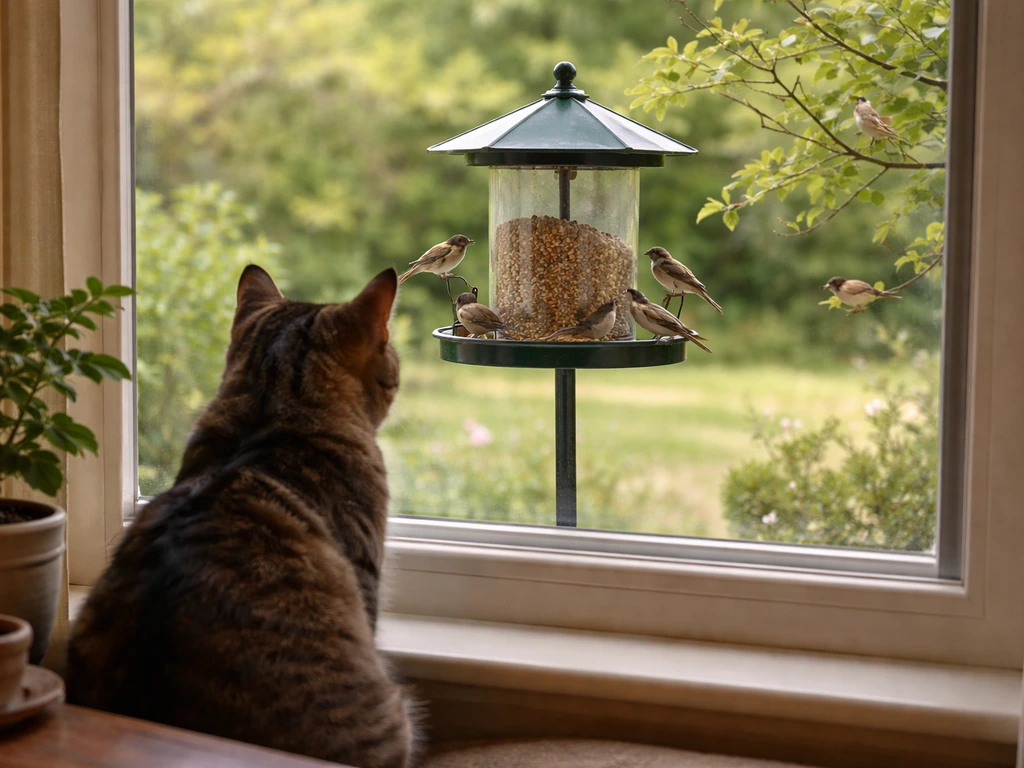
Do cats actually like bird feeders?
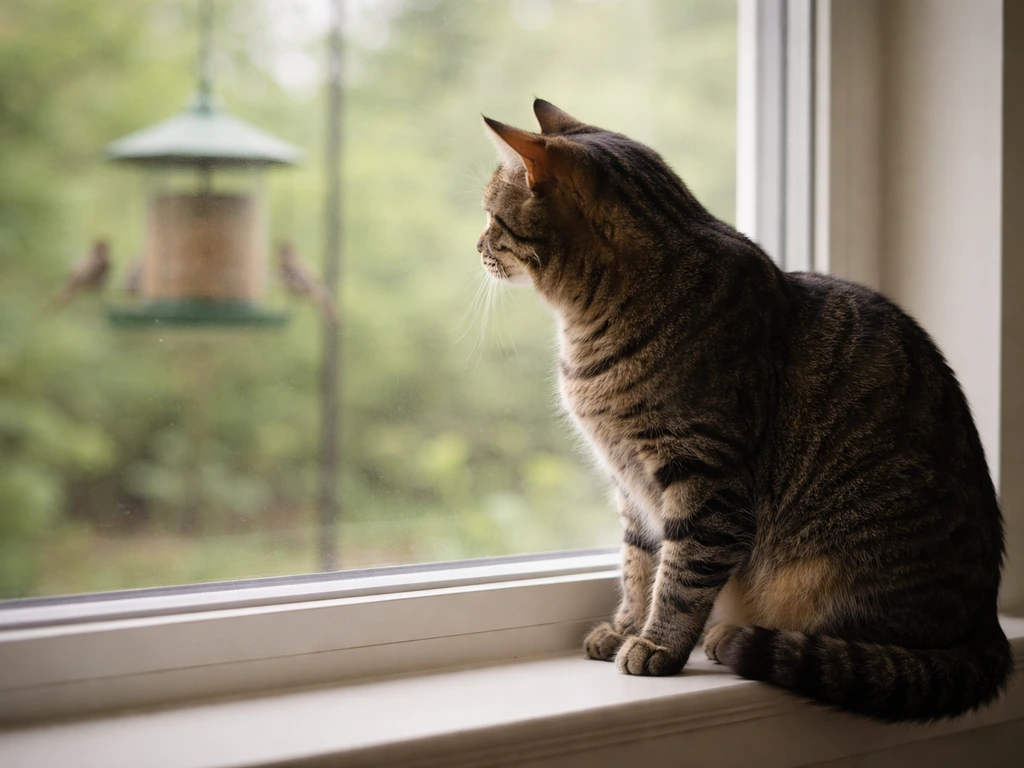
Yes, most cats are drawn to bird feeders, but for very different reasons than you might hope. The movement, sound, and clustering of birds near a feeder triggers the predatory response in almost every cat, regardless of whether they've ever successfully hunted. You'll see chattering, focused staring, tail-twitching, low-body stalking, and in some cats, genuine frustration or hyperarousal when they can't reach the birds.
For indoor cats that can only watch through a window, this is usually fine, stimulating, even. Many cat owners deliberately place feeders within window view as a form of environmental enrichment, and there's real value in that. The cat gets mental engagement without being able to act on the instinct. Watch your cat's body language: relaxed watching, occasional chirping, and easy disengagement when you call them away are signs of healthy curiosity. If your cat is fixated to the point of ignoring food or sleep, pacing the window, or becoming agitated when birds leave, that's a higher-stress response and worth adjusting the setup.
Outdoor and free-roaming cats are a different story. They won't just watch, they'll stalk, wait, and hunt. A feeder that concentrates birds in one predictable spot is an enormous advantage for a hunting cat. Even cats that rarely catch anything still spend hours in ambush mode around active feeders, which raises their own risk of injury, exposure to disease, and conflict with other animals.
Pros and cons when you have cats in the yard
There are genuine benefits here, but you have to be clear-eyed about the trade-offs. Let me break down both sides.
| Pros | Cons |
|---|---|
| Provides visual and mental stimulation for indoor cats | Concentrates birds in one spot, making hunting easier for outdoor cats |
| Encourages cats to spend calm, passive time at a window | Can trigger stress or obsessive behavior in high-drive cats |
| Can be placed to attract birds safely out of cat reach | Spilled seed draws rodents and other animals cats may chase or fight |
| Supports garden health by attracting pest-eating birds | Increases disease and parasite exposure for cats that contact bird droppings or carcasses |
| Rewarding for owners who enjoy watching both cats and birds | Neighboring or feral cats may be attracted to your yard as well |
The biggest variable is whether your cat has outdoor access. If your cat is fully indoor, the benefits almost always outweigh the downsides. If your cat roams outside unsupervised, the risks to birds and to your cat climb sharply. This is also worth thinking about if you're wondering whether bird feeders are good for gardens more broadly, the ecological benefits are real, but a hunting cat can undercut them fast.
The real safety risks: cats, birds, and everything in between
Hunting and bird mortality
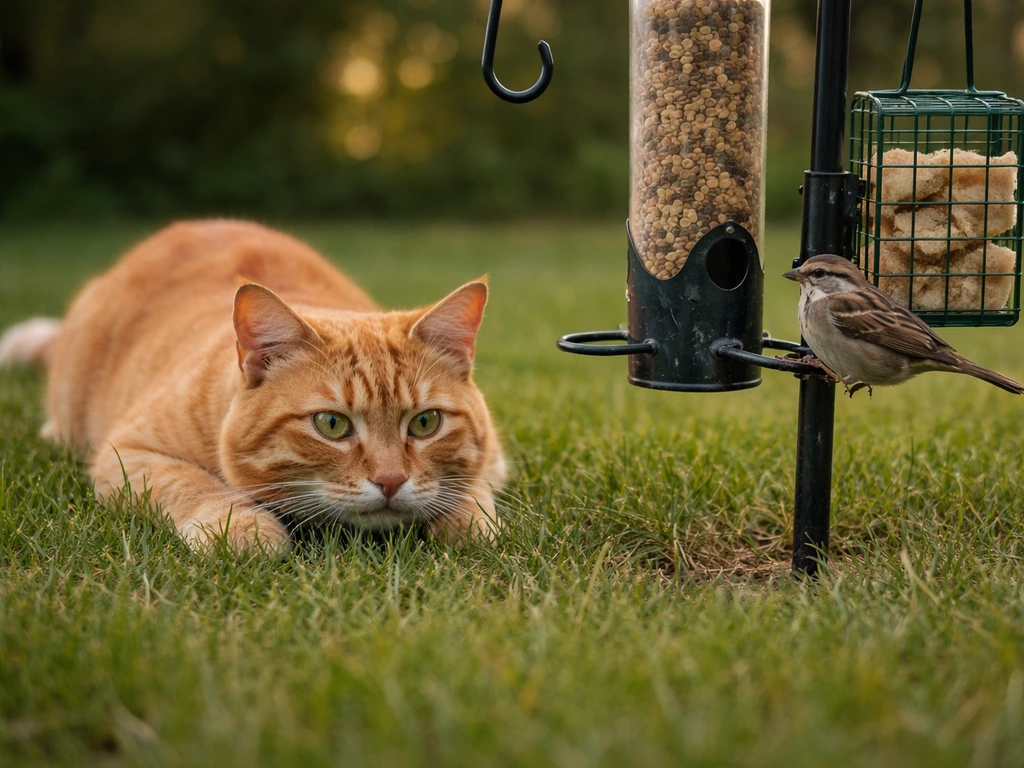
This is the biggest concern. Free-ranging cats are one of the leading causes of bird mortality in North America, and bird feeders that concentrate birds in a predictable location make that problem significantly worse. A cat doesn't need to be a skilled hunter to cause harm, even failed hunting attempts stress birds, disrupt feeding patterns, and can cause fatal window collisions when startled birds flee. The Florida Fish and Wildlife Conservation Commission is direct about this: if a cat (including a neighbor's or feral cat) is regularly hunting around your feeder, the most effective solution is to stop feeding temporarily until the cat loses interest and moves on.
Injury risks to your cat
Hunting near a feeder isn't risk-free for cats either. Cats that spend time around feeders can get into confrontations with squirrels, chipmunks, raccoons, and other wildlife attracted to the seed. Larger birds like crows, blue jays, and even mockingbirds will actively mob and dive-bomb cats, sometimes causing scratches or eye injuries. If your yard attracts hawks, a small cat or kitten outside near a feeder could also be at risk.
Disease and parasite exposure
Bird droppings, feathers, and carcasses left near feeders carry a real disease and parasite load. Cats that patrol feeder areas can pick up salmonella, campylobacter, and various parasites from contaminated ground. Cats that catch and eat birds are also at risk for toxoplasmosis and avian-associated parasites. This is one reason cleanup isn't optional, it protects your cat as much as the birds.
Pest attraction
Spilled seed and ground-level feeding attracts mice and rats, which cats may hunt. Rodent contact brings its own set of disease risks (including leptospirosis and rat-bite fever) and can lead to rat poison exposure if neighbors or pest control services are baiting in the area. It's worth keeping this chain of attraction in mind when you decide how much seed to put out and how often to clean up.
Where to put your feeder to keep both cats and birds safer
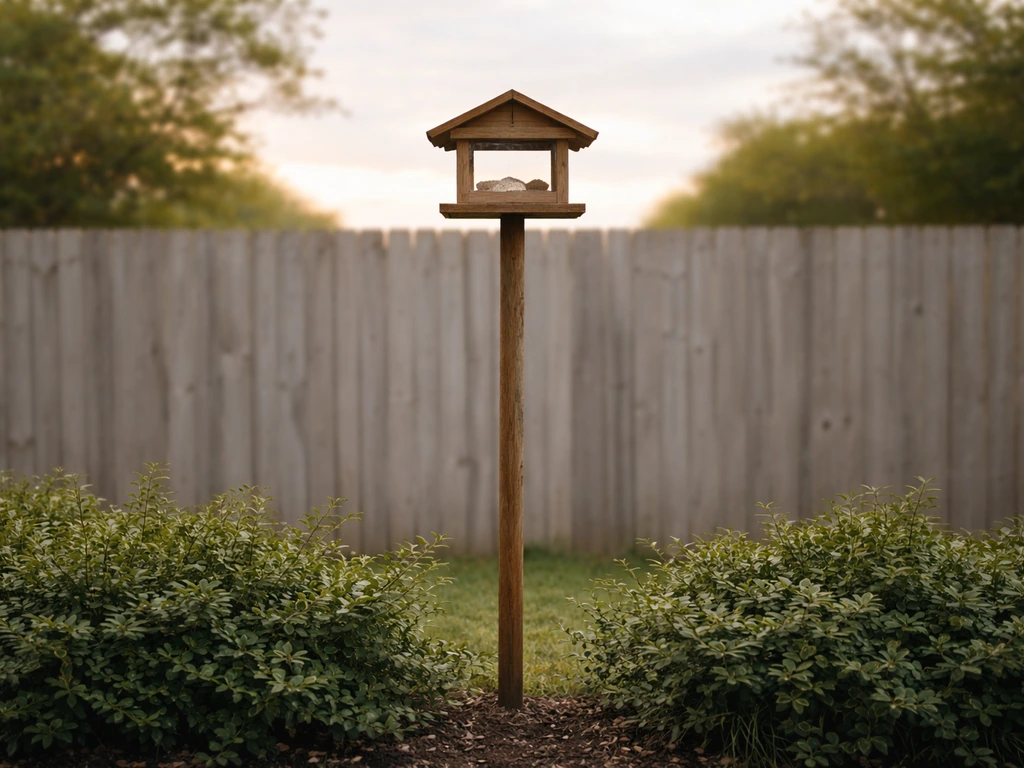
Placement is the single biggest lever you have. Get this right and you solve most of the problems at once.
Height is your first line of defense. The Internet Center for Wildlife Damage Management recommends mounting feeders at least 6 feet off the ground and at least 10 feet away from any nearby branch, fence, roof, or structure a cat could jump from. Cats are excellent climbers and jumpers, a feeder at 4 feet on a smooth pole is not safe if there's a fence 8 feet away at the same height.
Distance from windows matters too, but for a different reason: bird collisions. Tufts Cummings School of Veterinary Medicine recommends placing feeders either within 3 feet of a window (so birds don't build up enough speed to cause a fatal strike) or more than 30 feet away. The danger zone is the middle range, birds are close enough to be startled by a cat or reflection but far enough to accelerate into the glass. If your feeder is in that 3-to-30-foot window zone, consider moving it.
Think carefully about stalking routes. Cats hunt by approaching from cover, long grass, shrubs, garden borders, and low fencing are all preferred ambush routes. Place feeders in open areas away from dense plantings, with clear sight lines so birds can spot a cat approaching. A feeder in the middle of an open lawn is much safer than one tucked into a hedgerow corner.
Balconies and elevated decks can work well for urban cat owners. If your cat doesn't have access to the balcony, a feeder hung from a railing or hook gives birds a relatively cat-free feeding zone. Just clean the balcony floor regularly to prevent seed buildup and droppings.
Feeder types, baffles, and blocking ground access
Not all feeders are equally cat-proof. Here's what works and what doesn't when you have cats around.
- Hanging tube feeders: Good choice. Hang them high from a branch or shepherd's hook and they're hard to reach. Birds that drop seed are the weak link — add a seed-catcher tray below to reduce ground spillage.
- Pole-mounted feeders with baffles: A pole-mounted feeder with a cone or cylinder baffle (umbrella-shaped guard) below the feeder is effective at stopping cats and squirrels from climbing up. Penn State Extension and ICWDM both recommend baffles as a core access-prevention tool.
- Platform and tray feeders: These are the riskiest option if cats are present. Low, open platforms are easy to approach and give cats a clear shot at ground-level birds. If you use one, mount it high and use a baffle.
- Window-mounted feeders: These work well for indoor cat enrichment — birds visit right at glass level, the cat watches from inside, and there's zero hunting risk. Just be aware of the window collision concern if placed badly.
- Ground feeders: Avoid these entirely if you have cats with outdoor access. Ground-level feeding is the most dangerous setup possible for birds.
For ground access specifically, the goal is to minimize the amount of seed that ever reaches the ground. Use feeders with built-in trays, clean up spilled seed daily, and consider no-waste seed mixes (like hulled sunflower or millet) that birds are less likely to toss aside. If you do feed on the ground for ground-feeding species like doves or sparrows, Penn State Extension recommends rotating the feeding location regularly and raking up debris and droppings to reduce both disease buildup and cat ambush points.
Maintenance and cleanup when cats are in the picture
Cleaning is non-negotiable. The U.S. Fish and Wildlife Service cites Cornell Lab guidance that feeders should be cleaned at least once every two weeks as a baseline disease-reduction practice. If you have cats spending time near the feeder, I'd push that to weekly during heavy use periods. Cornell also recommends wearing rubber gloves when cleaning to avoid picking up pathogens yourself.
Beyond the feeder itself, the ground underneath matters. Rake or sweep the area below your feeder at least weekly to remove droppings, hulls, and any dead birds or feathers. This isn't just about aesthetics, decomposing debris is where the real disease risk concentrates, and it's the first thing a curious cat will investigate. If you're also wondering do bird feeders make birds dependent, the answer depends on how consistently you feed and whether natural food sources are still available nearby. If you notice your cat rolling in or chewing on anything near the feeder area, that's a red flag to clean more aggressively.
Feed only as much as birds will eat in a day. This is Penn State Extension's advice for platform feeders and decks, and it's worth applying broadly. Leftover seed that sits overnight gets wet, molds, and draws rodents. It also means more birds clustering longer, which is more tempting for a hunting cat. Match your fill level to actual bird traffic, you'll quickly get a feel for how much your local flock goes through.
If you find a dead bird near your feeder, remove it immediately using gloves and a bag. Don't let your cat investigate it. Bird carcasses can carry salmonella and avian parasites that transfer easily to cats, and leaving them near the feeder also trains cats to expect prey in that location.
Seasonal tips and what to do if your cat won't leave the feeder alone
Bird activity at feeders peaks in winter (when natural food is scarce) and again in spring migration. These are also the periods when cats are most likely to be fixated on feeder activity. If you have a cat that becomes genuinely obsessive around a feeder during peak season, spending hours at the window without disengaging, or making a beeline for the feeder zone every time they go out, it's worth adjusting your schedule and setup.
In summer and early fall, many bird species are raising fledglings. Fledglings that leave the nest are especially vulnerable to cats because they spend time on the ground before they can fly well. If you see fledglings in your yard, this is a strong signal to keep your cat indoors during the day and to temporarily reduce ground-level feeding that would attract birds to the same spots your cat patrols.
If a feral or neighbor's cat has found your feeder and won't leave the area, the most effective short-term fix, as the Florida FWC recommends, is to stop feeding for a week or two. Cats are routine-based hunters. Once the birds stop coming, the cat moves its attention elsewhere. You can restart once the pattern breaks. This feels frustrating, but it works more reliably than trying to deter a determined cat with sprays or motion-activated devices.
NC Wildlife's guidance is worth taking seriously: keeping cats indoors is the single most effective intervention, and it's the most direct action you can take today. If full indoor living isn't realistic for your cat, supervised outdoor time, a catio, or a leash/harness during peak bird activity hours (early morning and late afternoon) will cut predation risk dramatically without requiring you to give up bird feeding entirely.
One last thing: if you're weighing the broader question of whether bird feeders are worth keeping at all, given concerns about predation, disease, or bird dependency on supplemental feeding, those are real and legitimate considerations. If you’re asking whether bird feeders are killing birds, it helps to focus on placement and cleanup so you reduce predation and disease risk are bird feeders killing birds. The short version is that well-managed feeders do far more good than harm, but the 'well-managed' part is doing a lot of work in that sentence. The same principles that protect birds from cats (height, hygiene, placement, portion control) also address most of the other common concerns around feeder safety.
FAQ
If my cat is indoors, can a bird feeder still make my cat sick or cause problems beyond predation?
Yes, disease and contamination can still be an issue because your cat can touch or lick feeder-area residue (droppings, hulls, wet seed, or dead feathers). Even without hunting, you still want regular ground cleanup and more frequent feeder cleaning during heavy bird traffic, and avoid letting your cat paw at the tray where seed accumulates.
Will birds stop coming if I remove the feeder when a cat nearby is hunting?
Often they will, at least temporarily, but the key goal is to break the hunting routine. When you stop for a week or two, the birds usually return when the area becomes predictable again. Restart gradually (smaller fills, cleaner setup) so you can quickly tell whether the cat pattern has truly shifted.
My cat just watches the birds, but they get intense (staring, pacing). Does that count as a risk?
It can. Fixation is an early sign of hyperarousal, and it often escalates into pawing at windows, sudden bursts, or attempts to reach the feeder area if there is any access. If you notice ignoring food or sleep, repeated window-running, or agitation when birds leave, treat it like a stress indicator and adjust placement, reduce feeder attractiveness, and consider more structured supervision.
Are hummingbird feeders safer for cats than tube or platform feeders?
Not automatically. What matters most is whether seed or nectar leaves residue that draws your cat to the ground or lets them access birds. Nectar feeders can still attract ants and other insects, and spilled nectar can get on paws and whiskers. Use tight-mounted designs, keep them away from jump points, and clean them on schedule to prevent sticky mess that encourages investigation.
What’s the best way to prevent my cat from getting seed on the floor if I have a tray feeder?
Choose designs with a covered or contained tray, then control the “leak” rate by using no-waste or hulled seed blends and filling only what birds will eat in a day. If your cat can reach the tray or stir it, consider relocating the feeder to a balcony or enclosed area, and add routine sweeping of the immediate drop zone.
How far should I place a feeder from a window if I want birds to stay safe but still enjoy viewing from inside?
Aim for either very close (so birds cannot build speed) or very far (so reflections and startled flight don’t lead to the risky middle zone). The “middle range” is where collisions become more likely. If your current distance is in that 3-to-30-foot gap, moving the feeder is usually the most effective change.
What should I do if a hawk or other larger bird starts mobbing my cat near the feeder?
Stop feeding at that location temporarily, and remove the feeder until the behavior settles, since mobbing can cause unexpected scratches or eye injuries to your cat. Also reassess placement away from climbing cover so your cat cannot position itself for surprise ambush near where these birds concentrate.
Is it safe to let my cat investigate a dead bird or feathers near the feeder if I remove it later?
No. Even brief contact can expose your cat to pathogens or parasites carried in carcasses and decomposing material. Use gloves to remove the bird or debris, then clean the area, and keep your cat away until you have cleared visible feathers, hulls, or droppings.
How can I tell if spilled seed is attracting rodents that my cat will then hunt?
Look for activity signs beneath and around the feeder area, like droppings, gnaw marks, and missing seed overnight. If you see rodents or frequent pawing and circling by your cat near the ground, reduce the fill level, switch to a feeder that minimizes spillage, clean daily, and avoid over-seeding during peak bird arrival times.
What’s the safest outdoor setup if I can’t keep my cat fully indoors?
A catio or enclosed balcony is often safer because it removes hunting access while still allowing viewing. If that’s not feasible, supervised leash or harness time during peak feeder hours (early morning and late afternoon) reduces predation risk, and you should also place feeders where your cat cannot reach from nearby cover.
If I’m cleaning the feeder, do I need special precautions for myself as well as my cat?
Yes. Wear rubber gloves, avoid touching your face while cleaning, and bag and dispose of debris promptly so you do not aerosolize or spread contaminated dust. Wash hands thoroughly afterward, and keep cats away from the cleaned area until surfaces are dry and odor-free.
Next Article
Where to Hang Bird Feeders in Winter: Exact Placement Tips
Exact winter feeder placement tips for birds and safety: height, window distance, shelter, and troubleshooting.