Bird feeders are simple tools with surprisingly complex effects. Done well, they support birds through tough seasons, reward you with daily wildlife encounters, and contribute real data to citizen science. For a focused explanation of why bird feeders are important, see our detailed article on why bird feeders are important. Done carelessly, they can spread disease, attract unwanted animals, and create dependency that shifts bird behavior in ways you probably didn't intend. This guide is for anyone who wants to feed birds thoughtfully: backyard birdwatchers setting up their first feeder, homeowners troubleshooting a problem setup, and wildlife stewards trying to balance enjoyment with ecological responsibility. We'll cover the honest benefits and drawbacks, when to feed and when to stop, how to pick the right feeder and food, where to put everything, and how to keep it all clean and safe.
What to Know About Bird Feeders: Safe, Smart Feeding Tips

The honest benefits and drawbacks of feeding birds
There's real science behind the case for feeding birds. For a concise summary of the pros and cons of bird feeders, consult our pros and cons of bird feeders guide. Winter supplementation has been shown in field experiments to increase breeding productivity the following season, including higher fledgling success. That's not just anecdotal feel-good stuff; it's measurable. For species that overwinter in cold climates, access to reliable food can reduce starvation risk during energy-demanding cold snaps. From a backyard steward's perspective, feeders also create a consistent observation point, which makes it much easier to notice when something is wrong, whether that's a sick bird, a new species showing up, or a hawk working the area. Learn more about the benefits of bird feeders in our detailed guide.
But there are real trade-offs worth knowing. Supplemental food has been linked to changes in migratory behavior across multiple bird species, including shifts in migration timing and reductions in the proportion of individuals that migrate at all. A review (blank" rel="noopener noreferrer">Responses of migratory species and their pathogens to supplemental feeding) found supplemental food and feeders were linked to changes in migration timing and the proportion of individuals that migrate across birds and other vertebrates. Whether that's a problem depends on your perspective and your local ecosystem, but it's worth being aware that your feeder isn't operating in isolation. Beyond behavior, the bigger documented risk is disease. When birds congregate at feeders, pathogens spread. Mycoplasma gallisepticum, the bacterium responsible for house finch conjunctivitis, emerged in North American house finches in the 1990s and caused serious population declines; experimental research has confirmed that infected feeder surfaces (fomites) are a direct transmission route. In the UK, finch trichomonosis (caused by the parasite Trichomonas gallinae) emerged around 2005-2006 and devastated greenfinch and chaffinch populations, with blank" rel="noopener noreferrer">feeder congregation identified as a primary driver of spread. And in 2020-2021, a multistate Salmonella Typhimurium outbreak in the United States was epidemiologically linked to sick wild songbirds and backyard feeders, resulting in human illness. These aren't reasons to never feed birds. They are reasons to do it with your eyes open.
When to use feeders: seasonal guidance and conservation context
The question of when to feed is one I hear constantly, and the answer is more nuanced than 'year-round is fine. For a concise overview of timing and seasonal recommendations, see when to use bird feeders. ' Winter is the most defensible time to run feeders. Energy demands are high, natural food sources are scarce, and there's solid research showing that winter supplementation helps birds survive and breed more successfully the following spring. If you live somewhere with genuinely harsh winters, keeping feeders stocked from late autumn through early spring makes clear ecological sense.
Spring migration is another high-value window. Migrants passing through your area are burning enormous energy, and a feeder stocked with appropriate food can make a real difference for birds refueling on long journeys. That said, you should watch your feeders more closely during migration, because the mixing of species from different geographic populations increases pathogen exposure risk.
Summer is where it gets complicated. Many birds shift almost entirely to insects during breeding season, and supplemental seed is largely irrelevant to them. Hummingbird feeders are a legitimate exception, and feeders stocked with mealworms can support insectivores. But general seed feeders in hot, humid summer weather carry higher spoilage and disease risks. You'll need to clean them more frequently, and the benefit-to-risk ratio is lower than in winter. Late summer through fall, as birds begin fattening up for migration or winter, feeders become useful again.
One situation where you should temporarily stop feeding is during a local disease outbreak. If you're seeing sick or dead birds near your feeders, public health and wildlife authorities including the CDC and the Southeastern Cooperative Wildlife Disease Study recommend removing feeders entirely for two to four weeks to disperse the congregation and interrupt transmission. It feels counterintuitive, but it's the right call.
Choosing a feeder: types, materials, and disease risk
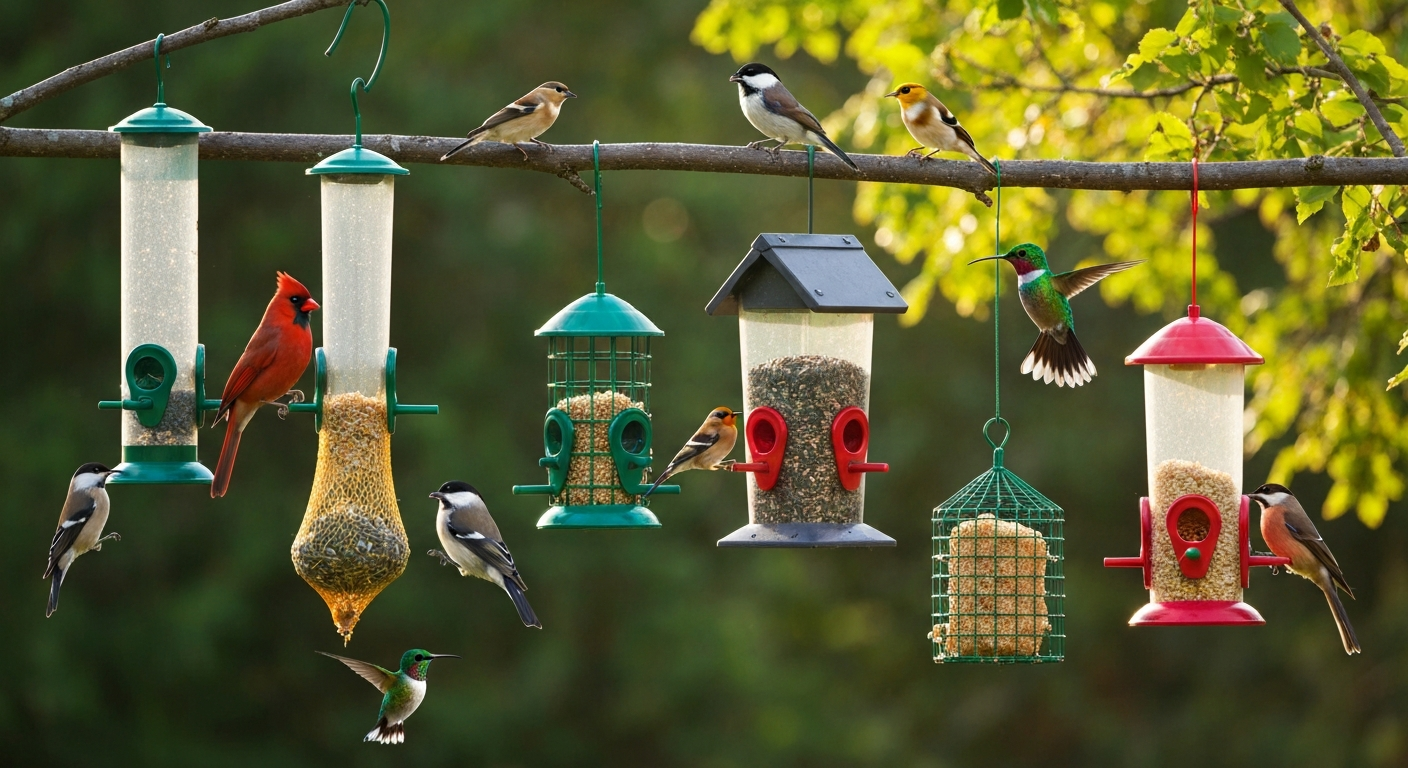
The type of feeder you choose directly affects which species you attract, how easy the feeder is to clean, and how much disease risk you're creating. For recommendations, see our guide to the best bird feeders to prevent disease. Platform and hopper-style feeders with flat, open surfaces are consistently identified in outbreak investigations as higher-risk for Salmonella and other pathogens because feces and spoiled food accumulate on surfaces that birds then walk across and eat from. That doesn't mean you can never use them, but if you do, you need to clean them more frequently and monitor them closely.
Tube feeders with small ports reduce surface contamination because birds can't stand in the seed. Mesh feeders work similarly well for nyjer and peanuts. Caged feeders add a layer of protection by limiting which species (and non-bird visitors) can access the food. For hummingbirds, glass or hard plastic bottle-style feeders with few ports and smooth surfaces are the most practical to disinfect properly.
Material matters too. Smooth, nonporous surfaces like metal, glass, and hard plastic are meaningfully easier to disinfect than porous or weathered wood. Wooden feeders can harbor pathogens in cracks and grain even after cleaning, which is why wildlife veterinary and extension guidance recommends metal or plastic feeders when disease risk is a concern. If you have a beloved wooden feeder, that's fine, but be honest with yourself about whether you can actually clean it to the surfaces that matter.
Feeder type comparison: disease risk, target species, and maintenance
| Feeder Type | Disease Risk | Best For | Pros | Cons | Maintenance Effort |
|---|---|---|---|---|---|
| Tube feeder (seed ports) | Low to moderate | Finches, chickadees, nuthatches, sparrows | Limits surface contamination; easy to disassemble; works with most seed types | Ports can clog; harder to clean thoroughly without disassembly | Moderate — disassemble and bleach-soak every 2 weeks |
| Platform / tray feeder | High | Ground-feeding sparrows, doves, jays, cardinals | Attracts wide variety of species; easy to fill | Open surface collects feces and moisture; rapid spoilage; higher Salmonella and MG risk | High — clean every few days in wet/hot weather |
| Hopper / house feeder | Moderate to high | Cardinals, jays, finches, chickadees | Holds large seed volume; weather protection | Flat interior surfaces accumulate waste; harder to clean completely; wood versions especially problematic | Moderate to high — full disassembly needed for thorough cleaning |
| Nyjer / thistle tube or mesh sock | Low | American goldfinches, pine siskins, common redpolls | Small ports limit contamination; finches eat quickly so seed doesn't sit | Nyjer goes rancid; must replace seed regularly; sock-style harder to clean | Low to moderate — replace seed frequently; soak tube in bleach solution biweekly |
| Suet cage | Low | Woodpeckers, nuthatches, chickadees, starlings (unwanted) | Simple wire design easy to scrub; suet doesn't attract ground-feeding disease vectors as much | Starlings mob suet cages; upside-down cages help exclude them | Low — scrub cage with brush; replace suet every 1–2 weeks in warm weather |
| Hummingbird feeder (bottle/saucer) | Moderate (nectar ferments quickly) | Ruby-throated and other hummingbirds | Glass and hard plastic versions clean well; saucer style easiest to disassemble | Nectar ferments in 3–5 days (faster in heat); mold grows in ports and reservoirs | High — clean and replace nectar every 3–5 days; bleach soak weekly in summer |
| Caged tube or hopper feeder | Low to moderate | Small songbirds; excludes larger birds and squirrels | Cage limits species access, reducing congregation of disease-prone mobs; deters squirrels | More expensive; some desired species may be excluded depending on cage size | Moderate — same as underlying feeder type |
What to put in your feeder: food choices by species
Generic 'wild bird mix' is a reasonable starting point but it's often full of milo, millet, and filler seeds that the birds you most want to attract will toss onto the ground. That seed pile under your feeder is a Salmonella risk and a rodent magnet. Being more intentional about food dramatically reduces waste and improves the quality of what you're offering.
Seed choices and who eats what
- Black-oil sunflower seed: the single most universally useful seed; attracts cardinals, chickadees, nuthatches, finches, jays, and many sparrows. The thin shells are easy for smaller birds to crack.
- Nyjer (thistle): small, oil-rich seed that goldfinches, pine siskins, and redpolls love. Use a dedicated nyjer tube or mesh sock feeder. Replace frequently — nyjer goes rancid within a few weeks of opening.
- Safflower: cardinals prefer it and many squirrels and starlings ignore it, making it a useful choice if those are your problem animals.
- Shelled peanuts or peanut pieces: woodpeckers, jays, chickadees, and nuthatches eat these readily. Use a mesh peanut feeder. Remove uneaten peanuts frequently to prevent mold.
- Mixed seed with white proso millet: good for ground-feeding birds like juncos, doves, and native sparrows. Offer in a low tray or scatter on the ground rather than putting it in an elevated feeder where it just gets tossed out.
- Avoid cheap mixes heavy in red milo (sorghum), oats, or wheat — most feeder birds in North America ignore these and they accumulate as waste.
Suet, mealworms, nectar, and fruit
- Suet: high-energy fat source critical for woodpeckers, nuthatches, and chickadees in winter. Use commercially rendered suet cakes. In summer above about 90°F (32°C), suet goes rancid quickly and can smear on feathers — switch to no-melt suet dough in warm weather or skip suet entirely.
- Mealworms: dried or live mealworms attract bluebirds, robins, thrashers, and wrens. Live mealworms are more attractive but harder to store. Offer in a smooth-sided dish the birds can reach but mealworms can't escape from.
- Nectar for hummingbirds: mix 1 part white granulated sugar to 4 parts water. Boil the water, dissolve the sugar, let it cool, then fill the feeder. Do not use honey (it ferments and promotes dangerous fungal growth), artificial sweeteners, or red dye. Change nectar every 3-5 days, more frequently in hot weather.
- Fruit: orioles and tanagers are strongly attracted to orange halves and grape jelly. Use small portions of jelly — large amounts can mat feathers. Change fruit every 1-2 days in warm weather.
- Portion control matters: only put out as much food as birds consume in a day or two. Seed sitting in a feeder for weeks is a disease and mold risk, not a kindness.
Where to put your feeder: siting it right the first time
Placement affects everything: which birds use the feeder, how safe they are from predators, whether squirrels and raccoons can reach it, and whether window strikes become a problem. Getting this right before you hang anything saves a lot of frustration.
- Window distance: place feeders either within 3 feet (about 1 meter) of a window or more than 30 feet (9 meters) away. The counterintuitive logic is that birds hitting a window from very close range don't build up enough speed to seriously injure themselves. At middle distances (3-30 feet), birds take off at full speed and window strikes are often fatal.
- Height from the ground: most feeders work well at 5-6 feet off the ground, which puts them at comfortable viewing height and above easy reach of cats. Ground-level trays or scattered seed for sparrows and doves are fine but position them where you have clear sightlines to watch for cats.
- Cover nearby: birds need perches and escape routes near feeders. A shrub or small tree within 10-15 feet gives birds a place to queue up and retreat to if a hawk appears. Don't put the feeder so close to dense cover that a cat can ambush from it.
- Predator buffer: keep 8-10 feet of open space between your feeder and any dense ground-level cover where cats or other predators could hide in ambush.
- Baffle placement: if mounting on a pole, install a cone-shaped or cylindrical squirrel baffle on the pole at least 4-5 feet off the ground and ensure no branches, fences, or structures are within 8-10 feet horizontally. Squirrels can jump far.
- Spread feeders out: if you're running multiple feeders, space them at least 10-15 feet apart. This reduces the density of birds at any one point, which measurably lowers disease transmission risk. It also means that a dominant bird can't guard all feeders at once.
- Drainage and shelter: avoid spots where water pools under the feeder. Wet seed on the ground is a mold and rodent magnet. Some overhead cover (a roof, an eave, a pergola) keeps seed drier and extends the time between cleanings.
Deterring squirrels, starlings, ants, and bears
Unwanted visitors are one of the most common reasons people give up on bird feeding, and most of these problems are solvable with the right hardware and feeder design choices. Here's what actually works.
Squirrels
The most reliable approach is a combination of pole mounting and a quality baffle. Mount your feeder on a smooth metal pole (not a wooden post, which squirrels can grip and climb) at least 5 feet high, and add a wide dome or cylinder baffle 4-5 feet up the pole. Keep the feeder at least 8-10 feet from any launching point: trees, fences, rooflines, or porch railings. Weight-sensitive feeders that close ports when a heavier animal lands are effective but vary in quality; look for ones where the weight threshold is actually adjustable, since a large squirrel and a large bird can weigh similar amounts. Cage-style feeders with openings sized for small songbirds physically exclude squirrels and work well for tube feeders. Switching to safflower seed reduces squirrel interest noticeably, though it doesn't eliminate it.
European starlings
Starlings are aggressive, come in flocks, and can empty a feeder in minutes while bullying native birds away. The most effective deterrent is feeder design rather than placement. Upside-down suet feeders work because clinging starlings can't feed comfortably hanging below the cage while woodpeckers and nuthatches can. Caged tube feeders with openings too small for starlings exclude them from seed as well. Starlings struggle with nyjer feeders and rarely bother with safflower, so shifting your seed mix is another option. Removing hopper-style feeders with open perches removes the platform style they prefer most.
Ants
Ants are primarily a hummingbird feeder problem. An ant moat, a small cup-shaped device filled with water that sits between the hanging hook and the feeder, is the simplest and most effective solution. Keep the moat filled with clean water. Applying sticky ant barriers directly to the feeder wire works temporarily but degrades and can trap hummingbirds or other insects, so a moat is the better long-term choice. Keeping the feeder clean and leak-free also helps since ants are following the scent of spilled nectar.
Bears
If you live in bear country, the simplest and most responsible thing to do is take feeders inside at night from spring through fall when bears are active. A bear that learns to associate your yard with food is a problem animal, and wildlife managers will tell you the situation usually ends badly for the bear. In states like New Jersey, New York, and many New England states, there are seasonal regulations specifically prohibiting bird feeders during active bear periods, so check your local rules. If you want to feed during the day, bring everything in well before dusk. Bears can and will knock over even well-mounted pole setups, so locking feeders away is the only reliable solution.
Reducing seed spillage and ground mess
Seed on the ground attracts rodents, draws ground-feeding disease vectors, and can germinate into invasive plants if your mix contains non-sterile seed. A tray or catch basin mounted below your feeder collects spilled seed before it hits the ground and makes it available to ground-feeding species at the same time. Using shelled seed (no-mess mixes, hulled sunflower, shelled peanuts) eliminates most hull accumulation. If you find sunflower seedlings sprouting under your feeder, switch to heat-treated sterile seed, which won't germinate.
Cleaning your feeders: protocols and schedules that actually work
Cleaning is the single most important thing you can do to make bird feeding safer. The research is clear: feeder surfaces act as fomites for Mycoplasma gallisepticum and Salmonella, and cleaning plus disinfecting with a bleach solution reduces bacterial loads on surfaces more effectively than soap alone. Cornell Lab guidance calls for cleaning seed feeders approximately every two weeks under normal conditions, and more frequently during heavy use, hot weather, or wet conditions. Here's the protocol that aligns with published guidance and field research.
- Empty the feeder completely. Discard any remaining seed, especially if it's clumped, discolored, or smells musty.
- Disassemble the feeder as much as possible. Remove all ports, perches, trays, and any removable components.
- Scrub all surfaces with a stiff brush and hot soapy water to remove debris, feces, and old seed. This mechanical step is important; disinfectant doesn't penetrate through caked-on material.
- Prepare a disinfecting solution of 1 part bleach to 9 parts water (a 10% bleach solution). Submerge or thoroughly wet all feeder surfaces and let them soak for 10 minutes.
- Rinse thoroughly with clean water. Residual bleach will deter birds and can be harmful, so rinse until you can no longer smell bleach.
- Allow the feeder to air dry completely before refilling. A damp feeder will cause seed to clump and mold quickly.
- For hummingbird feeders: clean every 3-5 days in mild weather and every 1-2 days in hot weather above 85°F (29°C). Use a bottle brush for reservoirs and small port brushes for feeding holes. Follow the same bleach soak and rinse protocol weekly.
- Rake or remove the area below feeders when you clean. Old seed hulls and droppings on the ground carry the same pathogens you just removed from the feeder.
If you observe sick birds (swollen eyes, lethargy, ruffled feathers, birds sitting still on the ground) or find dead birds near your feeders, remove feeders immediately, clean and disinfect them thoroughly, and keep them down for two to four weeks. Wash your hands after any contact with feeders, birdbaths, or areas where birds congregate. The CDC issued explicit guidance to this effect following the 2020-2021 Salmonella outbreak. Do not handle sick or dead birds with bare hands.
Environmental, legal, and ethical considerations
A few things that don't always come up in bird feeding guides but genuinely matter. First, seed germination: non-sterile seed in many commercial mixes can germinate under your feeder and some species, particularly certain sunflowers, can become weedy. If you're in an ecologically sensitive area, use heat-treated or sterile seed. Second, dependency: there's an ongoing debate about whether supplemental feeding creates problematic dependency in birds. The most honest current answer is 'probably not significantly for most resident species,' but the evidence on migratory behavior changes suggests feeders do alter movement patterns for some birds. That's worth factoring in. Third, legal issues: in bear country, feeding birds during certain seasons may be prohibited by local ordinance or state regulation. Some municipalities also regulate feeders as a nuisance wildlife attractant. Check your local rules before setting up an elaborate feeding station. Fourth, if you're feeding in a context where injured or orphaned wildlife might be present, be aware that supplemental feeding of wildlife that should be developing foraging independence can interfere with rehabilitation. That's a situation to coordinate with a licensed wildlife rehabilitator rather than handle at a backyard feeder.
FAQ
What are the proven benefits and risks of feeding wild birds in backyards?
Benefits: Supplemental feeding can reduce winter starvation risk and—when provided responsibly—has been experimentally linked to increased breeding productivity (higher fledging success) the following season. It also increases opportunities for public engagement, education, and local biodiversity observation. Risks: Feeders concentrate birds and can increase transmission of pathogens (e.g., Mycoplasma gallisepticum, Trichomonas gallinae, Salmonella) via contaminated surfaces, saliva, feces and spilled seed. Feeding can alter movement or migratory timing for some species and may increase attraction of non-target wildlife (squirrels, starlings, rats, bears). Balance benefits/risks by following evidence‑based cleaning, placement and species‑targeting practices.
When and why should I use feeders (seasonal and conservation contexts)?
When to use feeders: - Winter: high benefit for many species when natural food is scarce—help reduce starvation and support overwinter survival. - Early spring: supplemental food can support birds coming off winter limits and may increase subsequent breeding success. - Avoid heavy feeding of some species during peak migration unless you can provide consistent, high-quality resources across the season. Conservation contexts: - Use feeding to support small or declining localized populations or species known to use feeders (e.g., house finches, chickadees) but coordinate with local conservation groups if disease outbreaks occur. - During documented disease outbreaks (avian salmonellosis, trichomonosis, finch conjunctivitis) follow public-health/wildlife authority guidance: temporarily remove feeders for 2–4 weeks to reduce congregation.
How do I choose the right feeder type for target species and to reduce disease risk?
General guidance: prioritize smooth, non‑porous materials (metal, hard plastic, glass) for easier cleaning; prefer designs that minimize spillage, fecal buildup and shared-contact surfaces. Feeder choices by target species and disease risk: - Tube feeders with small perches: attract small songbirds (finches, chickadees, titmice); moderate disease risk if seed stays dry and spills are low. - Caged tube (finch feeders): selects for small finches, reduces grackles/starlings and large bird domination. - Hopper/box feeders: attract cardinals, grosbeaks, doves; higher surface area—higher contamination risk—clean frequently. - Platform/table feeders: attract ground-feeding species but are highest risk for fecal/seed contamination—avoid or clean very frequently. - Nyjer/small‑seed mesh feeders: attract finches (e.g., goldfinches) but can clog and trap moisture—clean more often. - Suet cages: attract woodpeckers and nuthatches; lower contact surface if cage isolates suet but can melt/spoil—replace in warm weather. - Hummingbird feeders (sugar water): disease risk via nectar spoilage; use simple designs with few small ports that are easy to scrub and disinfect. Disease‑reducing options: feeders with seed catch trays to reduce ground spillage, baffles to deter squirrels (but hygiene still required), and designs that minimize shared wiped/licked surfaces (e.g., individual-port feeders vs. large flat trays).
Can you give a comparison table of common feeder types focused on disease prevention and target species?
Feeder type — Target species — Disease-risk (relative) — Cleanability notes: - Tube feeder (metal/plastic) — finches, chickadees, titmice — Low–Moderate — Smooth surfaces, easy to scrub; watch perches/ports. - Caged tube (finch feeder) — small finches — Low — Selective design limits large birds; clean cage and tube. - Nyjer/mesh feeder — goldfinches, siskins — Moderate — Mesh traps moisture; soak + thorough drying required. - Hopper/box feeder — cardinals, jays, doves — Moderate–High — Flat ledges collect feces/seed; clean every 1–2 weeks. - Platform/table feeder — ground-feeders, jays — High — Highest contamination risk; avoid or clean very frequently. - Suet cage — woodpeckers, nuthatches — Low–Moderate — Replace melted suet promptly; wash cage. - Peanut/squirrel‑proof feeders — jays, woodpeckers, squirrels (if effective) — Moderate — Hard to sanitize moving parts; disassemble for cleaning. - Hummingbird feeder (port-based) — hummingbirds — Moderate (nectar spoilage) — Disassemble ports; change nectar every 3–5 days (hot weather more often). Notes: relative risk assumes regular cleaning; risk increases with wet weather, high bird density, and visible sick/dead birds.
How should I place and install feeders to maximize bird safety and reduce predation and unwanted wildlife?
Placement checklist: - Height: place feeders 4–6 ft above ground near bushes/cover so birds can escape predators quickly, but not so close that cats can hide and ambush (keep 10–12 ft from dense shrub cover where cats can stalk). - Distance from windows: mount 3 ft or less from windows or 30+ ft to reduce deadly collisions. - Squirrel/bear deterrence: add baffles on poles (1.5–2 ft below feeder) and use pole‑mounted spring mechanisms; hang feeders on thin wire >10 ft from launch points. In bear country: use heavy‑duty, wildlife‑resistant feeders or remove feeders during spring/summer when bears are active and local regs require removal. - Spacing: provide multiple feeders spaced across the yard (10–20+ meters apart when possible) to reduce bird density at single sites and lower disease transmission. - Ground considerations: use seed‑catch trays to limit seed fall; clear accumulated seed or sprouting plants to avoid creating attractive messes for rats or invasive plants.
What are routine cleaning and deep‑cleaning protocols (including bleach ratios and schedules)?
Routine schedule: - Seed feeders (tube, hopper): clean/scrub every 1–2 weeks; more often during wet/hot weather or heavy use. - Platform feeders: clean every 3–7 days. - Hummingbird feeders: empty and clean every 3–5 days (every 1–2 days in >85°F/30°C). - Suet cages: replace/clean when soiled or melted. Cleaning protocol (step-by-step): 1. Wear gloves and remove all old seed/nectar; dispose in trash away from birds. 2. Scrub feeder parts with hot soapy water and a stiff brush to remove debris. 3. Disinfect by soaking in 10% bleach solution (1 part household bleach to 9 parts water) for ~10 minutes. 4. Rinse thoroughly with clean water until no bleach odor remains. 5. Air-dry completely before refilling (sun drying preferred). 6. Reassemble and refill. Deep-cleaning: disassemble all removable parts, inspect for cracks/porous weathered surfaces (replace if damaged), soak small parts, and replace perches or components that trap moisture. Use dedicated brushes; avoid using bleach on metal that rapidly corrodes—use appropriate disinfectants per manufacturer guidance. After cleaning, wash hands.