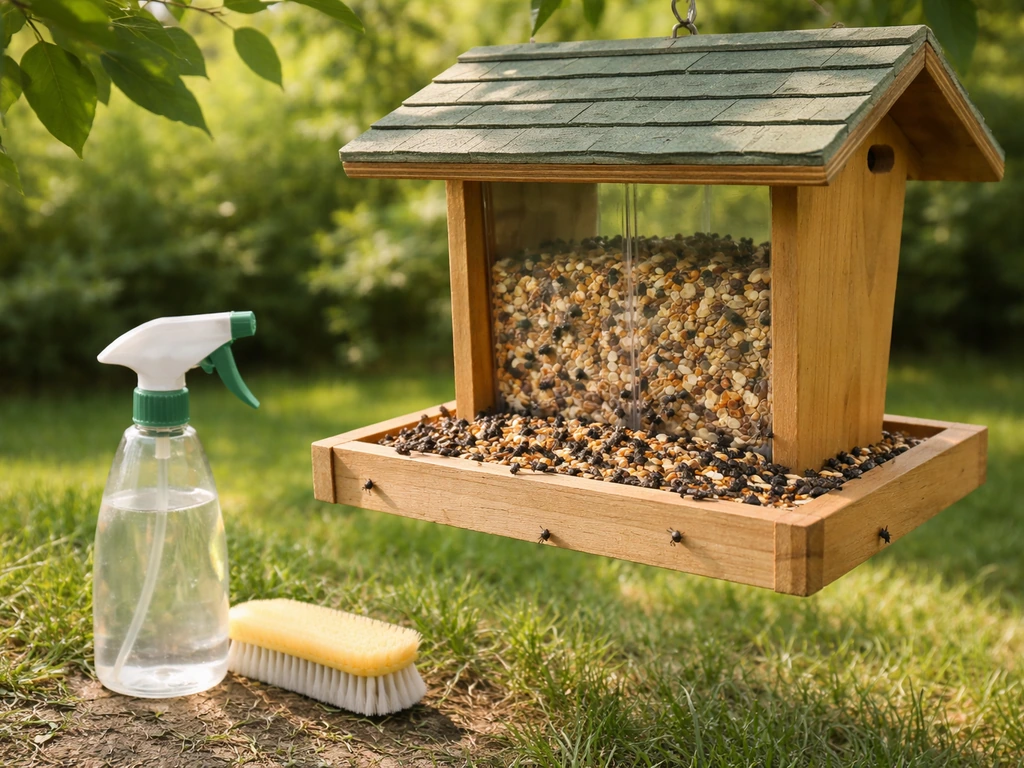
Wild Bill's feeders are well-made, but even a quality feeder develops the same handful of problems every backyard setup does: seed spills everywhere, ports clog, moisture sneaks in and turns things moldy, insects find their way inside, pigeons move in, and occasionally you spot a sick bird below the pole. None of these are dealbreakers. Most have a straightforward fix once you know exactly what you're dealing with.
Wild Bill's Bird Feeder Problems: Fixes for Pigeons & Mess

Eleanor Hartwick
24 Jul 2026
What this guide actually covers
I put this together specifically because Wild Bill's feeders come up a lot in reader questions, and the problems people describe fall into recognizable patterns. This guide walks through each one: how to tell which issue you have, what to do about it immediately, and how to prevent it from coming back. You'll also find feeder-type and placement recommendations to keep pigeons and large birds off your setup, plus strategies to stop insects from taking over seed or suet. Where the problem goes beyond a simple fix, I'll tell you clearly when it makes sense to pause feeding entirely.
The most common problems with any bird feeder, including Wild Bill's
Before you can fix anything, it helps to see the full list. These are the issues I hear about most often, and they apply whether your feeder is brand new or several seasons old. For more detail, see our guide on bird feeding problems. For a quick overview of common bird feeder problems and how to fix them, see the troubleshooting section below.
- Seed spill: seed falls or gets thrown to the ground faster than birds eat it, attracting rodents, pigeons, and other ground feeders
- Port clogging: feeding holes or seed channels block up with hulls, clumped seed, or debris, cutting off access for birds
- Mold and damp seed: moisture enters through rain, condensation, or humidity and causes seed to cake, ferment, or grow visible mold
- Insect pests: Indian meal moths, flour beetles, and warehouse beetles infest stored or feeder seed, leaving webbing, larvae, or fine powder
- Unwanted larger birds: pigeons, starlings, grackles, and doves crowd out smaller songbirds and consume seed rapidly
- Disease risk: feeders concentrate birds and can act as transmission points for Salmonella, Mycoplasma gallisepticum (house finch eye disease), and Trichomonas gallinae
How to tell exactly which problem you have
A quick inspection takes about five minutes and tells you a lot. Work through this checklist before reaching for a solution, because the fix for a clogged port is completely different from the fix for a disease outbreak.
- Look at the ground directly under the feeder: scattered whole seeds and hulls mean spill; rodent burrows or droppings mean the spill has been going on a while
- Check each feeding port: push a pencil or thin stick through each one; resistance or no seed flow means a clog
- Open the feeder and examine the seed: gray-green or black patches, sour smell, or sticky clumped seed signals mold or moisture intrusion
- Look for webbing, small larvae, or fine powder mixed into the seed: these are signs of a stored-product pest infestation (Indian meal moth being the most common)
- Watch the feeder for 10 minutes from a distance: if it is dominated by pigeons, starlings, or large doves, you have a feeder-type or seed-mix problem
- Observe birds at and below the feeder: puffed feathers, eye discharge or swelling, lethargy, or dead birds on the ground are signs of active disease
Quick fixes you can do today
Spills
Rake or sweep under the feeder right away and dispose of the debris in a sealed bag rather than composting it. Accumulated seed debris is a rodent magnet and an insect breeding site. Then reduce the amount you fill the feeder so birds clear it within one to two days, leaving no old seed sitting in the bottom.
Clogging
Empty the feeder completely, brush out the ports with a bottle brush or pipe cleaner, and inspect the seed tube or reservoir for compacted hulls. Switching to hulled or no-mess seed blends eliminates most clogging because there are no shells to jam ports. If the Wild Bill's feeder has a removable base, take it off for a thorough clear-out.
Mold and damp seed
Throw out all the seed in the feeder. Do not mix moldy seed with fresh. Discard it. Moldy seed can cause aspergillosis in birds, a serious fungal respiratory infection. Clean the feeder thoroughly using a 1:9 bleach-to-water solution (roughly 10% bleach), scrubbing all surfaces and soaking disassembled parts for about 10 minutes. Rinse well and let it air dry completely before refilling. Going forward, add drainage holes to the base if your feeder doesn't already have them, and consider a roof or dome cover to keep rain out.
Insect pests in seed
Discard the infested seed immediately (sealed bag, outdoor trash). Clean the feeder with the bleach solution above. The infestation almost certainly started in the storage bag or container, not at the feeder itself, so inspect your stored seed supply next. Transfer remaining seed to an airtight, rodent-resistant container and store it in a cool, dry location. For detailed storage and sanitation guidance, see Kitchen and Pantry Pests | University of Maryland Extension (storage and sanitation guidance). First-in, first-out rotation keeps old seed from sitting long enough for larvae to cycle through.
Sick or dead birds
Take the feeder down immediately. Also remove any bird baths nearby. Clean and disinfect everything with the 1:9 bleach solution, rinse thoroughly, and keep feeding suspended for two to four weeks. See Feeding birds (disease response guidance) | RSPB for official guidance recommending removal, disinfection, and suspension of feeding for 2–4 weeks when sick or dead birds are found. Only resume once sick-bird sightings in your area have stopped. This is not overcautious: research has confirmed that feeders can act as fomite transmission points for diseases like Mycoplasma gallisepticum (house finch conjunctivitis), and Salmonella outbreaks have been traced directly to wild bird feeding stations. Birds that spend the most time at feeders are also most likely to both catch and spread contagious pathogens.
Your regular cleaning schedule
Cleaning once and forgetting about it is one of the most common feeder mistakes I see. The baseline recommendation from ornithologists is to clean seed and suet feeders roughly every two weeks. In summer heat and humidity, or any time you hear of local disease activity, move that to weekly or even more frequently. Here is what the full cleaning process looks like.
- Empty all remaining seed or suet
- Disassemble the feeder as far as possible (base, ports, perches, roof)
- Scrub all parts with hot water and dish soap using a dedicated brush
- Prepare a 1: 9 bleach-to-water solution and soak all parts for about 10 minutes
- Rinse every surface completely until no bleach smell remains
- Allow all parts to air dry fully before reassembly and refilling
- Sweep or rake the area beneath the feeder and bag the debris
Feeder types that keep pigeons and large birds away
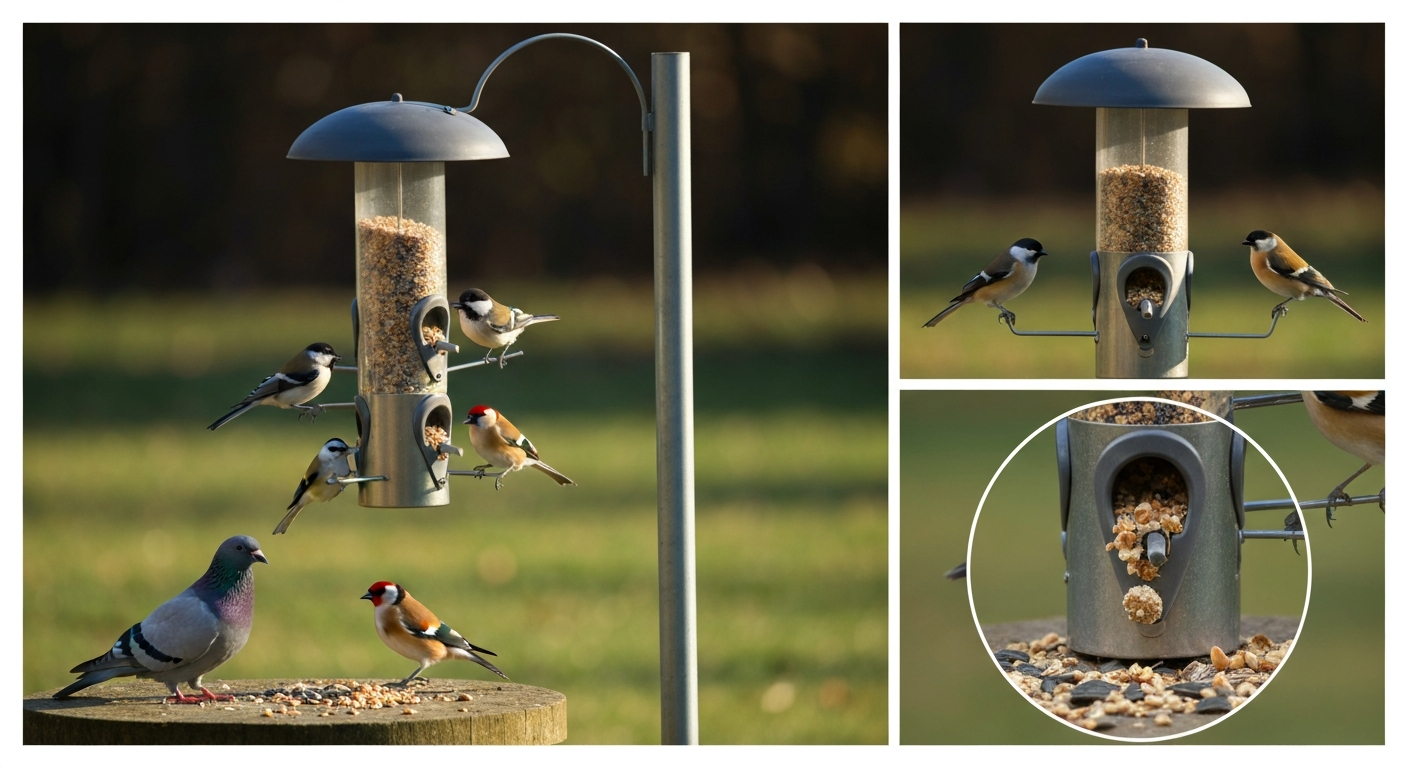
This is where feeder design does real work. Platform feeders and ground scattering favor large-bodied, ground-feeding species like pigeons, doves, sparrows, and juncos. They also produce the most spill and debris. If pigeons have taken over your Wild Bill's setup, the first question is whether the feeder style is even suited to exclude them. For more on specific designs and mixes that effectively exclude pigeons, see my roundup of bird feeders that pigeons can't use. If you want alternatives, consider bird feeders that big birds can't use to selectively exclude pigeons and similar species.
| Feeder Type | How It Excludes Large Birds | Best Seed Match | Notes |
|---|---|---|---|
| Tube feeder (small port) | Narrow ports and short perches don't accommodate larger birds comfortably | Black-oil sunflower, nyjer | Most effective for chickadees, finches, nuthatches |
| Caged or wire-mesh feeder | Outer cage bars allow small birds through but physically block pigeons and starlings | Black-oil sunflower, peanut pieces | Cage opening size matters: 1.5 inch spacing excludes most large birds |
| Weight-sensitive (spring perch) feeder | Perch collapses under birds heavier than a set threshold, closing seed access | Sunflower, mixed small seed | Threshold is adjustable on many models; test with target species first |
| Nyjer/thistle sock or small-port finch feeder | Tiny ports designed for goldfinch bill size; pigeons can't extract seed | Nyjer (thistle) | Least attractive to nuisance species overall |
| Upside-down suet cage | Only birds that can cling upside-down (woodpeckers, nuthatches) can feed; starlings and grackles rarely manage it | Suet cake | Simple and effective for starling exclusion |
If you're dealing with birds that big birds dominate but you still want to welcome some medium-sized species, a caged feeder is usually the most flexible option because you can choose the cage spacing. And if pigeons are specifically the problem, the seed mix matters just as much as the feeder design, which I cover below.
Where you place the feeder changes everything
A well-designed tube feeder placed on a low fence rail next to a flat rooftop is going to be colonized by pigeons regardless. Placement works alongside feeder design, not instead of it.
Height and mounting
Hanging feeders from a dedicated smooth metal pole (rather than a tree branch) removes most of the easy approach routes that squirrels and larger birds use. Mount the feeder at five to six feet off the ground. A freestanding pole at least ten feet from the nearest tree, fence, or structure limits the jump distance for squirrels and gives larger birds fewer stable landing platforms on the way in.
Distance from large perches and flat surfaces
Pigeons need a stable surface nearby to stage before approaching food. Keep the feeder away from rooflines, wide fence tops, and large branches. If you're in an urban setting where buildings and ledges are unavoidable, this won't eliminate the problem on its own, but it reduces the feeder's visibility and accessibility to flocking birds.
Pole vs. tree mounting
Trees are convenient but they give every animal a direct highway to your feeder. A smooth metal pole with a baffle (see below) is far more selective. If you must hang from a tree, use a long thin line rather than a thick branch to make perching harder for large birds.
Baffles, perch modifications, and anti-pest accessories
Hardware additions extend what feeder design alone can do. Here are the main types worth considering, along with what each actually accomplishes.
- Pole-mounted squirrel baffle (torpedo or cone shape, installed below the feeder): creates a smooth curved surface that squirrels and climbing rodents cannot grip past; also reduces rat access on pole-mounted setups
- Hanging baffle above the feeder (dome or disc style): blocks squirrels dropping from above and helps keep rain out of the feeder, reducing mold
- Cage excluder around the feeder body: the most direct mechanical solution for excluding large birds while allowing small ones; choose cage opening size based on the species you're trying to block
- Weight-sensitive perch inserts or replacement perches: spring-loaded perches close ports when anything above the target weight lands; effective against starlings, grackles, and pigeons
- No-perch or short-perch feeder modifications: smaller or removed perches force birds to cling, which small-bodied birds handle easily but large birds and pigeons do not
- Seed tray catches (tray below the feeder): reduce spill reaching the ground, cutting the seed signal that attracts ground-feeding species and rodents
I'll be honest: no single accessory does everything. Baffles stop squirrels but don't help with starlings. Cage excluders stop large birds but don't address seed storage pests. Stack the solutions that match your specific problem list rather than buying everything at once.
Seed and mix choices that reduce nuisance wildlife
Cheap mixed seed blends are one of the most common sources of feeder problems, and they're worth examining before anything else. Mixes high in cracked corn, sorghum (milo), or wheat are strongly preferred by pigeons and ground-feeding species. Extension research on pigeon behavior confirms cracked corn and sorghum as top attractants. If your mix contains a lot of either, you are actively inviting the birds you're trying to deter.
Hulled sunflower (no-mess), black-oil sunflower in the shell, safflower, and nyjer are the seeds most songbirds want and that pigeons and starlings find least appealing. Safflower in particular is accepted readily by cardinals, chickadees, and house finches but largely ignored by European starlings and pigeons. Nyjer is almost exclusively attractive to small finches. Switching to these options often reduces unwanted visitors more than any physical modification.
Beyond species selection, hulled seed reduces debris: no shells accumulate under the feeder, which means less insect habitat, less rodent attraction, and fewer ground-feeding species drawn in by the spill. The trade-off is slightly higher cost per pound, but you waste far less seed overall.
Cutting down on bugs in your feeder
Insect problems in bird feeders fall into two categories: stored-product pests (beetles, moths) that come in with the seed, and insects attracted to rotting or fermenting seed already in the feeder. For more on preventing and identifying common pests, see our detailed guide on bugs in bird feeder. The fixes for each overlap but start in different places.
Seed storage and purchasing
Indian meal moth infestations almost always start in the bag, not the feeder. Before you buy, check for webbing on the outside of seed bags or small holes chewed through the packaging. At home, transfer seed immediately to an airtight, rodent-resistant hard container, keep it in a cool dry location, and rotate stock so older seed is used first. Heat and humidity accelerate both insect breeding cycles and mold growth, so a garage in midsummer is a poor storage spot.
Feeder drainage and moisture control
Standing water in the base of a feeder makes seed clump, ferment, and attract insects fast. Check that your Wild Bill's feeder has drainage holes in the base. If they are blocked with seed hulls, clear them every time you refill. A dome or roof cover reduces direct rain exposure significantly. In humid climates, consider mesh-bottom tube feeders that allow airflow.
Suet timing in warm weather
Suet goes rancid fast in heat above around 50°F and attracts flies and other insects within days. In summer, either switch to no-melt suet formulas (which contain less rendered fat and more binders) or simply stop offering suet until temperatures drop in autumn. The insect and odor problems from spoiled suet are rarely worth the benefit in warm months.
Sanitation under and around the feeder
Seed debris on the ground is the primary insect breeding site, not the feeder itself. Rake or sweep thoroughly under the feeder at least weekly during warmer months. This removes the substrate that stored-product pests and other insects need to establish populations. It also removes the pathogen reservoir that can cycle disease back up to birds feeding above.
When to modify your setup or stop feeding
Not every feeder problem is worth pushing through. There are three situations where I think pausing or permanently changing your setup is the right call, not a failure.
| Situation | Recommended Action | When to Resume or Change |
|---|---|---|
| Sick or dead birds at the feeder | Remove all feeders and baths; clean and disinfect; suspend feeding | Resume after 2–4 weeks and only when sick-bird reports in your area have stopped |
| Persistent rodent activity despite cleaning and seed changes | Remove ground-level or platform feeders; switch to pole-mounted tube feeders with baffles; stop scattering seed | Resume in modified form once rodent signs cease for 2+ weeks |
| Feeder is dominated by pigeons or starlings despite feeder and seed changes | Switch to nyjer-only or safflower-only in a caged or small-port tube feeder; eliminate all corn/milo from your seed supply | If problem persists after two weeks, consider pausing and reassessing placement and nearby food sources |
Bird feeding works best when it's actively managed rather than set-and-forget. The problems that come with a Wild Bill's feeder or any other quality setup are rarely caused by the feeder itself. They're caused by seed sitting too long, infrequent cleaning, the wrong feeder style for the local bird population, or poor storage. Fix those underlying conditions and most problems resolve quickly.
FAQ
What are the most common problems at bird feeders and how can I recognize each one?
Common problems: 1) Spillage: seed hulls and whole seed scattered beneath feeder, more ground birds and rodents present. 2) Clogging/bridging: seed or suet packed in ports or tray, feeder stops dispensing or birds can't access food. 3) Mold/damp seed: musty smell, visible mold, clumping or darkened seed. 4) Pests: ants, Indian meal moths, beetles in seed, or rodents/pigeons visiting regularly. 5) Disease risk: sick, lethargic, or dead birds near feeders, repeated eye/nasal discharge in songbirds. Identify by inspection of feeder, seed, and the birds’ behavior and health.
How do I diagnose whether a feeder problem is primarily spill, clogging, mold, pests, or disease?
Stepwise diagnosis: 1) Inspect seed: clumping/musty = mold; frass/webbing = stored‑product pests. 2) Inspect feeder hardware: stuck ports or packed seed = clogging. 3) Look on ground: lots of hulls/uneaten seed = spillage. 4) Watch visitors: large flocks of pigeons/doves or ground feeders = attractants or placement issue. 5) Bird health: sick/dead birds or signs of eye/respiratory disease = suspect disease transmission. Use multiple indicators before acting.
What targeted fixes reduce spillage and prevent large ground‑feeding birds (pigeons, doves, grackles)?
Feeder type and seed: switch from platform/ground scatter to tube feeders with small ports, hopper feeders with adjustable ports, or caged feeders. Use single‑seed options like black‑oil sunflower or safflower in appropriate feeders; avoid mixes high in cracked corn, sorghum (milo), or cheap mixed grains. Placement: hang feeders 4–6 ft off ground, away from ledges that allow pigeons to roost; keep ground under feeders clear and rake up spilled seed promptly. Add hardware: dome or vertical baffle on pole, and cage excluder around feeder to prevent access by large birds.
How do I reduce bugs (Indian meal moths, flour beetles, ants) in feeders and stored seed?
Store seed in airtight, rodent‑resistant containers in a cool, dry place; rotate stock (first‑in/first‑out) and inspect bags before purchase. For immediate infestations: dispose of contaminated seed, thoroughly clean feeder before refilling. To deter ants, use ant‑moats on hanging feeders. Keep seed dry—elevated, covered feeders and quick turnover (seed eaten in 1–2 days) reduce insect attraction.
What are step‑by‑step cleaning and disinfection procedures and how often should I do them?
Routine schedule: clean seed and suet feeders every two weeks as baseline; increase to weekly during hot/humid weather or disease events. Procedure: 1) Empty feeder and discard old seed. 2) Disassemble feeder. 3) Scrub with detergent and hot water to remove debris. 4) Disinfect with ~1:9 bleach:water (≈10% bleach) soak for ~10 minutes. 5) Rinse thoroughly with clean water. 6) Air‑dry completely before refilling. For bird baths, change water daily and scrub weekly; during disease outbreaks, remove feeders/baths and suspend feeding for 2–4 weeks.
What immediate actions should I take if I find sick or dead birds at my feeder?
Immediate steps: 1) Stop feeding and remove feeders and bird baths. 2) Record species and take photos if possible. 3) Clean and disinfect feeders/baths using the bleach protocol above. 4) Keep feeding suspended for 2–4 weeks (follow local wildlife authority guidance). 5) Report findings to local wildlife/health authorities if required. Resume feeding only after sick‑bird reports cease.
Next Article
Bugs in Bird Feeder: Fast Fixes and Safe Prevention
Identify bugs in bird feeder and stop infestations fast with safe cleaning and prevention to protect birds.