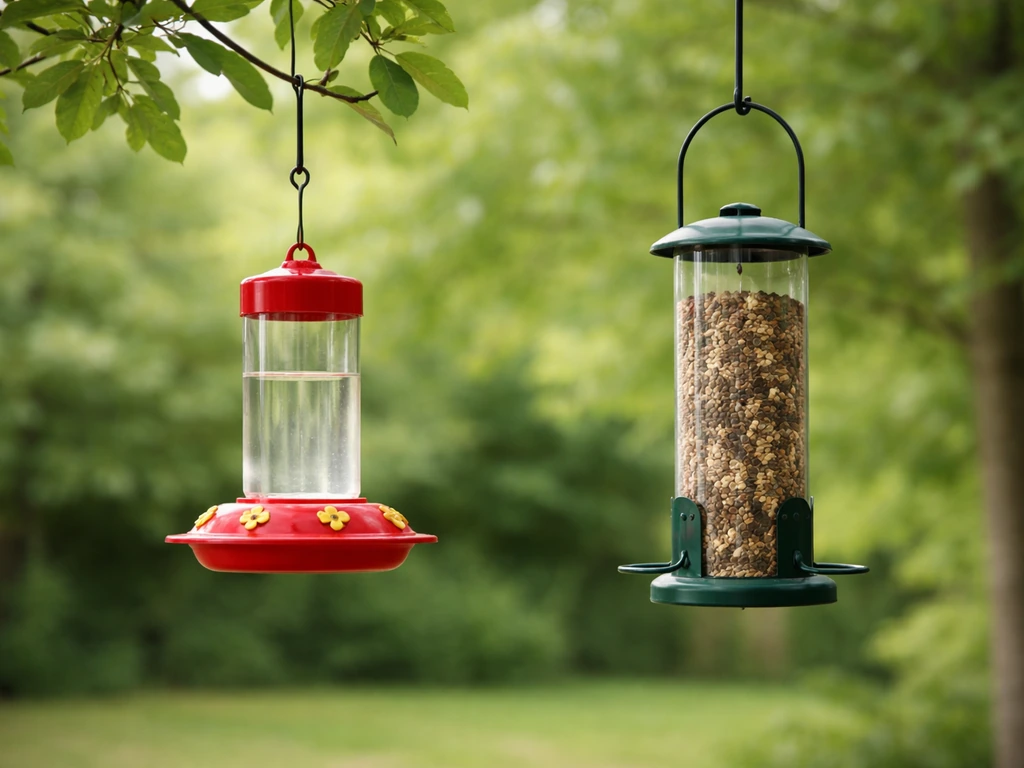
Yes, you can absolutely put two bird feeders next to each other, and many backyard setups work best with multiple feeders running at the same time. The real question is how close is too close, and whether your specific yard, species mix, and maintenance routine can support the arrangement. Cluster feeders too tightly and you invite competition, disease transmission, and pest problems. Space them thoughtfully and you end up with more birds, less conflict, and a yard that's genuinely easier to manage.
Can You Put Two Bird Feeders Next to Each Other? Placement Rules

Eleanor Hartwick
12 Jul 2026
Pros and cons of placing feeders close together
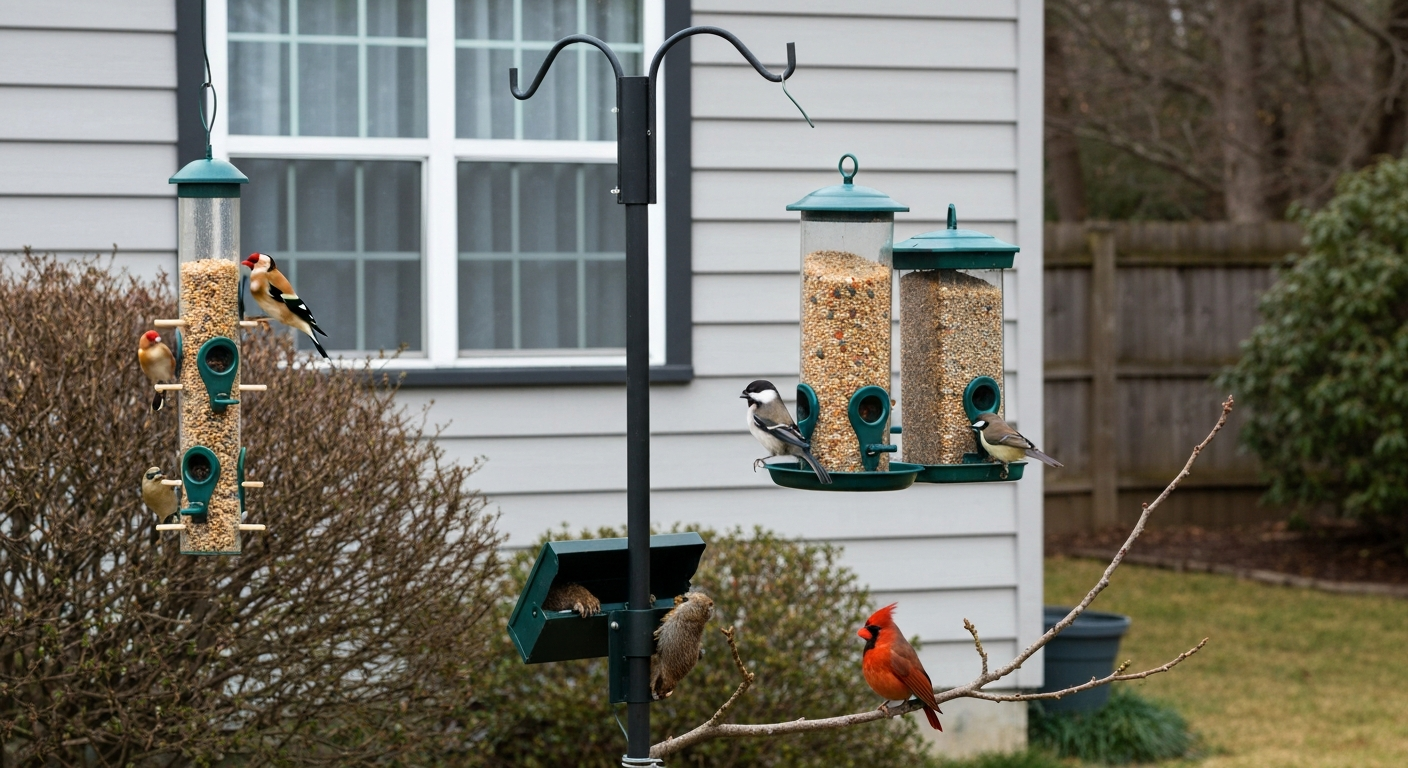
There are real advantages to running multiple feeders in a small area. You can offer different seed types side by side, attract a broader range of species, and reduce the bottleneck effect where dominant birds monopolize a single feeder. For many backyard birders, a tight cluster on one pole system is the most practical solution in a small yard, and it works well most of the time.
But close placement does carry genuine risks worth knowing about. Research on house finches has found that higher feeder density increases the spread of Mycoplasma gallisepticum, the bacterium behind conjunctivitis ('house finch eye disease'). The mechanism isn't just direct bird-to-bird contact; experimental work has shown the pathogen transmits via contaminated feeder surfaces, particularly tube feeders with shared ports. When multiple feeders are packed together, you're effectively concentrating bird traffic and shared surface contact in one spot, which amplifies that risk during any disease event in your area. Salmonella is another documented concern: a 2020–2021 outbreak traced Salmonella Typhimurium from wild songbirds (including pine siskins) at feeding sites to human cases, prompting guidance to clean feeders and even remove them during active outbreaks.
| Factor | Close placement (under 3 ft) | Moderate spacing (3–10 ft) | Wide spacing (10+ ft) |
|---|---|---|---|
| Species variety | Lower — dominant species crowd out others | Good for most species mixes | Best — species sort naturally |
| Disease transmission risk | Higher — concentrated surface contact | Moderate | Lower — reduces aggregation |
| Pest/predator ambush risk | Higher — concentrated target | Moderate | Lower with open sightlines |
| Yard space needed | Minimal | Small to medium | Medium to large |
| Maintenance complexity | Simple — one cleaning session covers all | Manageable | More time per session |
| Feeder-to-feeder competition | High — especially with tube feeders | Moderate | Low |
Clear placement rules and distances
These are the numbers I come back to repeatedly, drawn from field research, conservation guidance, and a lot of trial and error. None of them are magic thresholds, but they give you a working framework.
- Minimum between same-type feeders (e.g., two tube feeders): 5–10 feet (1.5–3 m) to reduce direct competition and surface-contact clustering.
- Between different feeder types on the same pole: keep individual feeder bodies at least 12–18 inches apart vertically to prevent cross-contamination of seed types and allow birds to approach without crowding.
- For territorial species (hummingbirds, mockingbirds): 10–20 feet (3–6 m) minimum, ideally out of direct line of sight.
- Window distance: follow the 3-foot or 30-foot rule — place feeders either within 3 feet (~1 m) of glass so birds can't build lethal speed, or beyond 30 feet (~9 m) so they have room to avoid the reflection. The 3–30 foot zone is the danger zone for fatal window strikes.
- Escape cover distance: place feeders either very close to shrubs or dense planting (within 3–5 feet) for quick escape routes, or in open areas with cover intentionally set back 10–30 feet to eliminate cat ambush spots.
- Squirrel-proofing: mount poles at least 8 feet from any jumping surface (trees, fences, structures) and use baffles; this applies to multi-feeder pole systems as much as single feeders.
- During disease outbreaks in your area: increase spacing to 10+ feet between feeders, clean more frequently, or temporarily remove feeders until the outbreak passes.
Layout examples: small, medium, and large yard plans
Small yard (under 500 sq ft of usable garden space)
In a tight space, a single multi-arm pole system is your best option. Mount one tube feeder with nyjer for finches and one hopper or tray feeder for mixed seed, spaced vertically by at least 18 inches on the same pole. Position the pole in the middle of available open ground, at least 8 feet from fences and 3 feet from or 30+ feet from any windows. Squirrel baffles are non-negotiable here because there's less open space to work with. Clean both feeders every 5–7 days as a routine, more often if birds look unwell.
Medium yard (roughly 500–2,000 sq ft of garden)
Here you have room to separate feeders meaningfully. Put a seed-and-suet station (pole-mounted, with a suet cage on one arm and a tube feeder on another) on one side of the yard, then place a second pole with a platform or hopper feeder at least 10 feet away, ideally with a line of shrubs or a hedge between them. This creates two distinct feeding zones, which gives subordinate species a chance to access food without competing with whichever birds dominate the first station. If you want to add a hummingbird feeder, put it on the opposite side of the yard and out of direct sight of the seed station.
Large yard (2,000+ sq ft or rural property)
With more space, you can create genuinely distinct feeding habitats. Run three or four stations: a finch-focused nyjer tube cluster near open ground, a woodland-edge station with suet and peanuts near a tree line, a generalist platform feeder in an open area, and a hummingbird cluster near flowering plants. Space stations at least 20–30 feet apart. On a large rural property, putting feeders at different heights (ground-level tray, mid-height tube, elevated suet cage) and in different microhabitats dramatically increases the range of species you'll see. Heavy-duty multi-arm pole systems should be rated for the combined loaded weight of all feeders plus a 25–30% buffer for wind, ice, and the occasional raccoon.
Species-specific spacing and height recommendations
Different birds have different comfort zones at feeders, and matching feeder placement to those preferences cuts down on competition and wasted seed. Here's what I've found works consistently.
| Species group | Preferred feeder type | Recommended height | Suggested spacing from other feeders | Notes |
|---|---|---|---|---|
| Songbirds (general) | Hopper, tray, tube | 4–6 ft (1.2–1.8 m) | 5–10 ft minimum | Most adaptable; will share stations if not crowded |
| Finches (goldfinches, siskins) | Nyjer/thistle tube | 4–6 ft (1.2–1.8 m) | 5–10 ft from other tube feeders | Susceptible to Mycoplasma and Salmonella — clean frequently |
| Northern Cardinals | Platform or hopper with wide perch | 3–5 ft (0.9–1.5 m) | 8–10 ft — cardinals prefer space | Prefer lower feeders near cover; avoid overcrowded stations |
| Woodpeckers | Suet cage or peanut feeder | 5–8 ft (1.5–2.4 m) on a tree or pole | 6–10 ft from busy seed feeders | Tolerate proximity to other feeders but prefer to approach from a quiet angle |
| Hummingbirds | Nectar feeder | 4–6 ft (1.2–1.8 m), shaded if possible | 10–20 ft from each other; out of sight of seed feeders | Territorial; spacing between nectar feeders is critical (see below) |
Hummingbirds and other feeders: the proximity question
I get asked this constantly: can a hummingbird feeder go right next to a seed or suet feeder? The short answer is that it's usually fine from the seed birds' perspective, but it's not ideal for the hummingbirds. Hummingbirds are intensely territorial about nectar sources. A single dominant bird will stake out a feeder and spend most of its time chasing others away, so the more feeders you have and the more spread out they are, the more birds get to feed. Putting your only nectar feeder right next to a busy seed station tends to make that territorial behavior worse, because the constant activity from other species keeps the dominant hummingbird in a state of high alert.
There's also a practical hygiene difference. Cornell Wildlife Health Lab recommends cleaning feeders with a 1:9 bleach:water solution (10%), soaking and scrubbing contact surfaces when disease is suspected, and notes hummingbird feeders should be changed every 1–3 days in hot weather Cornell Wildlife Health Lab recommends cleaning feeders with a 1:9 bleach:water solution (10%), soaking and scrubbing contact surfaces when disease is suspected, and notes hummingbird feeders should be changed every 1–3 days in hot weather.. Nectar ferments quickly, especially in warm weather, and hummingbird feeders need changing every 2–5 days in mild conditions and every 1–3 days when temperatures climb above about 80°F (27°C). Keeping a nectar feeder in a shaded spot slows fermentation. If your nectar feeder is crammed in between seed feeders on a sun-exposed pole, you'll likely be changing it more often than you'd like. Placing it in a shadier location slightly removed from the main seed station is genuinely easier to maintain.
There's more detail on this pairing question in the related articles on whether hummingbird feeders can go next to bird feeders and whether you can hang hummingbird feeders with other bird feeders, both of which cover the territorial and hygiene angles in depth. See our guide on can you hang hummingbird feeders with other bird feeders for practical tips on hanging nectar feeders alongside seed and suet stations. See the related article Can you put hummingbird feeder next to bird feeder for a focused discussion of the territorial and hygiene considerations.
Pairing hummingbird feeders with seed and suet feeders: best practices
- Place nectar feeders at least 10–20 feet from seed or suet stations, or around a corner/behind a screen of plants so the territorial hummer can't easily monitor both.
- If you want multiple nectar feeders, spread them so no single bird can defend all of them — that typically means 10+ feet apart and ideally out of each other's direct line of sight.
- Keep nectar feeders shaded to slow fermentation; a north or east-facing spot often works well.
- Use separate cleaning schedules: seed feeders every 5–7 days with 10% bleach solution (1 part bleach to 9 parts water); nectar feeders every 2–5 days (or every 1–3 days in hot weather), rinsed thoroughly before refilling.
- Don't mount a nectar feeder on the same arm system as a suet cage — dripping suet and insects attracted to seed can contaminate the nectar ports.
- Seed hulls and debris falling from overhead seed feeders can land in open nectar feeders below; always position nectar feeders away from the debris drop zone of seed feeders.
How proximity affects competition, disease, and when spacing matters most
The competitive dynamics at clustered feeders are pretty predictable once you've watched them for a season. Dominant species (house sparrows, starlings, larger finches) will concentrate at the most accessible feeders and displace smaller or shyer birds. Packing feeders together amplifies this: a bird that controls one feeder can often intimidate birds at an adjacent one if they're only a foot or two apart. Spreading feeders by 5–10 feet lets subordinate species use the second feeder while the dominant bird is occupied at the first.
The disease picture is more serious and worth understanding clearly. Multiple studies have shown that time spent at feeders and contact with feeder surfaces are direct predictors of Mycoplasma gallisepticum infection risk in house finches. A study titled 'Feeder use predicts both acquisition and transmission of a contagious pathogen in a North American songbird' found that feeder time and aggregation at feeding ports predict increased Mycoplasma infection risk. Feeder density, how many feeders are packed into an area, was experimentally shown to increase the spread of this pathogen through a population. The mechanism includes fomite transmission: a sick bird contaminates a port or perch, and the next bird picks it up. Tube feeders with multiple shared ports are particularly high-risk surfaces. When two feeders are placed very close together, the effective contact surface area doubles while the bird traffic concentrating around those feeders doesn't spread out proportionally.
Cleaning helps significantly. Scrubbing feeders with a 10% bleach solution (1 part bleach to 9 parts water) and rinsing well has been shown to prevent Mycoplasma spread from contaminated surfaces. The limitation is that if infected birds are actively visiting your feeders, cleaning alone won't fully stop transmission because birds continuously recontaminate the surfaces. This is why, during an active disease event in your area, removing feeders temporarily or at minimum spreading them farther apart and cleaning daily is more effective than cleaning on a normal schedule.
Spacing matters most in these situations: during spring migration when high volumes of unfamiliar birds pass through, during any local disease outbreak you become aware of (watch for birds with swollen or crusty eyes, fluffed feathers, or unusual lethargy), and during winter when birds are already stressed and more susceptible. If finches are looking unwell at your feeders, the right move is to take the feeders down for two weeks, clean them thoroughly, and put them back up. It's a meaningful intervention, not just a precaution.
Mounting options, pole sizing, and installation tips
Whether you hang feeders from a tree or use a dedicated pole affects how much control you have over spacing, pest-proofing, and cleaning access. See the article “Can you hang a bird feeder from a tree” for detailed guidance on branch strength, bracket options, and window-distance considerations. Hanging feeders from trees is a natural and low-cost option, but it makes squirrel baffles harder to use effectively and gives you less control over feeder-to-feeder distance. A pole system in an open area, at least 8 feet from trees or fences, lets you arrange multiple feeders precisely and add a baffle to the pole shaft. There's more on the tree-hanging question in the related article on hanging feeders from trees, which covers branch strength, bracket options, and window-distance considerations in detail.
For multi-arm pole systems carrying two or more feeders, think about load. A filled large hopper feeder can weigh 5–8 lbs; add a filled suet cage, a water dish, and wind loading, and you're pushing significant forces on the pole anchor. Commercial guidance for heavy-duty systems recommends calculating the full loaded weight of all feeders and leaving a 25–30% buffer above that for wind, ice accumulation, and the weight of any wildlife that climbs on. Use a ground-sleeve foundation or a weighted base rather than simply driving a lightweight pole into loose soil if you're running three or more feeders on one system. If you're unsure whether feeders have to hang or whether there are good ground-level alternatives, that question is covered in a separate article in this series.
A maintenance and installation checklist
Keeping two feeders next to each other in good shape is manageable if you build the routine upfront rather than reacting to problems. Use this as your starting reference.
- Before installation: check feeder-to-window distance (place within 3 ft or beyond 30 ft of glass), confirm the pole anchor or hanging point can support full loaded weight plus 25–30% buffer.
- Set feeder spacing: minimum 5 ft between same-type feeders; 10–20 ft for hummingbird nectar feeders from each other and from seed stations.
- Install squirrel baffles on pole systems, keeping the pole at least 8 ft from any jumping surface.
- Establish a cleaning schedule before you fill the feeders: seed feeders every 5–7 days; nectar feeders every 2–5 days (every 1–3 days in heat above 80°F / 27°C); use a 10% bleach-to-water solution (1:9), scrub contact surfaces, rinse thoroughly, and allow to dry before refilling.
- Remove and dispose of seed hulls, wet or moldy seed, and debris beneath feeders at each cleaning; accumulated debris attracts rodents and is a secondary infection source.
- Monitor birds for signs of disease (eye swelling, lethargy, fluffed feathers at unusual times) — at first signs of illness in multiple birds, remove feeders for at least two weeks and clean with bleach solution before returning them to service.
- During known local outbreaks (Mycoplasma, Salmonella, or similar): follow public guidance, which may include temporarily stopping feeding altogether.
- Review placement seasonally: winter congregations and spring migration bring higher bird volumes and increased transmission risk — consider wider spacing or reduced feeder numbers during these peak periods.
FAQ
Can you put two bird feeders next to each other?
Yes — you can place two feeders close together, but do so intentionally. Close placement increases competition, crowding at ports, and the risk of disease transmission because birds spend more time in contact with the same surfaces. For many species a modest separation (see recommended spacing below) balances convenience and disease/pest risk.
What are evidence-based spacing rules for placing multiple feeders?
General rules: - For seed/suet/peanut feeders: space feeding ports at least 3–6 ft (1–2 m) apart so different individuals can feed without direct contact and to reduce queuing at ports. - For hummingbird feeders: place 10–20 ft (3–6 m) apart or out of sight of one another to reduce territorial exclusion. - For mixed setups (hummingbird + seed): keep hummingbird feeders 10–20 ft from high-traffic seed feeders to reduce territorial stress and hostile interactions. - For window safety: follow the 3‑ft or 30‑ft rule (put feeders within ~3 ft of a window or farther than ~30 ft) to reduce collision risk.
How does feeder proximity affect disease transmission?
Closer feeders increase aggregation and repeated contact with the same feeder surfaces, which raises risk of pathogen spread (e.g., Mycoplasma in finches; Salmonella linked to songbird feeders). Feeder surfaces and ports act as fomites; higher feeder density and longer individual contact time predict greater transmission risk according to multiple experimental and observational studies.
How often should I clean feeders to reduce disease risk?
Routine schedule: - Seed/suet/peanut feeders: clean thoroughly every 2 weeks; clean more often during outbreaks or in wet/moldy conditions. - Hummingbird feeders/nectar: change nectar and clean every 1–3 days in hot weather and every 2–5 days in cool weather. - Disinfecting: use a 10% household bleach solution (1:9 bleach:water), soak and scrub contact surfaces, rinse thoroughly and dry before refilling. Cleaning reduces but does not eliminate transmission risk if infected birds are continuously present.
When should I avoid placing feeders close together?
Avoid close placement when: - You are seeing signs of disease (conspicuous eye disease, lethargy, unusual mortality) — reduce feeders or remove them and increase cleaning. - You have large flocks that crowd ports, leading to prolonged contact. - You are managing species-sensitive sites (wildlife rehabilitation, certain conservation areas) where aggregation is undesirable. - You cannot maintain a rigorous cleaning schedule.
Are hummingbird feeders okay next to other feeders?
Hummingbird feeders can be near other feeders if spaced and sited thoughtfully. Best practice: keep hummingbird feeders 10–20 ft (3–6 m) from seed feeders and position some hummingbird feeders out of sight of each other to reduce territorial exclusion. Keep nectar shaded and change often to prevent spoilage.
Next Article
Can You Hang Hummingbird Feeders With Other Bird Feeders?
Yes. Learn how to hang hummingbird and bird feeders together safely with spacing, placement, and clean-up tips.