Most HOAs can legally restrict or regulate bird feeders, but a flat ban is far less common than you might expect. What's far more typical is a set of conditions: feeder placement must not face the street, seed mess must be cleaned up regularly, feeders can't drip onto shared surfaces, and you may need written approval before hanging anything outside. Whether you're a homeowner, a renter, or a condo resident, your first job is to find your governing documents and read what they actually say, because the rules vary enormously from one association to the next.
HOA Rules for Bird Feeders: What Homeowners & Renters Need

Eleanor Hartwick
22 Jul 2026
Why this matters more than most people expect
I hear this question constantly from readers who set up a feeder, got a violation notice two weeks later, and had no idea a rule existed. That's a frustrating and completely avoidable situation. At the same time, I also hear from people who assumed their HOA would say no, never asked, and spent years without feeders they could have had. Both outcomes come from the same root problem: not knowing what the documents actually say. The good news is that HOA rules, unlike city ordinances, are negotiable at the community level. You can request exceptions, propose amendments, and often find a compliant setup that works for you and satisfies the board.
What HOA rules actually cover
HOA governance typically flows through three layers of documents, and each layer carries different legal weight. CC&Rs (Covenants, Conditions, and Restrictions) are recorded with the county and are the most legally durable. They govern what you can and can't do with your property at a fundamental level. Bylaws govern how the association itself operates: meeting procedures, board elections, quorum requirements. Rules and Regulations (sometimes called Architectural Guidelines or Policies) are adopted by the board and are the most flexible layer. See HOA Rules Enforcement & Violations: Board Guide, CMGT for practical guidance on how boards adopt and enforce Rules and Regulations that govern balcony use, exterior attachments, and similar day‑to‑day restrictions HOA Rules Enforcement & Violations: Board Guide — CMGT (board/management guidance summarizing documents and enforcement practice). This third layer is where you're most likely to find anything specific about bird feeders, balcony items, or exterior attachments.
Bird feeder restrictions rarely appear in CC&Rs by name. Instead, you'll find language about 'exterior attachments,' 'nuisance conditions,' 'balcony use,' or 'items visible from common areas.' Boards then interpret that language through their Architectural Review Committee (ARC) guidelines or general rules. The practical implication: what looks like an outright ban in the CC&Rs is often a conditional restriction in the actual rules, and what's in the rules can sometimes be waived through a variance request.
How to find and actually read your governing documents
Start with the packet you received at closing or move-in. If that's long gone, your HOA management company is legally required in most states to provide current governing documents upon request, often within a specific timeframe and sometimes for a nominal copying fee. In California, the Davis-Stirling Common Interest Development Act (Civil Code sections 4000-6150) requires associations to make key documents available to members. The Davis‑Stirling Common Interest Development Act (California Civil Code §§4000–6150) is the primary statute governing condo/HOA/Planned Unit Development governance in California and sets rules for architectural approval, enforcement, reserves, records, meetings and remedies; it limits or preempts CC&R provisions that conflict with the Act blank" rel="noopener noreferrer">The Davis‑Stirling Common Interest Development Act (Cal. Civ. Code §§4000–6150) is the primary statute governing condominium, homeowners’ association, and planned unit development governance in California and sets rules for architectural approval, enforcement, reserves, records, meetings, and remedies; it limits or preempts CC&R provisions that conflict with the Act.. Florida's Chapter 720 Homeowners' Association Act contains similar member-access rights. Most states have comparable provisions.
When you're reading, search for these specific terms: 'bird feeder,' 'feeder,' 'balcony,' 'patio,' 'exterior attachment,' 'nuisance,' 'wildlife,' 'infestation,' and 'aesthetic standards.' Read the definitions section too, because terms like 'structure,' 'fixture,' or 'personal property' may be defined narrowly or broadly in ways that determine whether a feeder is covered. If you find a rule but aren't sure how it applies to your situation, you can submit a written question to the board or management company and request a written answer. That written answer becomes part of your documentation if a dispute arises later.
Common restrictions and the real reasons behind them
When HOAs restrict feeders, they're usually working from one or more of four concerns. Understanding the actual concern makes it much easier to propose a solution the board will accept.
| HOA concern | What they're worried about | How you can address it |
|---|---|---|
| Aesthetics | Feeders visible from the street or common areas look cluttered or unattractive | Use natural-finish or low-profile feeders; position them out of street view |
| Pest attraction | Seed mess and hulls attract rodents, squirrels, raccoons, and other wildlife | Use no-mess seed blends, tray catches, and clean up fallen seed regularly |
| Liability | Attracting wildlife to common areas or neighboring units creates injury/damage risk | Hang feeders away from pathways, fences, and shared walls; control seed scatter |
| Maintenance burden | Seed husks, droppings, and feeder staining on shared surfaces create cleanup costs | Commit in writing to a regular cleaning schedule; document your maintenance |
Boards that receive a request acknowledging all four concerns with specific, practical answers almost always respond more favorably than those that get a vague 'I just want to watch the birds.' The Community Associations Institute (CAI), which trains HOA board members and managers, emphasizes that due-process enforcement (notice, cure period, hearing, and appeal) is the standard framework. That means even if you get a violation notice, you typically have a structured process for responding before any real penalty applies.
When city ordinances, state laws, and DNR guidance come into play
HOA rules and local laws operate in parallel, and they don't always point in the same direction. Your HOA cannot grant you permission to do something local law prohibits, and local law can't override a valid HOA restriction. So you need to check both independently. State-level rules vary: for specifics in Vermont, consult the Vermont bird feeder law and related wildlife-feeding guidance.
On the municipal side, some cities ban feeding wildlife outright on public and sometimes private property. Boulder, Colorado, for example, prohibits feeding wildlife in many parks. Other cities carve out specific exemptions for bird feeders: Lake Forest Park, Washington, prohibits general wildlife feeding but explicitly exempts hanging bird feeders that are designed to prevent access by other wildlife. If you're in a city with a wildlife-feeding ordinance, read the language carefully for those kinds of exemptions before assuming feeders are prohibited.
State DNR and wildlife agency guidance matters too, especially during disease events. During high-pathogen avian influenza (HPAI) outbreaks, state agencies in California, Michigan, and elsewhere have recommended temporarily removing feeders in affected areas to reduce bird congregation. This is guidance, not typically a legal mandate for backyard feeders, but it's something boards may reference when making temporary rules. The U.S. Fish and Wildlife Service notes that backyard feeders are unlikely to substantially drive HPAI spread in general, but USDA/APHIS still recommends good hygiene and keeping feeders away from any backyard poultry. Local and state ordinances on bird feeding can vary significantly, similar to how regulations differ by city and region across the country.
Renters, condo owners, and shared spaces: who actually has authority
This is where things get genuinely complicated, and I want to be direct: the answer depends on your specific documents and your state's property law.
Condo owners typically own their unit interior but not the exterior walls, balcony railing, or common elements. That means attaching a feeder to a railing or exterior wall may require association approval even if it's 'your' balcony in everyday terms. Check your condo declaration for the definition of 'limited common elements' and whether balconies are listed as such. If they are, the association controls what gets attached to them.
Renters face a two-layer problem. Your landlord's lease agreement governs what you can do with the unit, and your landlord is also bound by the HOA's rules. If the HOA prohibits feeders, your landlord can't give you permission to have one. Before hanging anything, ask your landlord in writing whether feeders are permitted under both the lease and the HOA rules. Get the answer in writing. If the landlord isn't sure, ask them to check with the HOA management company before you invest in equipment.
Common areas and shared green spaces are entirely under association control. You cannot place a feeder in a common area without explicit written approval from the board, and the board can revoke that approval at any time. Some associations have established communal feeding stations in common areas as a compromise, which can actually be a great outcome if you're willing to propose and help manage it.
Practical, compliant feeder options for different living situations
Once you know what your documents allow, the question becomes how to set up a feeder that stays within those limits. Here's what tends to work in different situations.
Balconies and patios
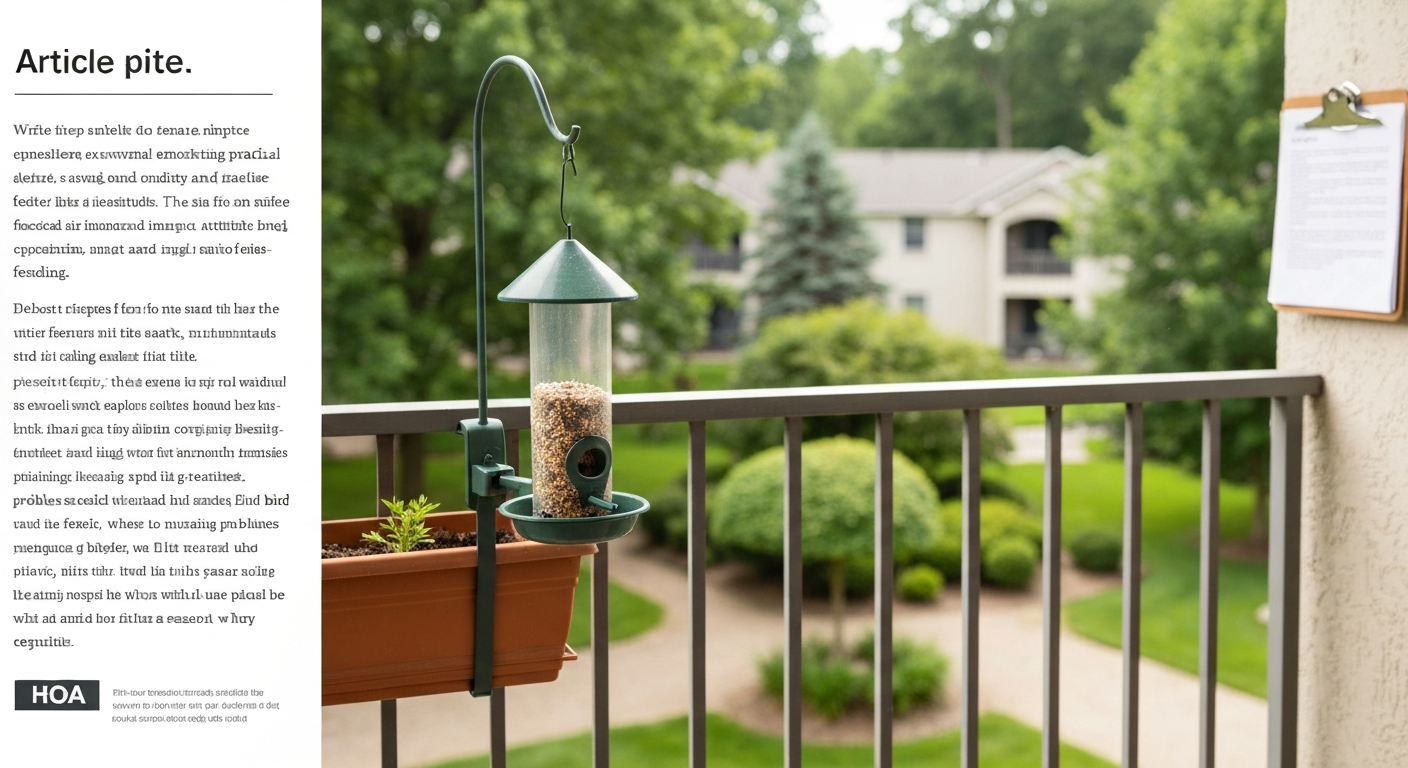
Clamp-on or hook-style feeders that attach to railing without drilling are generally lower-impact and more likely to pass ARC review than permanently mounted feeders. Use a seed-catching tray underneath to contain mess. Choose feeders with a small seed capacity if spillage is a concern, since smaller feeders get refilled more often and are easier to keep clean. Tube feeders with selective ports for sunflower chips or nyjer seed create less ground mess than platform feeders. Position the feeder so it's not directly visible from street level or the main common area entrance if your rules require that.
Private yards in HOA communities
Freestanding pole-mounted feeders in the back yard are usually the least contentious option for homeowners with private yards. Place the pole at least 10 feet from fences shared with neighbors to minimize any argument about seed mess crossing property lines. If your community requires all exterior items to blend with the landscape, natural wood or dark powder-coated metal finishes read as less obtrusive than bright plastic. Keep the area beneath the feeder raked or covered with a catch tray, and remove fallen seed at least weekly.
Shared and common property
In shared spaces, your best approach is to propose a managed, communal feeding station to the board rather than asking permission for a personal feeder. Offer to take responsibility for maintenance, cleaning, and restocking. This reframes the conversation from 'I want to do something' to 'I want to contribute something to the community.' Boards tend to respond very differently to those two framings.
HOA-approval checklist: what to include in your request
Before submitting anything to your ARC or board, gather the following. An incomplete submission is the most common reason requests get delayed or denied on procedural grounds. In California, for example, an ARC must issue a written decision on a complete architectural application within the statutory timeframe (typically 60 days under Civil Code section 4765), and an incomplete application resets that clock.
- A photo or product description of the exact feeder model, including dimensions (height, width, depth)
- The proposed installation method (clamp, hook, pole, bracket) and whether any drilling or permanent attachment is required
- The exact proposed location with measurements from property lines, fences, shared walls, walkways, and the street
- The seed type(s) you plan to use and why they minimize mess (for example, hulled sunflower chips produce no shell debris)
- Your maintenance and cleaning commitment in writing: how often you'll clean the feeder and remove ground debris
- A statement about wildlife management: how you'll prevent access by squirrels, raccoons, or rodents
- A note on seasonal use if applicable: whether you plan to remove the feeder during certain months
- Your contact information and the date of submission
- A request for written acknowledgment and a decision timeline
Allowed and forbidden feeder types: a quick-reference guide
| Feeder type | Typically allowed? | Common conditions or concerns |
|---|---|---|
| Tube feeder (hanging or pole-mounted) | Often yes | Must have seed catch tray; no permanent drilling into exterior walls |
| Hopper/house feeder (pole-mounted) | Often yes with approval | Size limits may apply; placement away from street view required |
| Platform/tray feeder | Sometimes, with conditions | High mess potential; usually requires catch system and frequent cleaning |
| Suet cage (hanging) | Often yes | Small footprint; grease drips can stain railings or concrete |
| Nyjer/thistle sock or tube | Often yes | Fine seed can escape and stain surfaces; use baffle or tray |
| Ground feeder or scatter feeding | Frequently prohibited | Directly attracts rodents and larger wildlife; hardest to defend to a board |
| Hummingbird nectar feeder | Often yes | Nectar can ferment and drip; needs frequent cleaning in warm weather |
| Large decorative multi-arm feeder stations | Frequently restricted | Visual impact and seed volume are main concerns; may require ARC review |
| Window-mounted feeders (suction cup) | Often allowed without approval | Minimal exterior impact; usually below threshold requiring ARC review |
A sample permission request letter you can adapt
Keep this brief, factual, and solution-oriented. A board that sees you've thought through their concerns is far more likely to say yes.
[Date]
To the Architectural Review Committee / Board of Directors, [Association Name]:
I am writing to request approval to install one bird feeder at my residence at [your address]. I have reviewed the association's governing documents and architectural guidelines and want to ensure full compliance with all applicable rules.
Proposed feeder: [Brand/model, dimensions]. Installation method: [Clamp-on railing hook / freestanding pole / bracket, no permanent drilling]. Proposed location: [Specific description, e.g., rear patio, 12 feet from the south fence, not visible from street or common walkway]. Seed type: [e.g., hulled sunflower chips, shell-free, minimal ground debris]. Maintenance: I will clean and disinfect the feeder every 1-2 weeks, remove any seed debris from the ground weekly, and remove the feeder temporarily if the association or relevant wildlife agency recommends it during a disease event. I will use a squirrel baffle and seed-catch tray to minimize wildlife access and ground mess.
I am happy to provide additional information, photographs, or a product specification sheet. I would appreciate written confirmation of receipt and a decision within the association's standard review period. Please feel free to contact me at [phone/email]. Thank you for your time.
Sincerely, [Your name, unit/lot number]
Nuisance control and maintenance: what actually keeps you in compliance
Even if your HOA approves a feeder, a maintenance failure is the fastest way to get the approval revoked. More importantly, poorly maintained feeders genuinely do cause problems: Cornell Lab of Ornithology recommends cleaning feeders every one to two weeks under normal conditions, and more often during warm or wet weather or if you observe sick or dead birds near the feeder. The recommended method is disassembly, scrubbing, a soak in a roughly 1:9 bleach-to-water solution for at least ten minutes, a thorough rinse, and complete drying before refilling. This isn't just about neighborhood relations. Concentrated bird feeding sites are documented transmission points for passerine salmonellosis, trichomonosis, and avian pox. Cleaning on schedule is the single most effective thing you can do to reduce that risk.
Ground management matters as much as feeder cleaning. Remove wet, moldy, or caked seed from beneath feeders at least weekly. The National Audubon Society specifically flags ground seed accumulation as a disease and pest risk. If you can't commit to weekly ground cleanup, use a no-mess seed blend (hulled chips, shelled peanuts, or nyjer) and a well-fitted seed-catch tray mounted below the feeder. That combination dramatically reduces what reaches the ground in the first place.
Squirrel and wildlife deterrence
Squirrel baffles on poles (a dome or cylinder baffle at least 18 inches long, mounted at least 5 feet off the ground) and cage-style feeders that close under a squirrel's weight are both effective and generally acceptable to HOAs because they reduce the mess and wildlife traffic that boards worry about. Avoid loose platform feeders with no barriers if you're trying to make a case to a skeptical board. Raccoon and bear activity is more situational: if you're in an area with regular wildlife incursions, a board may have legitimate grounds to deny a feeder request, and you should address that in your application proactively.
Seasonal considerations
Some HOAs or state agencies recommend or require feeder removal during specific seasons, particularly in bear country or during active bird-disease outbreaks. Offering to follow seasonal-use guidelines in your approval request (and actually following through) builds the kind of track record that makes future requests easier. State wildlife agencies, including those in California, Michigan, and others, issue seasonal advisories during HPAI events; keeping an eye on those and acting on them before the board asks you to demonstrates good faith.
When feeders are banned: practical alternatives that still work
A complete feeder ban is frustrating but not the end of the story. Several alternatives attract birds effectively without triggering the concerns that drive HOA restrictions.
- Native plantings: shrubs and trees that produce berries, seeds, or nectar (serviceberry, coneflower, native sunflowers, and holly are reliable examples) attract birds year-round without any HOA-approval hurdle in most communities, since they're typically treated as landscaping
- Window feeders: suction-cup mounted feeders attach to glass with no exterior hardware and usually fall below the threshold requiring ARC review; they have minimal visibility from outside and are easy to remove and clean
- Water features: a simple birdbath or dripper is often easier to get approved than a feeder and attracts a wider range of species than seed feeders do; moving water is especially effective
- Community feeding programs: some cities and parks departments maintain bird-friendly areas where residents can observe feeding without maintaining a private feeder; local Audubon chapters sometimes coordinate these
- Bird-friendly landscaping: reducing lawn area, adding brush piles (where permitted), and eliminating pesticide use creates habitat that supports birds more durably than supplemental feeding alone
Next steps: submitting, following up, and escalating if needed
Submit your request in writing (email is fine; certified mail is better for anything contentious) and keep a copy. Note the submission date. Most associations have a stated review period in their rules or bylaws, typically 30-60 days. If you don't receive a response within that period, follow up in writing and reference your original submission date. In California, Civil Code section 4765 provides that a complete application not decided within the statutory timeframe may be deemed approved by operation of law. Other states have varying provisions; check yours.
If your request is denied, ask for the denial in writing with the specific rule citation(s) used. That tells you exactly what you're dealing with. You can then either propose modifications to your setup that address the stated concerns, request a variance or exception (most associations have this process even if it isn't advertised), or ask what change to the rules would be needed to allow your setup and begin building support for a rule amendment. CAI guidance emphasizes that associations must follow due-process procedures including a formal hearing and appeal process before imposing fines for violations. If you've received a violation notice rather than a denial, you have the right to request that hearing before any penalty is assessed.
Document everything: keep copies of your requests, the board's responses, any approval letters, and records of your maintenance activities. If you ever sell your home, that documentation may be useful for the next owner. If the dispute escalates, many states (including California and Florida) provide mandatory or optional alternative dispute resolution processes before a resident can be compelled to litigate against their association. These ADR processes are often faster and cheaper than court, and boards know it.
Resources and further reading
For your governing documents, start with your state's HOA statute. California residents should look up the Davis-Stirling Act (Civil Code sections 4000-6150) at the California Legislative Information website. Florida residents should check Chapter 720 of the Florida Statutes at Online Sunshine. Texas residents can find relevant provisions in the Texas Property Code at the Texas Legislature's Capitol website. Most states have similar statutes; search '[your state] homeowners association act' or '[your state] condominium act.'
For city and county ordinances, search your municipality's name plus 'wildlife feeding ordinance' or 'bird feeder ordinance.' Many city codes are searchable online through Municode or American Legal Publishing. If you're navigating specific local rules, your city or county's parks department or animal services office can often point you to the right ordinance. Check local rules such as Chicago's bird feeding ordinance for specifics on feeder restrictions in that city. State and city bird feeding regulations can differ significantly by location, so it's always worth checking the rules specific to your area.
For feeder maintenance standards, Cornell Lab of Ornithology's All About Birds and Project FeederWatch pages are the most practical and regularly updated free resources available. The National Audubon Society's bird feeding FAQ covers cleaning, disease risk, and habitat. University cooperative extension services (Clemson, Virginia Tech, Penn State, Oregon State, and others) publish practical, peer-reviewed feeder hygiene guides. USDA/APHIS and your state's wildlife health lab (for example, the California Department of Fish and Wildlife Wildlife Health Lab) issue outbreak-specific guidance worth bookmarking. On the feeder setup and placement side, this site covers topics including feeder types and placement, maintenance schedules, and species-specific feeding approaches, which pair directly with the compliance steps outlined here. For state-specific best practices, see Wild About Birds: The DNR Bird Feeding Guide for practical guidance on feeder hygiene, species-appropriate feed, and seasonal advisories.
FAQ
What primary governing documents should I check to determine whether my HOA allows bird feeders?
Start with your recorded CC&Rs (covenants, conditions & restrictions), then review the bylaws, rules & regulations or architectural guidelines, and any board‑approved balcony/terrace or exterior‑use policies. CC&Rs set baseline covenants; rules/architectural standards implement daily restrictions and are the most common place feeder rules appear. Also request any recent board resolutions or variances that may affect enforcement.
Which state or federal laws might affect HOA rules about bird feeders?
State statutes that govern HOAs (e.g., California’s Davis‑Stirling Act, Florida’s Chapter 720, Texas Property Code) set procedural limits on rulemaking, architectural review, and enforcement and can preempt inconsistent CC&R provisions. Federal agencies (USFWS, USDA/APHIS) provide disease and wildlife guidance that can inform HOA policies during outbreaks. Check your state’s HOA statute and any controlling case law or administrative guidance for member protections and timelines.
Should I check local city or municipal ordinances too?
Yes. Municipal or park ordinances may restrict feeding wildlife on public property and occasionally provide exemptions for private feeders. Local laws are enforceable within city limits and can supersede HOA rules in certain contexts (e.g., public right‑of‑way). Contact city code enforcement or check municipal code online for wildlife‑feeding provisions.
What authoritative wildlife and public‑health sources should I consult for safe feeder practices?
Use federal and state wildlife/public‑health agencies and conservation science sources: U.S. Fish & Wildlife Service and USDA/APHIS for disease guidance; your state Department of Natural Resources or Fish & Wildlife for local outbreak advisories; Cornell Lab of Ornithology (Project FeederWatch) and National Audubon for feeder‑care best practices; and university extension publications for practical cleaning protocols.
What HOA procedural rules apply when requesting permission for a feeder?
HOAs typically require a complete architectural application or written permission request processed according to the association’s review procedures and timelines. Many state HOA laws require written decisions within a statutory period (e.g., California’s Davis‑Stirling rules include deemed‑approval provisions if no timely decision). Follow the association’s submission checklist and appeal/variance steps if needed.
What does an HOA‑approval checklist for bird feeders look like?
Essential items: cite the exact rule or guideline you’re requesting to follow; location and photo(s) of proposed feeder placement; feeder type, dimensions and mounting method; materials and color; plan for maintenance/cleanup and disease prevention (cleaning schedule, seed storage); nuisance mitigation (squirrel guards, seed trays, predator deterrents); proof of liability insurance if requested; and contact information plus a request for written decision and appeal instructions.
Next Article
Where to Hang Bird Feeders in Winter: Exact Placement Tips
Exact winter feeder placement tips for birds and safety: height, window distance, shelter, and troubleshooting.