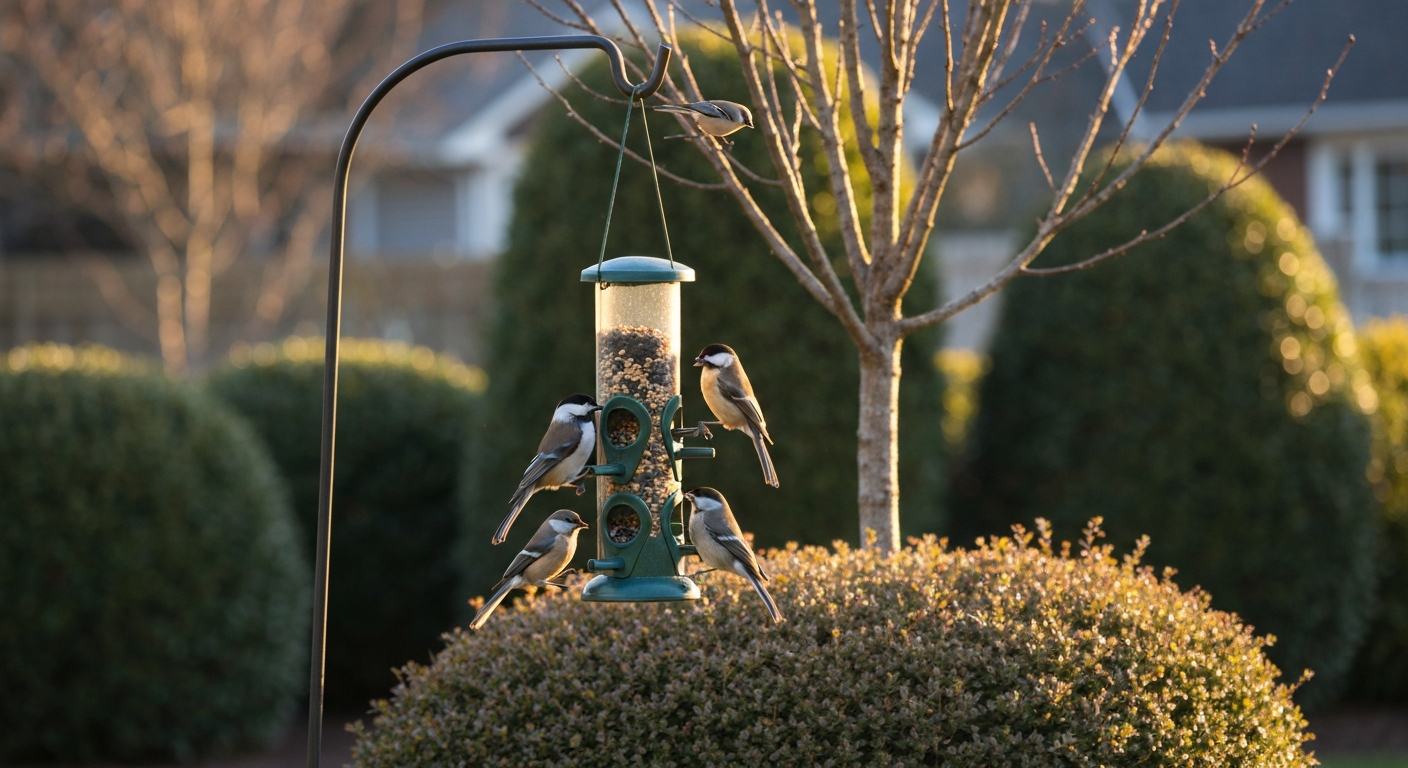
If your bird feeder has been up for a week or two and nothing has visited, the most likely explanation is simple: birds haven't found it yet. Where to Locate Bird Feeders – Cornell Cooperative Extension (Cornell Lab guidance PDF) notes that Feeder placement strongly affects visitation: Cornell Lab recommends placing feeders within 10 ft of protective cover but far enough from launch points for mammal pests; location, visibility and nearness to perches matter for discovery and use. Give it another week, scatter a small handful of seed on the ground directly below the feeder, and make sure you're using black-oil sunflower seed, which is the single broadest-appeal option you can buy. On the other hand, if your feeder is being emptied fast and you're not seeing birds doing it, something else entirely is going on, and the fix is different. This article walks through both situations from diagnosis to solution.
I Have a Bird Feeder But No Birds: Quick Diagnosis & Fixes

Start here: no visitors vs. feeder being emptied
Before you change anything, figure out which problem you actually have. These two situations look similar on the surface but have almost opposite causes. I hear this question constantly, and about half the time the person asking has confused one for the other.
| Symptom | Most likely cause | First thing to check |
|---|---|---|
| Feeder stays full, no activity for 1–7 days | Birds haven't discovered feeder yet | Seed type, feeder visibility, nearby cover |
| Feeder stays full, no activity for 2+ weeks | Habitat issue, predator disturbance, wrong seed or placement | Local habitat changes, recent predator sightings |
| Feeder empties in 1–2 days | High bird activity OR large pest visitors (squirrels, starlings, grackles) | Time of day seed disappears, watch for 10 minutes at peak morning hours |
| Feeder empties overnight | Nocturnal mammal (raccoon, opossum, rat) | Check for paw prints, gnaw marks, or spilled seed at base |
| Seed disappears from ground but feeder stays full | Ground-feeding rodents or birds | Look for droppings, tracks, burrowing near base |
| Seed looks wet or moldy quickly | Feeder leak, rain exposure, or seed left too long | Inspect feeder ports and roof for cracks or poor drainage |
Run through this table before doing anything else. If your feeder is genuinely being ignored, the fixes are about discovery, placement, and seed choice. If it's being emptied, the fixes are about identifying and deterring whoever is doing the emptying. These are different problems.
What the physical signs at your feeder are telling you
Spend five minutes looking closely at the feeder and the ground beneath it before you do anything else. The evidence is usually right there.
Seed and husks
Birds crack seeds open and drop the husks. If you're seeing a growing pile of cracked shells directly below the feeder, birds are visiting, possibly while you're not watching. Uncracked whole seeds scattered on the ground in a wide radius suggest something is physically disturbing the feeder, tipping it, or knocking seed loose rather than eating carefully at the ports. A feeder that's losing whole seed but not showing husks is almost always a mammal problem or a leaky/poorly designed feeder.
Droppings
Small rice-grain-sized dark droppings near the base of the feeder pole or on the ground underneath suggest mice. Larger blunt droppings, roughly raisin-sized, indicate rats. Bird droppings tend to be whitish and liquid and will appear on the feeder itself, on perches, and on surfaces directly below. Raccoon droppings are much larger and often deposited away from the feeder in a latrine area nearby. Don't handle any droppings without gloves.
Tracks, hair, and damage
Check for paw prints in soft soil or mud around the feeder base. Squirrel prints are small with four toes in front and five behind; raccoon prints look like tiny human handprints. Gnaw marks on plastic feeder ports or the pole itself almost always mean squirrels or rats. Hair tufts caught on wire mesh or feeder hardware point to mammals large enough to force their way in. Claw marks on a wooden pole are a raccoon giveaway.
When you can't find any signs
If the seed is disappearing and you can't find any physical evidence at all, the most useful thing you can do is set up a trail camera or even a cheap phone-mount camera pointed at the feeder overnight and for the first two hours after sunrise. A concise tip titled "excuse me your bird feeder is empty" also summarizes quick diagnostic steps and fixes you can use or share with neighbors. This removes all the guesswork.
Who's taking the seed: an identification guide by time of day
Timing is your best first clue. Daytime emptying and nighttime emptying have almost entirely different culprit lists.
Daytime visitors
- Songbirds (chickadees, finches, sparrows, nuthatches): visit in early morning and late afternoon, crack seeds cleanly, leave husks and white droppings, typically light on the feeder
- Squirrels: active morning through afternoon, will sit on or in the feeder for extended periods, knock large amounts of seed to the ground, leave gnaw marks on plastic ports and paw prints on the pole
- House sparrows, European starlings, grackles, and pigeons: arrive in flocks and can empty a feeder within an hour or two, leave large quantities of droppings, tend to displace smaller birds
- House cats: don't take seed but will sit near or under the feeder and cause all bird activity to stop; sudden unexplained quiet at a previously active feeder is a cat (or raptor) sign
Nighttime visitors
- Raccoons: primarily nocturnal, very strong, will knock feeders down or twist them open; leave large handprint tracks and may tip or relocate the feeder entirely
- Opossums: slower than raccoons, usually eat spilled seed from the ground rather than climbing to feeders, leave narrow pointed tracks
- Rats and mice: attracted by spilled seed on the ground; mice leave rice-grain droppings, rats leave larger blunt ones; both are drawn by accumulated seed under the feeder rather than the feeder itself initially
- Deer: in suburban and rural settings, deer will push over pole feeders or eat directly from platform feeders overnight; they leave obvious hoof prints and often damage the feeder hardware
Human visitors
It's uncomfortable to raise this, but feeders in high-traffic areas, near roads, or in shared spaces do occasionally get raided by humans, either taking the seed or the feeder itself. If your feeder is disappearing rather than just being emptied, and there's no physical wildlife evidence, this is worth considering. A trail camera solves this too, and a lockable feeder or one mounted on a high pole that requires a ladder to access is the practical fix. If theft is possible, see who took the money from the bird feeder for concise steps on investigating and preventing human theft from feeders. This is also the situation behind the classic 'excuse me, your bird feeder is empty' social dynamic in shared outdoor spaces, where neighbors or passersby feel entitled to comment on or interfere with your setup.
Zero-day emptying and seed loss from new feeders
A feeder that empties within the first 24 to 48 hours of being put up is not always a pest problem. If you're in an area with established bird activity and you've put up a good feeder with quality seed, it can genuinely get cleaned out fast by excited birds. This is especially common if you've had a feeder in the same spot before, or if neighbors already maintain feeders that have built up a local bird population.
That said, zero-day or single-day emptying on a brand-new feeder in an area with no established feeding history is usually a pest issue or a design/leakage problem. Check the feeder ports and drainage holes: some cheaper feeders allow seed to pour out or get wet and clump, causing apparent disappearance when the seed has actually spoiled and needs to be cleared out. Tip the feeder to one side and see if seed pours freely from any opening it shouldn't. If it does, the feeder design is the problem, not wildlife.
New feeders also sometimes take time to be discovered. Cornell Lab and extension guidance both recommend waiting one to two weeks before concluding that a new feeder isn't working. Scattering a small amount of seed on the ground near the base helps birds locate the new food source. This is especially true in areas where feeders haven't been used before and there's no existing 'feeder culture' among local birds.
Choosing the right feeder and seed for the birds you want
The feeder design and seed you choose have an enormous effect on both who visits and whether you end up with a pest problem. There is no single perfect feeder, but there are clear tradeoffs worth understanding.
Feeder types compared
| Feeder type | Birds attracted | Pest risk | Disease risk | Best for |
|---|---|---|---|---|
| Platform / tray feeder | Widest variety including ground feeders | High (squirrels, raccoons, large birds) | Higher (shared surface, moisture) | Watching many species; bad choice if pests are a problem |
| Hopper / house feeder | Most common backyard species (chickadees, cardinals, finches, sparrows) | Moderate (squirrels will access if not baffled) | Moderate | General use with a baffle system in place |
| Tube feeder (standard ports) | Finches, chickadees, nuthatches, small sparrows | Lower (hard for squirrels to grip) | Lower | Reducing waste and pests while keeping songbird variety |
| Tube feeder with caged surround | Small songbirds only | Very low | Low | Squirrel-heavy yards or areas with starling flocks |
| Nyjer / thistle feeder (tiny ports) | Goldfinches, pine siskins, redpolls | Very low (seed unappealing to most pests) | Low | Attracting finches specifically |
| Suet cage | Woodpeckers, nuthatches, creepers, starlings | Moderate (starlings and raccoons will take suet) | Low | Attracting woodpeckers; use upside-down design to deter starlings |
Seed choices that make a real difference
Black-oil sunflower seed is the default recommendation for good reason: it has thin shells most birds can crack, high fat content, and it appeals to the widest range of species. If I were starting from scratch trying to attract birds to a new feeder, I'd use nothing but black-oil sunflower for the first month.
Nyjer (sometimes sold as thistle) is excellent for finches but requires a specialized feeder with tiny ports. Without those ports, the lightweight seed blows out or falls through and creates a mess without feeding anyone. Safflower is worth trying if you're dealing with aggressive European starlings or certain squirrel species, since many of them avoid its bitter taste, though individual responses vary. Avoid cheap mixed seed bags that contain large amounts of milo, red millet, or wheat: most desirable songbirds won't eat these, they end up on the ground, and they attract the pests you don't want.
Placement, timing, and how you refill the feeder
Where you put the feeder and when you refill it matters more than most people expect. Cornell Lab guidance recommends placing feeders within about 10 feet of protective cover like shrubs or trees, so birds have somewhere to flee if a predator appears. But this same proximity to trees and fences is what gives squirrels their jumping platform. You need to balance both concerns.
Height and distance from structures
For pole-mounted feeders, aim for a height of 5 to 6 feet off the ground. Squirrels can jump roughly 4 feet vertically and 10 feet horizontally from a standing surface, so place your feeder pole at least 10 to 12 feet away from any tree, fence, roof edge, or other structure they can launch from. If that's not possible in your yard, a good baffle system becomes non-negotiable.
Timing your refills
Refill in the morning, not at night. Leaving a freshly filled feeder overnight is an open invitation to nocturnal mammals, particularly if the feeder is accessible at ground level or from a nearby structure. Most small songbirds do the bulk of their foraging in the first two hours after sunrise, so a morning refill catches peak activity and reduces overnight exposure. If you're finding the feeder empty every morning, the issue is likely nocturnal rather than bird activity, and the nighttime section below applies directly. If you're wondering why is my bird feeder empty every morning, see our guide on nocturnal seed loss for diagnosis and fixes.
Helping birds find a new feeder
If you've just installed a new feeder and there's no activity after a week, scatter a small amount of seed on a light-colored surface or the ground directly below. Birds discover food sources partly by watching other birds and partly by visual contrast. A feeder that blends into its background and has no seed scattered visibly nearby can take two to three weeks to be found. Be patient, and check that the feeder is visible from the perches and cover trees birds actually use in your yard.
Seasonal expectations
Bird feeder use genuinely drops when natural food sources are abundant. In late summer and early fall, when berries, seeds, and insects are plentiful, it's completely normal for a previously busy feeder to go quiet for weeks. This isn't a problem with your setup; it's birds making rational foraging choices. Winter is typically peak feeder activity in most of North America, when natural food is scarce and energy demands are high. If your feeder is quiet in July or August, that's expected. If it's quiet in January, something else is going on.
Hardware that actually works: baffles, cages, and squirrel-proofing
The right hardware reduces mammal raids significantly, but installation details matter. A baffle installed incorrectly doesn't work.
Pole baffles
A pole baffle is a cone or cylinder mounted on the pole below the feeder. It works by blocking the squirrel's ability to climb past it. For it to be effective, the baffle needs to be at least 17 inches in diameter (wider is better), mounted no higher than 4.5 feet from the ground (so a squirrel can't jump above it), and the pole needs to be smooth metal that they can't grip. Plastic baffles on wooden poles fail because squirrels just go around or gnaw through them. Weight-sensitive perch systems that close seed ports when anything heavier than a songbird lands on them are a good supplement, but they don't stop squirrels from simply sitting on top of the feeder and digging into the seed reservoir.
Caged feeders
A metal cage surrounding the feeder tube with openings sized to allow small songbirds through but exclude squirrels and large birds is one of the most reliably effective designs available. These work well in squirrel-heavy areas but do restrict species variety since larger birds like cardinals may not fit through the cage openings depending on the model. Check the cage opening diameter: 1.5 inches allows most common songbirds, while 1.25 inches excludes starlings and grackles as well.
Trays and seed catchers
A seed-catching tray mounted below the feeder reduces seed waste and, importantly, keeps spilled seed off the ground where it attracts rodents and ground-feeding pests. Empty and clean the tray regularly; wet accumulated seed in a tray becomes a disease risk for birds and an attractant for rodents.
Rodent barriers
Ground-level rodent problems are almost always caused by spilled seed accumulation rather than the feeder itself. Clean up spilled seed under the feeder every day or every other day. Spilled or accumulated seed beneath feeders attracts rodents (mice, rats) and omnivores (raccoons, opossums); Home & Garden Education Center Articles – University of Connecticut Extension (advice on seed, pests and cleanup) advises regular ground cleanup and sealed seed storage to reduce rodent attraction. Store your seed in a metal container with a tight-fitting lid, not in a plastic bin or bag where rodents can chew through. If you're seeing mouse or rat signs, the seed storage location is as important to address as the feeder placement.
Protecting the feeder at night: raccoons and other nocturnal raiders
Raccoons are strong, dexterous, and persistent. They can open latches, twist feeder lids, and knock down or carry away feeders that aren't properly secured. If you're finding the feeder empty or disturbed every morning and you haven't seen any wildlife during the day, raccoons are the first thing to suspect.
The single most effective thing you can do is bring the feeder in at night or remove all the seed from it. For more on nighttime seed loss, see what is emptying my bird feeder at night. Wildlife extension sources consistently endorse this as the most reliable method. It's slightly inconvenient but it works completely. If you'd rather not bring the feeder in, a large pole baffle (at least 24 inches in diameter for raccoons, which are larger than squirrels), a lockable feeder lid, and ensuring there are no nearby structures raccoons can climb to reach the feeder from above are your main options.
Motion-activated lights or sprinklers can deter raccoons short-term, but raccoons are smart and habituate to them quickly, often within days. They're useful as a supplement but not as a primary control. Removing spilled seed from the ground each evening also helps significantly since it eliminates the secondary reward that keeps raccoons returning to check the area nightly.
If you're seeing nighttime emptying happen very fast on a new feeder, this also connects directly to what's sometimes called zero-day feeder emptying: a problem worth understanding in detail because the fix for raccoon-driven zero-day emptying is completely different from the fix for a feeder that birds have simply discovered enthusiastically.
Cleaning your feeder and keeping it healthy through the seasons
A dirty feeder can spread disease between birds, and it can also drive birds away because they avoid feeders with moldy or rotting seed. This is one of the most commonly overlooked reasons for declining feeder activity.
How often to clean
Clean your feeder every two weeks as a baseline, and more frequently during wet or humid weather when seed spoils faster. Scrub with a 10 percent bleach solution (one part bleach to nine parts water), rinse thoroughly, and let the feeder dry completely before refilling. A wet feeder refilled immediately breeds mold. Platform and tray feeders need more frequent cleaning than tube feeders because multiple birds share the same surface.
Wet weather and winter tips
In rainy seasons, switch to no-mess seed options like hulled sunflower chips or use a feeder with a wide rain guard over the ports. Wet sunflower seed in the shell is very prone to molding inside the feeder reservoir. In winter, check after snowfall: a snow-covered feeder opening is effectively a sealed feeder, and you may have activity drop off simply because birds can't access the ports. Clear the openings after heavy snow.
When to take a break from feeding
There is no harm to birds in stopping feeding temporarily. Project FeederWatch is clear that feeders supplement rather than replace natural food sources, and birds won't starve if you take a feeder down for a week or a season. If you're dealing with a persistent rodent problem, a disease outbreak (you may see visibly sick birds at the feeder), or a significant pest control situation, stopping feeding temporarily while you address the underlying issue is a reasonable, responsible choice.
Your next steps: a quick decision checklist
Use this to decide what to do next based on what you're actually experiencing.
- Feeder is new and has been up less than two weeks with no activity: wait, scatter a small amount of seed on the ground, and confirm you're using black-oil sunflower seed in a visible location near cover
- Feeder has been up for more than two weeks with no activity: reassess placement (too exposed, too close to a disturbance), check for nearby predators, and consider whether a recent habitat change has occurred in your yard or neighborhood
- Feeder empties during the day within a few hours: watch for squirrels or large bird flocks; if present, switch to a caged feeder or add a baffle, and consider seed that deters aggressive species
- Feeder empties overnight: bring it in at night or remove seed each evening; check for raccoon signs; ensure there is no spilled seed accumulating on the ground
- Seeing rodent signs near the feeder: clean up spilled seed daily, switch to a seed catcher tray, and move seed storage to a metal container; consider temporarily stopping feeding if rodent activity is severe
- Birds were visiting regularly and have suddenly stopped: look for a new predator in the area (cat, hawk), check that the feeder is clean and seed is fresh, and confirm it's not simply a seasonal decline in feeder use
- Feeder looks damaged or seed is wet and moldy: clean and dry completely, replace damaged components, and refill with fresh seed only
- You want to confirm what's visiting: set up a trail camera or phone mount pointing at the feeder, run it for two to three nights and mornings, and review the footage before making any hardware changes
Bird feeding is genuinely rewarding, but it works best as an active practice rather than a set-and-forget one. Watch what happens, track what changes, and adjust based on what you observe. The birds in your yard are telling you something every time visitation rises, drops, or stops entirely. The goal is to read those signals accurately rather than assuming the problem is always the same thing.
FAQ
What primary research questions must the article answer to be evidence-based and practical?
1) Is the feeder being discovered but unused, or is feed being removed/emptied? 2) If emptied, who or what is removing seed (birds, squirrels, rodents, raccoons, cats, humans)? 3) When (day vs. night) and how fast does emptying occur (single‑day rush vs. gradual)? 4) Which feeder types, seed types and placements attract or deter target species? 5) What physical signs and forensic clues identify culprits? 6) Which anti‑pest measures (baffles, weight‑activated ports, caging, placement) are effective under real conditions? 7) What cleaning, maintenance, and seasonal practices reduce disease, spillage and pest attraction? 8) How to monitor/verify outcomes (camera, logs, citizen science) and evaluate whether to continue feeding? 9) What social, legal or etiquette issues affect human theft or neighborhood conflicts? 10) What species‑specific guidance (seed/feeder combos) is needed for the local bird community?
Which types of credible sources should the author consult?
Peer‑reviewed ecology and wildlife management studies (e.g., journals indexed in PubMed/PMC), university extension publications (Cornell Cooperative Extension, UF/IFAS, UConn), authoritative conservation NGOs (Cornell Lab of Ornithology 'All About Birds', Audubon), long‑running citizen science programs (Project FeederWatch), public health or wildlife agencies for rodent/raccoon biology (CDC, state wildlife agencies), and practical product/field tests from reputable outlets (extension reviews, consumer science reporting). Use primary sources for behavior/seasonality and extension/practical guides for applied fixes.
Which key empirical findings and facts must be cited or checked?
Seasonal and individual variation in feeder use; time required for birds to find new feeders (days–weeks); species preferences for seed types (black‑oil sunflower, nyjer, safflower); feeder‑type effects on species composition and disease risk; timing and signatures of mammal vs. bird vs. human removal (diurnal vs. nocturnal); effectiveness of baffles, weight‑activated feeders and placement distance; role of spilled seed in attracting rodents; cleaning intervals to reduce disease; and documented forensic signs (droppings, footprints, gnaw marks).
What observational and forensic indicators help identify culprits?
Day vs. night timing: daytime losses implicate birds, squirrels, rodents, or people; nighttime losses implicate raccoons/other nocturnals. Dropping size/shape: tiny rice‑grain droppings suggest mice; larger blunt droppings suggest rats. Physical signs: husked seed and tiny bird footprints indicate bird activity; gnaw marks, plastic damage, hair tufts and paw prints indicate mammals. Spillage patterns: widespread scatter under tray feeders suggests birds or sloppy feeders; concentrated large‑seed stashes in corners suggest squirrels. Camera traps give definitive ID.
What monitoring and proof methods should the article recommend?
Use a motion‑activated trail camera or wildlife camera aimed at the feeder (day/night capable) for definitive ID. Keep a simple feeding log: date, time observed full/empty, approximate amount removed, weather, and any visible signs. Weight sensors or smart scales under the feeder can quantify removal. Short observational watches in morning/evening help. For social/theft issues, keep discrete timestamps/photos and contact neighbors or local authorities if theft is suspected.
What practical fixes and step‑by‑step interventions must be reviewed and referenced?
Feeder type: switch from open platform to tube/port feeder or caged feeder to reduce non‑target access. Seed choice: use black‑oil sunflower as a general attractant; nyjer for finch‑specific feeders; safflower to discourage some species. Placement: position feeders within ~10 ft of protective cover but 10–15 ft from jumpable structures to deter squirrels. Anti‑pest hardware: install pole baffles (cone or cylindrical), use weight‑activated ports, smooth poles, and heavy‑duty cages. Night measures: bring feeders indoors at night or install large baffles to deter raccoons. Cleanup: remove hulls/spilled seed, store seed in sealed containers. Timing: be patient for new feeders (1–2 weeks); scatter small amounts of seed at first to advertise. Each fix should cite extension or lab guidance and product tests.